Beyond the story; beyond characters, graphics, or the feel of cruising through Vice City at sunset, Grand Theft Auto VI promises something more meaningful: a tangible world rife with personality, freedom, and opportunity to distract yourself for hours at a time. For many, the prospect of exploring Leonida itself has been attractive enough to earn your pre-order.
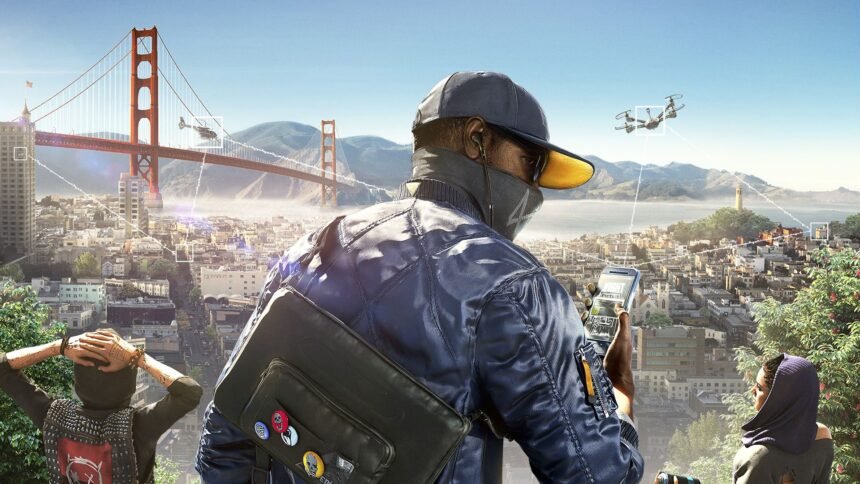
There are, of course, other GTA-adjacent games which scratch a similar itch, with 2016’s Watch Dogs 2 arguably the closest a non-Rockstar open-world game has gotten to feeling similarly alive. The developer go all-in on world-building, with a city, and wider in-universe country, wrapped in hyper-surveillance. Set in San Francisco and the surrounding Bay Area, Watch Dogs 2’s populace has been gaslit into believing the city-wide operating systems on which all their devices hook into benefit their everyday life. Day-to-day convenience aside, the game’s citizens seem ambivalent to the nefarious organisations pillaging user data, boiling society down to numbers that can be sold and re-sold.
They’re surveilled en-mass, categorised, and targeted, yet no-one seems to care. So, while gameplay follows familiar GTA rhythms, the fixation on cyber security risks shared by the DeadSec – the game’s central hacktivist group – translates into a range of techno-hacking mechanics. In other words: the reality the game’s inhabitants face establishes the world, with a suite of tools and systems giving you the means to interact.
The design of the world itself, however, fictionalised versions of San Francisco, Oakland, Silicon Valley, and Marin County is bright, bold, and vibrant, a far cry from the first game’s gritty, greyscale Chicago. And, here’s the other thing: Watch Dogs 2’s world design feels grounded. Perhaps even a little authentic, and this helps the smart city narrative feel more believable. Neighbourhoods are visually distinct, with the calibre of person walking the streets changing depending on where you are.
The NPCs themselves are one of Grand Theft Auto’s defining features, and it’s something Watch Dogs 2 replicates well. Sausalito’s beach community is full of laid back surfers, while professionals in suits occupy San Fran’s finance district. They speak banal chatter, make wry observations, and sometimes show some truly absurd behaviour. Elements like this are something Grand Theft Auto has been doing for decades, with GTA 6’s Vice City and surrounding Leonida state poised to offer something similar.
Watch Dogs 2’s citizens seem to have a degree of independence hardwired into their code. You can be in a store and hear a commotion outside – vehicle crashes, screams, perhaps a gunshot. On exiting the shop you might walk straight into an ongoing standoff between cops and bystanders. On other occasions, a dogwalker gets clipped by a van at an intersection.
A fight ensues as a pedestrian calls the cops. Others, meanwhile, are recording the fisticuffs on their phone while you pet the dog. Now, these kinds of interactions are very GTA-inspired, and while we don’t know the underlying AI systems GTA 6 will inhabit, we can imagine it’ll take what Watch Dogs 2, and its predecessor GTA 5, achieved to maximise its hilarious, emergent potential.
The other great thing about the NPCs, though, is how easy it is to mess with them. Again, it’s too early to say what kind of carnage you can concoct in GTA 6, but Watch Dogs 2, in the meantime, gives you plenty of ways to disrupt an intersection with all manner of chaos-causing hacks. You can access traffic lights to confuse motorists, explode manhole covers to cause unnatural roadblocks, and hack a passer-by’s phone, forcing it to overheat before emitting an electric shock. But, as useful as these default actions are, it’s once you start upgrading protagonist Marcus’ abilities that the fun begins.
Gang hack, for instance, has the potential to chain react one command into street-wide carnage. Order a hit on an unsuspecting security guard, for example, to summon a hoodlum. They might throw a grenade, or a gunfight could ensue. Others will get involved. The police will be called. Bystanders will scream and run. You can watch the whole thing unfold from a security camera while Marcus hides.
Another chaotic tool is vehicle hacking, allowing you to take remote control of a car. You can command a police cruiser to careen straight into the epicenter of a gunfight you caused, for instance, or, more useful, swing any pursuers into the highway barrier during a high-speed getaway.
What we would say is the ensuing chaos isn’t as unhinged as the limits GTA reaches. But, as a convincing recommendation for anyone eagerly anticipating Grand Theft Auto VI, Watch Dogs 2’s ability to produce memorable, world-building subplots away from the main campaign shouldn’t be overlooked.
And, if you were to spend time away from the main campaign, Watch Dogs 2’s Bay Area is a fantastic place simply to cruise. It’s a familiar appeal that it will share with GTA 6, where riding a convertible through Vice Beach, or exploring the Everglades-inspired wetlands in charge of a bayou boat will undoubtedly provide worthy distractions. See, travelling without any particular destination in mind is often where open world games shine the most.
For its part, Watch Dogs 2 provides plenty of distractions, even during those more aimless sessions. You’ll happen upon gang hideouts, satellite dishes to hack, intel missions, and more. Armoured vans tour the city, and more-often-than-not you’ll stumble upon one when your mind is on other things. There’s a huge cash reward inside, but you’ll need to shake a hefty armed response to keep the spoils for yourself. Again, this rhythm is very GTA-alike, but arguably Watch Dogs 2 gives you more options to improvise your escape – raising bollards, disrupting traffic signals, and the aforesaid exploding manholes included.
Another important element shared between both games is their commentary on present culture. Grand Theft Auto has always been sharp, whereas Watch Dogs 2 focuses more earnestly on prescient topics, treating corporations, media, and institute overreach with disdain and humour alike. These themes give the game’s setting a recognisable contemporary identity, and, arguably, the topics Watch Dogs 2 explores have only become more alarming in the years since.
GTA 6 is set to toy with these themes too, especially via social media, livestreaming, and engagement. Now, exactly how this will work in gameplay hasn’t been fully revealed, but it’ll likely be different to Watch Dogs 2’s approach, where DeadSec’s follower-driven campaign forms a core part of progression. The hacktivist group posts corporate espionage, sabotage, and scams to their app – the Martin Shkreli-like pharma bro target whom you dupe into donating millions to cancer research a particular highlight.

The overriding sentiment, though, is anti-corporate. Yet, the game’s coverage of these themes alongside anti-consumerism and the pitfalls of late-stage capitalism never feel more than pastiche. It basically says that doing something contentious online garners the strongest engagement; something that is true of real-life as it is in-game. The real issues – the infringements on civil liberties, the harvesting of user data to influence behaviour – are, as we’ve already said, largely overlooked by the population. Again, kind of like real-life, inaction is easier than joining a physical movement which campaigns for real change to the socio-economic landscape.
We can only speculate on how GTA 6 portrays these themes. Both games could draw similar conclusions: that controversial content is king. However, in the lead-up to release, it feels as though GTA 6’s satire will be wittier and more absurd than what Watch Dogs 2 manages.
Look – even if you’d rather not engage with the socio-economic themes, there’s a more glaring issue with Watch Dogs 2 that Grand Theft Auto has managed to side-step for decades. This is the unignorable ludonarrative dissonance between Marcus’ stature as a young, exuberant freedom fighter who also 3D prints deadly firearms and blasts any opponent who gets in his way. Now, you might be thinking that a pacifist run is possible.
Indeed, his default weapon is a stun gun, but those early missions are extremely difficult to complete through stealth and non-lethal violence. This gulf between what the game tells you and what the gameplay imposes on you is minimised in Grand Theft Auto where the protagonists are seasoned criminals. Yes, you are endeared to the characters – and we’re sure GTA 6’s Jason and Lucia will be the same kind of multi-layered protagonists – but all-in-all crime and killing are something you expect them to do.
These critiques and differences aside, there’s no escaping that Watch Dogs 2 feels very much like GTA in atmosphere, NPC interactions, freedom, and potent spontaneous chaos. The sandbox may be distinct, but the loop is familiar. Much like we expect of GTA 6, you can enter Watch Dogs 2 with a simple plan and spend the next hour following distractions and dodging the consequences. If you’re looking for something to play before Grand Theft Auto VI, Watch Dogs 2’s experience is our non-Rockstar recommendation.