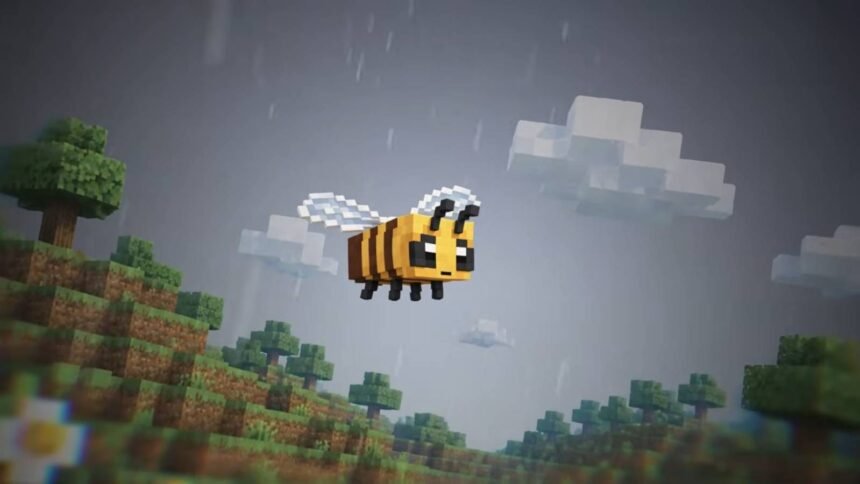
Maybe you’ve already heard the news that, after a decade of research, scientists were able to map the entire brain of a fruit fly. Perhaps you’ve also seen the headlines that this fruit fly brain has since been “forced” to play video games like Doom. You may have even come across the claim that a fruit fly killed itself not long after its consciousness was uploaded to the popular block-building game, Minecraft. There’s some truth to these incredible claims, but many of them carry asterisks. Much of that murkiness is rooted in a fundamental misunderstanding of what scientists achieved with the fruit fly brain map.
Ro0oney is a Minecraft YouTuber who has recently come into the public eye after his YouTube short titled “I uploaded a consciousness into Minecraft” went viral. In it, he says that he digitally birthed an arachnid with free will — and the first thing it did was suffocate itself. A follow-up video uploaded in early September dove into more detail about what Ro0oney actually did and how he achieved it.
Ro0oney’s primary aim here is entertainment, but there’s some rigor to the experiment. He begins the video by consulting Dr. Arie Matslian, a research scientist at Princeton who built the public tool people are using to mess around with the digital fruit fly brain. The researcher plainly says that the tool “oversimplifies a lot of biophysics.” Even so, it’s still a high-fidelity representation of how the brain works.
Since the YouTuber has to manually program the fruit fly to react to Minecraft‘s stimuli, that leaves a lot of room for user error. Early versions of the Minecraft brain didn’t have active steering neurons — or in the case of the spider, couldn’t even fly. The fruit fly can decide how to react to its environment, but the possibilities are, to some degree, constrained by Ro0oney. A digital spider with the brain of a fly isn’t exactly set up for success, nor does it reflect some grand philosophical idea about the nature of consciousness.
The very first thing Ro0oney adds to the fruit fly is a sense of fear, which he claims is the “main thing that keeps consciousness alive.”
We could probably spend hours debating that point, and how the function of fear differs among evolutionary biology, psychology, and neuroscience. It’s also a great illumination of how the finer points of this spectacle get lost in translation. It’s easy to mistake his statement for the idea that fear creates consciousness.
Another example: the fruit fly can get hungry, but is it truly “feeling” what a living, breathing creature would? The answer is no, but functionally, the Minecraft fruit fly is more or less doing what our bodies do when we feel hunger. The digital fly tracks its energy level, and if it gets low enough, its hunger neurons activate and tell it to replenish its stores. Our neurons are constantly sending signals to our bodies as well, and vice versa. At the same time, the fruit fly can’t truly remember anything. It has the same structural pathways, generally speaking, as a real fruit fly — but unlike an actual specimen, that structure can’t be rewired on its own. It’s a snapshot of one brain — a dead brain at that–not a living, breathing creature that truly perceives what is going on.
Even with all those caveats in mind, Ro0oney’s trial-and-error exploration of consciousness is a fun watch.