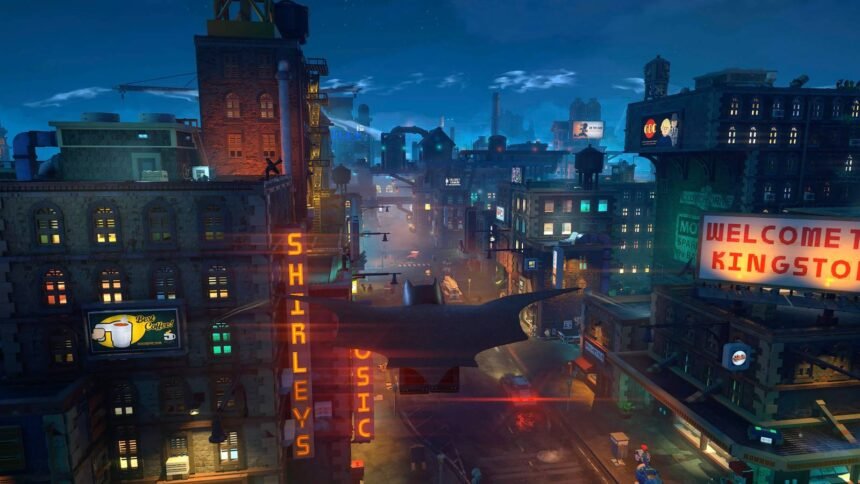
Even before it came out, Lego Batman: Legacy of the Dark Knight sparked a lot of chatter about how it emulates the feel of Rocksteady’s Batman: Arkham games. The trilogy (and its black sheep prequel, Batman: Arkham Origins) originated a new type of freeflowing melee combat, and melded that combat with slick stealth gameplay.
Lego Batman does a good job of bringing that melee combat to its Lego world, earning those comparisons to the Batman: Arkham titles. And that shouldn’t be too surprising; a small contingent of Rocksteady developers lended their Bat-expertise to Legacy of the Dark Knight. But for as much as it is an Arkham facsimile built out of Legos, Lego Batman actually tops the Arkham games in one specific way.
Arkham City, Origins, and Knight all feature open-world exploration as a major pillar of the experience. Their Gotham Cities are vast and filled to the brim with activities to do, like collecting never-ending Riddler trophies. Perhaps the best thing about their open worlds is just how much space they give Batman to glide around. Using the grappling gun to launch Batman into the air, and later diving down to pick up speed and momentum, never gets boring.
Though Arkham’s open worlds are expansive and fun to glide around in, they feel weirdly empty. Sure, there are criminals with guns and stun batons patrolling their streets, but the maps are oddly devoid of any regular citizens, whether it’s because the setting is a city for criminals (Arkham City), citizens are sheltering in place because of a blizzard (Arkham Origins), or Gotham has been issued a city-wide evacuation order (Arkham Knight). Because of this, Gotham feels less like a lived-in world.

That’s not the case in Lego Batman: Legacy of the Dark Knight. People are everywhere, even though Gotham is dark, rainy, and dangerous. They wander the sidewalks, drive around town (and get in my way), and relax in a diner. Just by having other Lego people present and going about their lives, Lego Batman feels very lived-in and real. Despite everything being, ya know, Legos.
I get a chuckle out of overhearing people complain about not grabbing an umbrella (Your fault — it’s always raining!) or saying, “Nothing bad can happen if I keep wandering around aimlessly, right?” Wrong! It’s Gotham City, dude. Something bad is always about to happen.
Because citizens are everywhere, that means there’s crime everywhere. Muggings, purse-snatchings, break-ins — you name it. All the random crime gives you a chance to feel like a real do-gooder, a hero who can pause his Joker investigation for a moment to stop a street-level crime.

It makes Lego Batman feel a bit like Insomniac’s Spider-Man games. In all three, Spider-Man gleefully swings about New York, swooping down to stop crimes in progress. Though, like the Spider-Man series, sometimes there’s a bit too much crime taking place in Lego Batman. Sometimes I’d just like to glide for a few moments in peace, without a police officer yapping about a kerfuffle between criminal groups taking place.
Aside from all the crime to stop, there are plenty of activities in Lego Batman‘s open world, just like in the Arkham and Spider-Man games… and every other open-world game this side of Assassin’s Creed. Riddler trophies are scattered about, traversal challenges test your mastery of the game’s mechanics, and escaped zoo animals need wrangling. Each unlocked character brings their own set of side activities, like how Catwoman can break into safes around the city.
You’re never wanting for something to do in Lego Batman: Legacy of the Dark Knight. The open worlds of the Batman: Arkham games were great too, but Lego Batman benefits from the citizens walking its streets, giving it life. Even if my terrible Batmobile driving represents an imminent threat to those Lego lives.