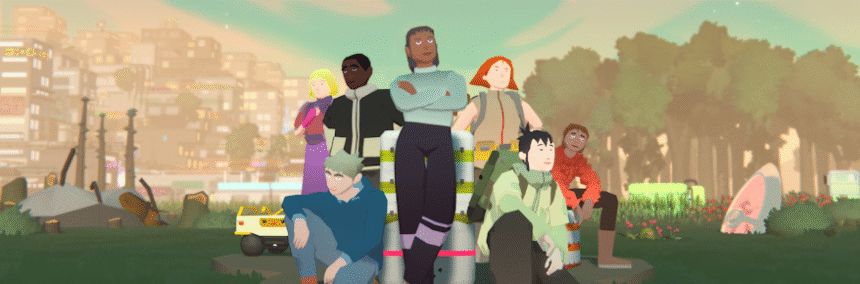
SEED is a game that wasn’t on my radar until right before it came to early access, which may seem strange since it’s been in development for years. My only explanation is that my radar must have limited range. At any rate, when news started to trickle in about a life simulator with an always-on persistent world where your character continues to live life even when you’re not tending to them, my interest was piqued. How would this even work? How well would it work? I guess the only way to find out is to dive straight in!
Upon launching the game for the first time, you (the cultivator) create the character (seedling) who will be your primary eyes into the world of SEED. You will be with this character until it dies, so choose carefully. Being the thoughtful, provocative journalist that I am, I chose to randomize everything. Then, you are prompted to either join an existing society or to create your own. Being part of a society is vital in SEED, as this is not a game of self-sufficiency. Seedlings perform different jobs (farming, wood processing, tailoring) that all contribute to their society. If seedlings don’t perform their jobs, over time the society can collapse, and the seedlings will die.

I decided to join an existing society, which turned out to be a good choice for a first run. Society leaders certainly have a lot on their plates from the standpoint of managing the community: setting up jobs, coordinating the building and placement of buildings and workbenches, and I assume local elections and whatnot, although I haven’t experienced that last one yet. Seedlings are then delivered into the chosen society and encounter a tutorial that walks you through the basics.
The UI will look incredibly familiar to anybody who’s ever played a Sims game. That’s a good thing because there is a lot to learn and a familiar UI helps the player feel a little less overwhelmed. All the expected elements are present: basic needs (food, water, rest, hygiene, etc.), mood, current action, moodlets, and portrait. The game experience also feels quite a bit like The Sims. The seedlings will do what you tell them to do, and you can queue and cancel actions. One difference that is immediately noticeable is the inability to speed up time, because, of course, that would be impossible in a world where others are playing. It’s also one of the features that makes SEED feel a little slow but very intentional. Meaning, while the seedling is asleep, cultivators can focus on things like planning out their seedling’s schedule.

Schedules are a mechanic that may seem tedious at first glance but quickly become a vital tool for guiding your seedling through life, especially when the cultivator goes offline. You can set up a daily routine for the seedling to make sure they carve out time to gather, farm, go to work, and even socialize and develop relationships with other seedlings. Without a schedule, seedlings tend to wander around, meditate, do yoga, or simply stare at the clouds. Those things might seem like the makings of a fun life, but they don’t do much for leveling up vital skills. As is the case with real humans, having a daily routine is needed to keep seedlings focused and continually improving!
One feature that Klang games has touted heavily is the ability for the cultivator (you) to communicate directly with the seedling (character on the screen). This is accomplished through a special chat channel. Honestly, it feels more like talking to an early chatbot on a website that is trying to sell you something. It feels less like a personal connection with the seedling and more like an automated response.
Also, maybe it’s just my seedling, but the sarcastic-sounding responses coated with a thick Gen Z irony are starting to make me dislike my seedling a bit. Case in point, after complaining about being hungry, I offered up the very simple piece of advice: You should eat when you’re hungry. Her response – “A profound truth. Truly, a masterpiece of advice.” Sheesh, if I wanted that kind of sass, I’d talk to my real kids.

I may incur some wrath here, considering the current strong opinions surrounding everything AI, but there is one bit that has been implemented very well in SEED. Part of the in-game UI is an AI helper called PAM. When you click on PAM, you can ask any question in plain English, and it will source an appropriate response from the SEED wiki. No more tabbing out of the game to get answers to your more simple questions. No more dual-screen external sites. It does provide something of value to the player in a way that makes sense, and at least it isn’t taking away anybody’s job, though you can decide whether it’s worth all the other costs when the alternative was a simple wiki database built into the game.
Something that I’ve always thought more MMOs should invest time in is the creation of mobile companion apps. RIFT had a nice one back in the day, and it always made sense to me that if a game was vying for your stickiness and attention, what better way than to give you a way to interact with the game while away from the PC? SEED, being a persistent, always-on world of activity, saw the potential in resurrecting the old mobile companion app idea. Klang’s execution of it is quite good. It not only gives you access to world chat, society chat, and current needs but shows the action your seedling is currently executing and gives you the ability to adjust their daily schedule. I’m kind of amazed at how much real-time information it has. This could be a very dangerous distraction during the workday!

In all, my first three days in SEED have been enjoyable. The game can be as casual or in-depth as you want it to be, depending on how far you want to get into society and business building. Conversely, you can set a schedule and let your seedling go. It’s an interesting experiment on the interaction of AI entities converging with human societal direction. I’m excited to see how people respond to it, and how big the simulation will get!