
I completed Roman Sands RE:Build late last night, and haven’t had nearly enough time to digest it, but I’m keen to help get the word out and energise whatever algorithmic chicanery might contribute to this gorgeous, ugly thing making money. So! Roman Sands RE:Build is two exquisitely grim games locked in a collapsing binary orbit. You should play it, preferably before reading the rest of this review, which is only going to spoil and dilute its squalid magic.
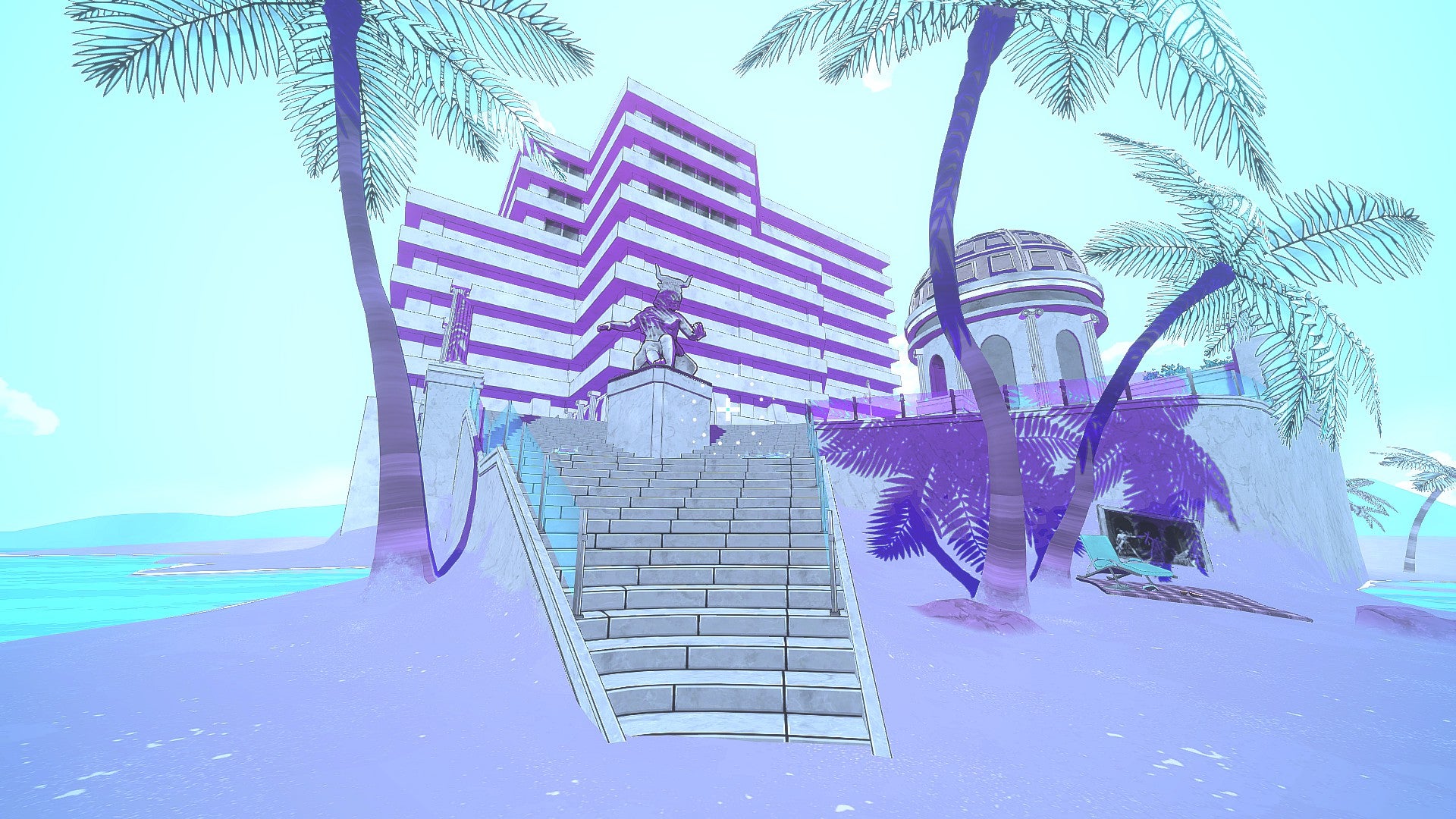
Each of those component games is a short masterpiece, executed with huge prowess at every level of the art, sound, design and writing. They might seem totally dissimilar, at first. One game is a hyperactive, time-looping hotel job simulator in which you tend to some cartoonishly awful older guests, shifting incrementally between times of day as you hurry between parts of a garish and phantasmagorical resort that is being menaced by an approaching sun. It’s a place without memory, in which activities reset when you stroll back into the sea at moonrise – a lovely spectacle of swirling stars and blissfully solid darkness.
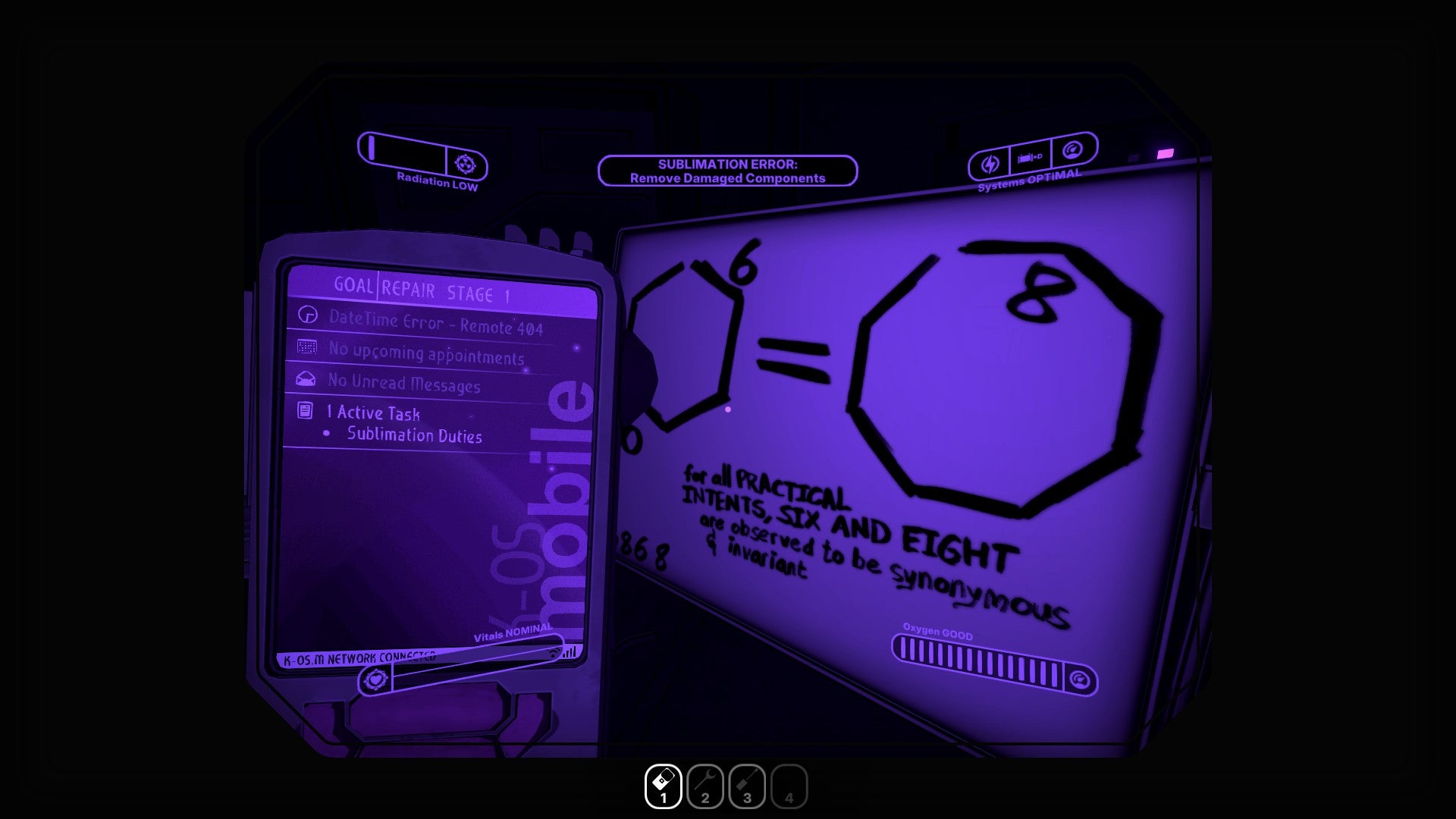
The other component game is a meticulous, but rapidly deteriorating ocean base exploration sim, stewed in sexy cybernetic horror and good old-fashioned thanatophobia. It might remind you of Frictional’s Soma, if Frictional’s Soma had more toxic yuri. Here, you’ll lumber about in a helmet with PDA and spanner, attempting to purge a radioactive, honeycomb-like infestation by repurposing chunks of machinery. Between descents, you’ll listen to the denizen of another base enthuse over the radio about the sensuality of decay.
In practice, many things connect these diverging experiences. Aesthetics, for starters: Game 1 is luxuriant, spacious and frenzied, while Game 2 is dense, mulish and murky, but they are both broadly an exercise in getting relentlessly brainjacked by the colours pink through purple. I’ve heard the art and musical direction described as “breakcore meets vaporwave”. Even if, like me, you’re not very expert in these precedents, I’m sure you’ll notice how careful Roman Sands is as a work of partial pastiche, how specific in its borrowings and allusions.
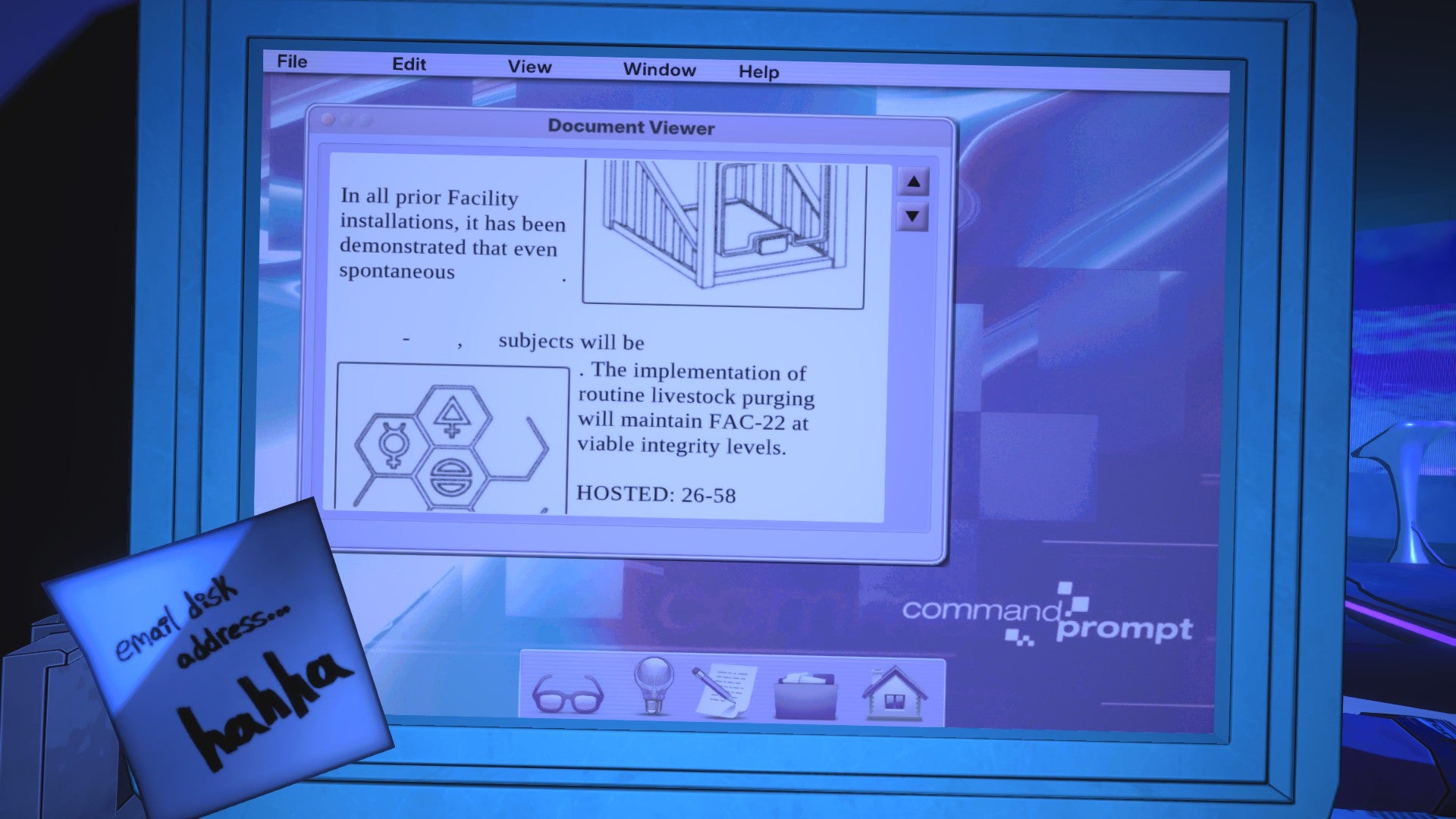
The games further share a love of baroque and strange interface design, spanning two HUD setups and a number of in-world devices. There’s a more ominous, connecting thread of alchemy and arithmancy: each environment is rife with planetary symbols, magic circles, and a fascination with the number three. There are places where the worlds echo each other almost directly: for example, a growing heap of discarded, meat-clogged pipes that recalls a mounting pile of luggage in the hotel lobby. As each setting fragments beneath your curiosity, it becomes easier to peer across the divide. Sometimes, you can even stick a hand through and fondle the other game’s bowels.
While there’s a connecting plot, of sorts, each half of the game is sort of a retelling or refiguring of the other. The shared conceptual binary is maintenance, in the janitorial sense, versus transcendence. In each game you are a ground-down worker, subjected to a rigid and imbalanced, palpably doomed structure that is contemptuous or careless of you, but which depends absolutely on you to exist. You shore each realm up through your labour, while searching for your Exit.
The resort absorbs the bulk of the 10-hour playtime (it did in my first runthrough, anyway), and is the most openly hateful of the two environments. The guests – represented by spaghetti noodle caricatures and anime dialogue portraits – are immediately atrocious. There’s Betty and Harold, a hectoring hag paired with a suffocatingly pleasant old gimmer. There’s Bunk, a lecherous middle-aged drunk who is constantly throwing up on himself, and Sylvia, a more sophisticated predator, who receives your efforts at Good Service with seductive scorn.
Watch on YouTube
Each guest has demands that vary depending on the time of day and location: fetch my hair curlers! Mix me a drink! Get me a book! Get me a better book! DO IT DO IT DO IT. Why are you still here? “All I want is for things to get done,” Sylvia says at one point. The implied overall objective is to meet all these requests within a single loop, which is impossible at first. Completing tasks earns you XP that unlocks more options and features from run to run. Sounds like an entertaining puzzlebox, maybe, but if you embrace the progression rush you are giving into the game’s undisguised efforts to characterise you as a spineless toady.
The hotel portion of Roman Sands is an entertaining, knowing test of how ruined you are by videogames, how ravaged you are by gacha jingle and level-up chime, how willing you are to debase yourself for an incremental unlock. Each day begins with the text “Work harder!” and the garbled afterthought “…motherfucker”. The HUD is a softly clawed mask of quest tabs, interaction counters and scrolling objective reminders, nibbling away at your efforts to actually look at things and consider their purpose. Every action, every transition is stretched out into a crude bombardment of SFX, tuned to be as obnoxious as possible… without being entirely resistible. Are you collecting six garbage bags? Get ready for six hyperkinetic “YOU COLLECTED THE GARBAGE BAG” screens, one after the other.
Save for when you haven’t unlocked an item you need, the requests are insultingly easy to fulfil. The game generally lays down a path of fizzy quicksilver triangles to the item in question. As you repeat the days, you unlock a melodic speed-boost when following the triangle trail – an aleatoric caffeine jolt I often succumbed to despite my better judgement, glomming onto the trail while trying to do things the simulation didn’t ‘want’ me to do.
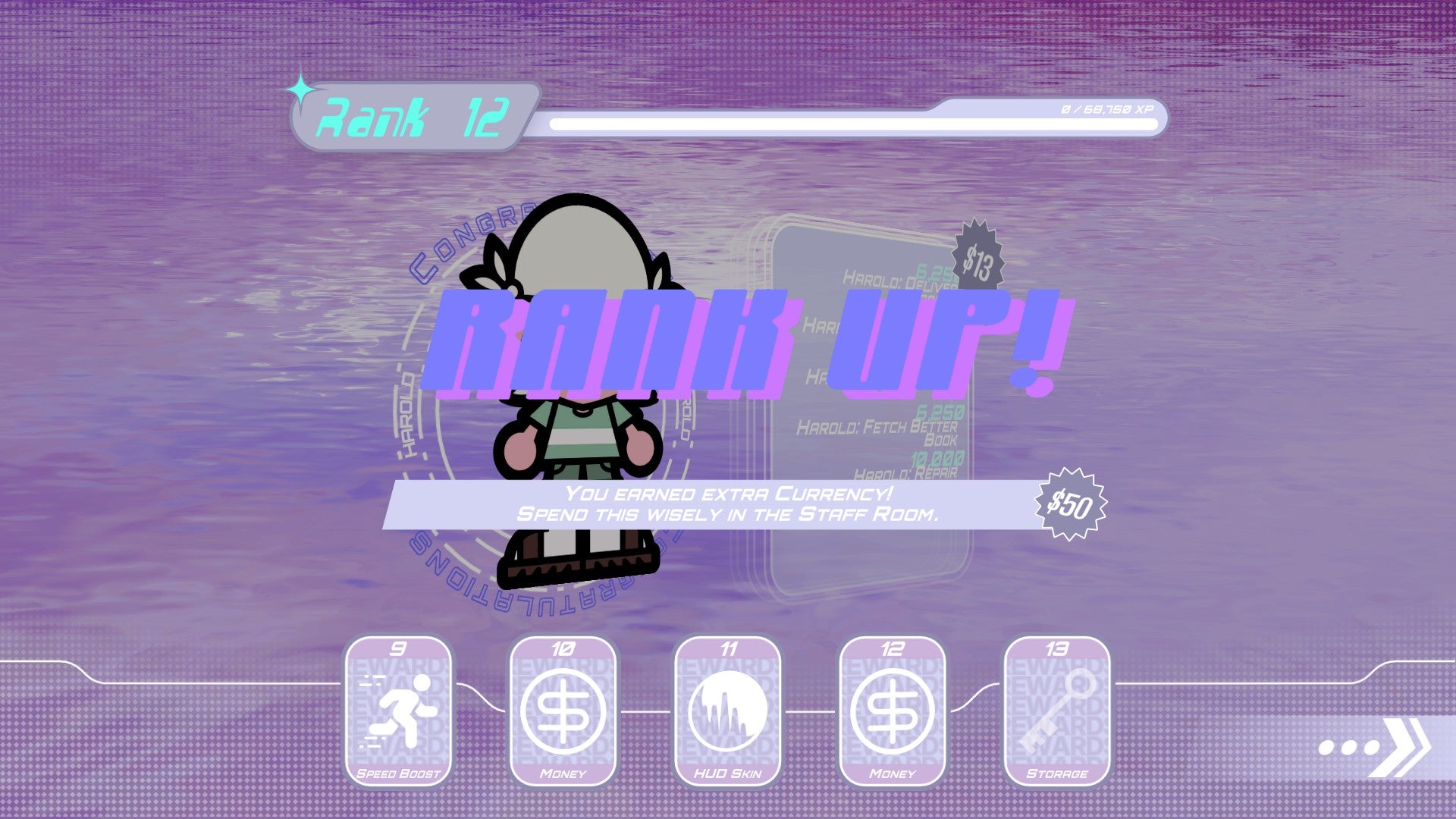
I think it’s possible to spend the entirety of a Roman Sands playthrough just living the dream of being a hypnotised thrall. There’s a catalogue of cocktail recipes to master, randomised plushies of different rarities to entice from the casino machine in the basement, timer-based XP bonuses and other mood-juicers to keep you engaged and pliant. One of the higher-level unlocks is simply the status of “NPC”. Another is acquiring the means to finally check the guests into the hotel, which feels like the basis for an alternative endgame I don’t really want to experience.
In practice, you’ll probably want to split from the program, as soon as possible – identifying ways to ‘hack’ the scenery, exploiting its symbology to bypass the time mechanics, and getting to grips with an underlying, occult mystery that involves some enjoyably esoteric room puzzles. This journey will eventually lead you into the other half of Roman Sands, which applies the theme of exploited and patronised labour very differently.
In Act 2, your bosses are become chunky handheld terminals and sweeping control room displays that flash technojargon and talk of “sublimation”. You have to stop whatever it is that’s devouring your base reactor. There’s still the suggestion of a timeloop, here. You’ll restart again and again from your dorm, slipping into your void suit by means of an “elevator” that looks worryingly like a hollowed-out Vitruvian Man – an airlock that imposes a form. But the splenetic and jabbing design of the hotel simulation has disappeared. In its place, you get a more elegant, diegetic range of prompts and interactions, firmly rooted in the technology of this realm.
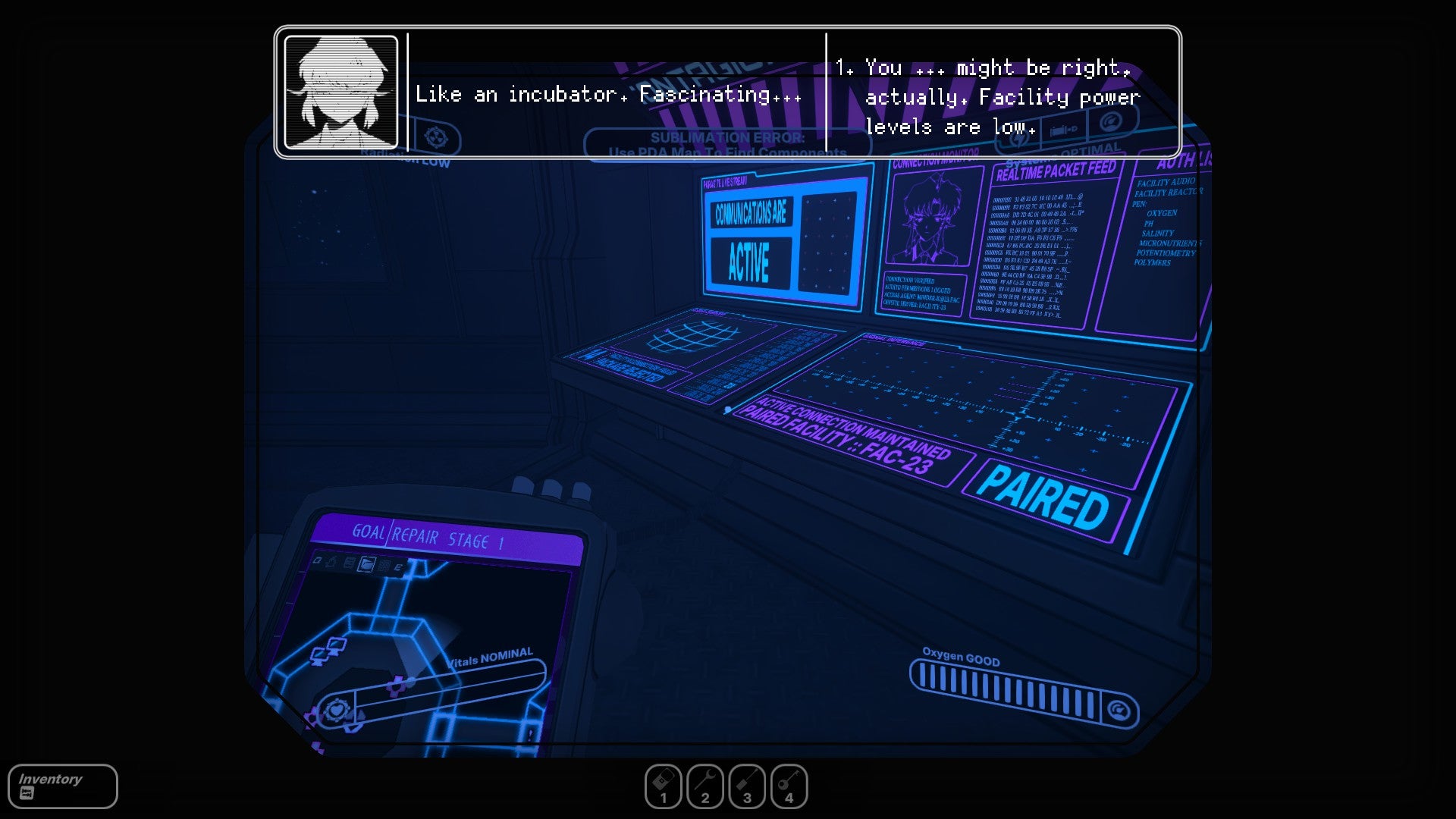
The base’s areas are separated by pneumatic doors: to open them, you might need to redirect oxygen by twisting a valve, or pump a handle to pressurise the mechanism. There are screws to unscrew, blueprints to download, spent fuses to yank free and source replacements for. As dangerous and decrepit as the base can be, the tactile manual implements give you a feeling of mastery, where the hectic F2P reward systems of the hotel served to infantilise you. This space is the work of your own two hands.
Still, you remain a worker and the unseen, possibly automated managers who issue your instructions clearly don’t care much for your survival. You could argue that the base chapter is more predatory than the hotel layer, for being couched in the unpretentious vernacular of an engineering sim. In each half of the game, videogamey devices contrive to make you preserve something that should have turned long ago to sludge and dust. The base just puts the hook in more subtly. Meanwhile, redacted terminal docs paint a picture of some larger, apocalyptic landscape of biological experiments. The girl cooing about rigor mortis over the commslink doesn’t do much to fill in the history; the “world building” here is half-fleshed, soon rotting down into symbols as you repeatedly strive to rid your habitat of infection.
Having read through that last paragraph again, I don’t think the base is just a repetition of the hotel’s febrile exploitation themes by way of another genre. If Act 1 is about shattering a pocket universe of delusion and privilege, Act 2 is about reckoning with the fact that your own life is at stake in this simulation. Making your exit involves raw terror and a leap of faith, discussed perhaps a little too straightforwardly in a closing monologue. At one point, you are told not to trust the complaining of the facility’s life support systems, and it’s hard to know in the moment whether this is the system fighting your efforts at self-preservation, or a healthy encouragement to let go.
I find it hard to let go of Roman Sands. There is so much else to notice and discuss. I’ve skipped over the quality of the writing, for instance – one thing I really liked was that the hotel guests slowly become more sympathetic as you satisfy their demands, and force them to realise that all they have are demands. They gradually lapse into confusion and forgetfulness in a way that makes me want to go back and save them. Maybe except Sylvia, she’s terrible.
If I had the proper terminology for it, I’d also talk about how the audio component develops over the course of the game, from the woozy spinning-up of the percussion when you approach the gacha machine, to how the soundscape dulls as you slowly deplete the ocean base of oxygen. I haven’t even touched on the climate crisis parallels, which are hopefully unambiguous enough, or mentioned all the references to cows both in alchemy and in laboratory experimentation.
For the moment, though, I just want to stress that there’s nothing out there like Roman Sands. Certainly, I’ve yet to play a two-parter that is quite so compelling and devious in its asymmetry. It’s more ritual than game, at times, a sacrificial dagger wielded against both itself and against other videogames that are more at ease with their age. It is witty and expressive, doom-ridden and cathartic. It’s a hideous thing, a total nightmare, absolutely no fun whatsoever. You must play it at once and tell me what you think.