Becoming a boost junkie in arcade racers that offer such potent bursts of extra oomph is usually only a matter of time. Star Wars: Galactic Racer is no different. The hooks have been in deep.
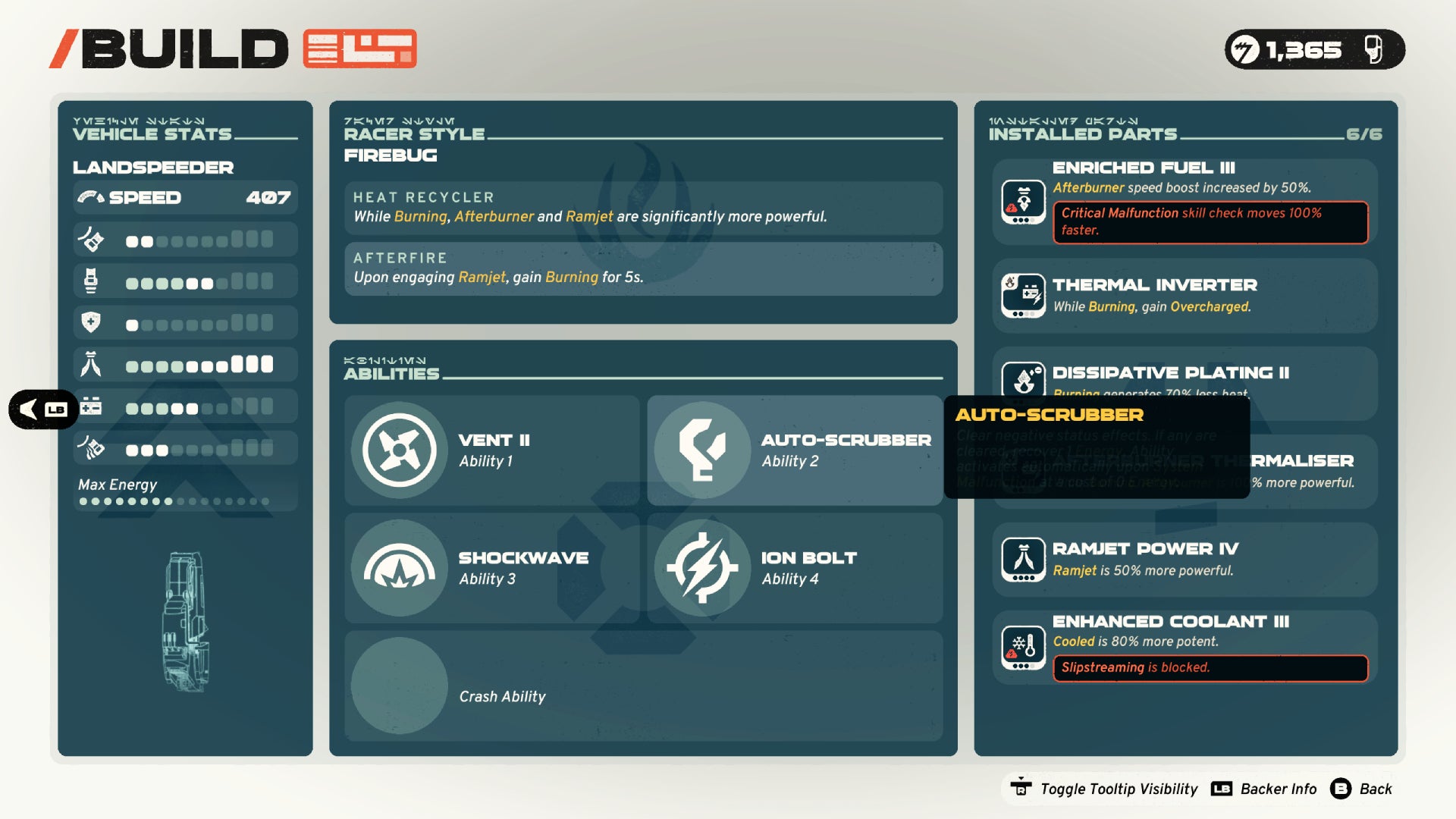
The vast majority of the builds I’ve pulled together in runs through its singleplayer campaign have lived and died in their effectiveness by the two types of boost you can cram into your landspeeder, speeder bike, or skim speeder. The first, afterburner, is less potent, but can be deployed at any time once it’s built up. The other, ramjet, is more powerful, but must be squirted out in whatever length of continuous chain you can muster without either taking your finger off the deploy button, overheating to the point your ride explodes, or running into some other obstacle which forces you back to regular speed. Both are separately upgradeable as you progress through one of the game’s rogue-lite style runs through a tourney of various Galactic League events staged across a decent variety of planetary biomes.
Some planets are tougher on the would-be ramjet rider than others. Crossing the dust trail of a competitor on Crait will stop your boost chain in its tracks, so will touching any of Sentinel 1’s acid rivers. Jakku and Lantana both have heat to contend with in staying explosion-free. However, generally speaking, I’ve found being boost-focused is a good way to go regardless of track or vehicle type. The three principal variants of Galactic Racer ride are largely blank slates onto which you can impose any build you might like and have it be effective. There are some basic traits specific to each type – landspeeders can be thrown around more easily, bikes can burst out of corners with a jolt of extra speed, and skim speeders are fastest if you can master pulling off wide, sweeping turns on uniform lines.
Outside of that, however, there are no boundaries beyond your own driving preferences in terms of which vehicle traits are most effective for your ride to specialise in or any specific routes through the courses geared towards it. That allows for plenty of player control and creativity compared to the more rigid arcade racers of yesteryear. You don’t need to go for the bulkiest vehicle if you want your playstyle to revolve around smashing foes into walls. You don’t need a set body shape to evolve into being dead fast in the corners. You don’t need to pick the most nimble ride to be an agile speed demon. Thus, in my case, all three have usually been transformed into ramjet and afterburner-filled racers whose road to success lies in maximising the length and potency of boost bursts.
On one hand, the freedom to shape your own path to success is what leaves me feeling as though I’ve barely scratched the surface of the litany of possible builds Galactic Racer has to offer as I’ve scythed through its campaign. On the other, the game has struggled to convince me to head in non-boost-heavy directions for any runs in which I’m keen to maximise my chances of victory. Annoyingly given I write for a PC site, my initial pre-release impression of Galactic Racer was that its action most closely resembled that of the defunct PlayStation exclusive off-road racing series Motorstorm. That too had a variety of types of vehicle bumping and boosting to beat each other on courses shaped by the elements. However, the strengths and weaknesses of each vehicle were set in stone. If you picked a dirt bike, you were best served seeking out jump-laden high ground and avoiding bashing into bigger foes. If you picked a big rig, your best bet was to cut through the mud of lower routes and try to bully opponents off the road. If you went for a rally car, the challenge was in finding the best combination of the two. Events throughout the campaign forced you to use certain vehicles on certain tracks, ensuring that you had to master every ride, course, and driving approach to be the best.
In Galactic Racer, while new parts and abilities that offer fresh perks to spice up your build pop up after every successful race and during regular mid-run shopping trips, the onus is generally on the player to want to stray beyond whichever skills they’ve specialised in up to that point. In my case, as I imagine will be the case with most once they realise how key maintaining speed is to success, that’s been three racing styles – ramjet rider, redliner, and firebug. Your goal in the races, eliminators, and face-offs your ride faces is always to finish as high as possible. Gaining places early is always key, especially in eliminator races where the competitor running last is rapidly at risk of being struck from the finishing list.
Fields tend to quickly string out, so while some contact and Burnout-style takedowns happen in most events, relying first and foremost on taking out the competition rather than outpacing them feels more risky than just investing in more pace that’s useful whether they’re running alongside you or ten seconds up the road. The same applies to tying your success too heavily to weapon-based abilities like landmines or the ion bolt you can use to plink a foe running a short distance in front with a disruptive blast of energy. Go all-in on improving how your vehicle handles corners and you’ll likely haemorrhage any gains on the long straights most tracks have. Ditto trying to embrace hazardous environmental effects like heat and freezing, making the effort to turn them into benefits, when it’s easier just to try and avoid them. All of these areas and skills can be worth investing in to different degrees if you get the chance during a run, but only once a strong foundation of maximised power from one or both of the boost types and the means to maintain it are built to ensure you’ve got a chance of keeping up at all once the going gets serious.
Something similar applies to Galactic Racer’s online chases, which are either standalone races or condensed versions of the campaign’s multi-planet tours. Admittedly I’ve only had the chance to jump into a few pre-release multiplayer sessions against other journos and YouTubers, but speed and boost-heavy styles have seemed pretty dominant.
Things would be different if any of the events you use your main speeder for challenged you to hit a specific number of opponent takedowns, negotiate shorter tracks stacked with impossibly tight turn after tight turn, or to race through environments so overwhelmed with a particular hazard that anyone who’s not dialled into actively mitigating its threat will struggle mightily. Some of the test flight events you can opt for as you chart your path from planet to planet do make you take down a set number of bot racers, but such test flights are always done in a one-off borrowed vehicle, so any upgrades you’ve done to make your primary one into the galactic equivalent of a Carson Inferno Van don’t matter in them.
None of this is to say Galactic Racer doesn’t offer twists or sometimes decide to forcibly throw a wrench in the works of your perfectly planned tuning. Your build can be compromised big time if you damage one of the parts you’ve installed by crashing to the point your ride malfunctions. After the race, said part will develop a debuffing defect to go alongside the boon it offers.
The most devastating instance of this I’ve encountered came when I was using the firebug racer style, which afflicts your vehicle with the burning effect whenever you ramjet boost, but trades that off by increasing the base power of each ramjet burst. I damaged a part, and the debuff it developed meant that whenever my vehicle was burning, it’d now also be afflicted by the choked effect, which immediately stops the ramjet from working the moment the effect applies. There is another part which stops choked from cancelling ramjets, but I hadn’t encountered it during that particular run. So, suddenly my very ramjet-centric build couldn’t ramjet at all. I bowed out very quickly.
At one point in a landspeeder run, I bought a number of powerful, but already faulty, parts at a discount from a scrap dealer. My hope was to survive without getting knocked out of the tour until my next visit to the dealer, when I’ve the credits to have defects fixed and be left with perfectly working powerful parts I’d paid next to nothing far. The faults were so debilitating I never made it that far.
At the start of each run, you’ve got to choose between one of three financial backers. In storyline, they’re the ones supporting your entry into the tour by providing the token you need. In practice, they serve to give you a choice of extra goals for each planet while rewarding you based on your overall performance. While each backer has a unique favour – another type of perk the game boasts – to dish out when you’ve gotten to know them well enough, the goals they dish out are randomised, but otherwise boringly boilerplate. Use your ramjet for a set number of seconds across events on this world. Activate a set number of abilities. Spend a set amount of time in last place. You pick the one of the three that best suits your playstyle and try to beat it, something that can be rendered near impossible if one or two of the events you run through don’t involve taking to the track. Whenever you jump to a new planet, your backer rates how you did on the last one. Unless you both beat your goal and finished in the top three every race, get ready to be told you’re only doing satisfactorily or poorly.
So, Galactic Racer will judge you and punish mistakes, in addition to forcing you to maintain a fairly high level of competitiveness so as not to lose the precious league tokens you get to act as lives during a run. You can choose a path to the final races for each narrative chapter that puts these lives at risk less often, with test flights not depriving you of a token if you fail them, and races only snatching one if you crash so many times you don’t even cross the finish line last. Eliminators, meanwhile, demand you finish in the top three to avoid forfeiting a token, while offering more powerful points than the aforementioned events to those who can battle through.
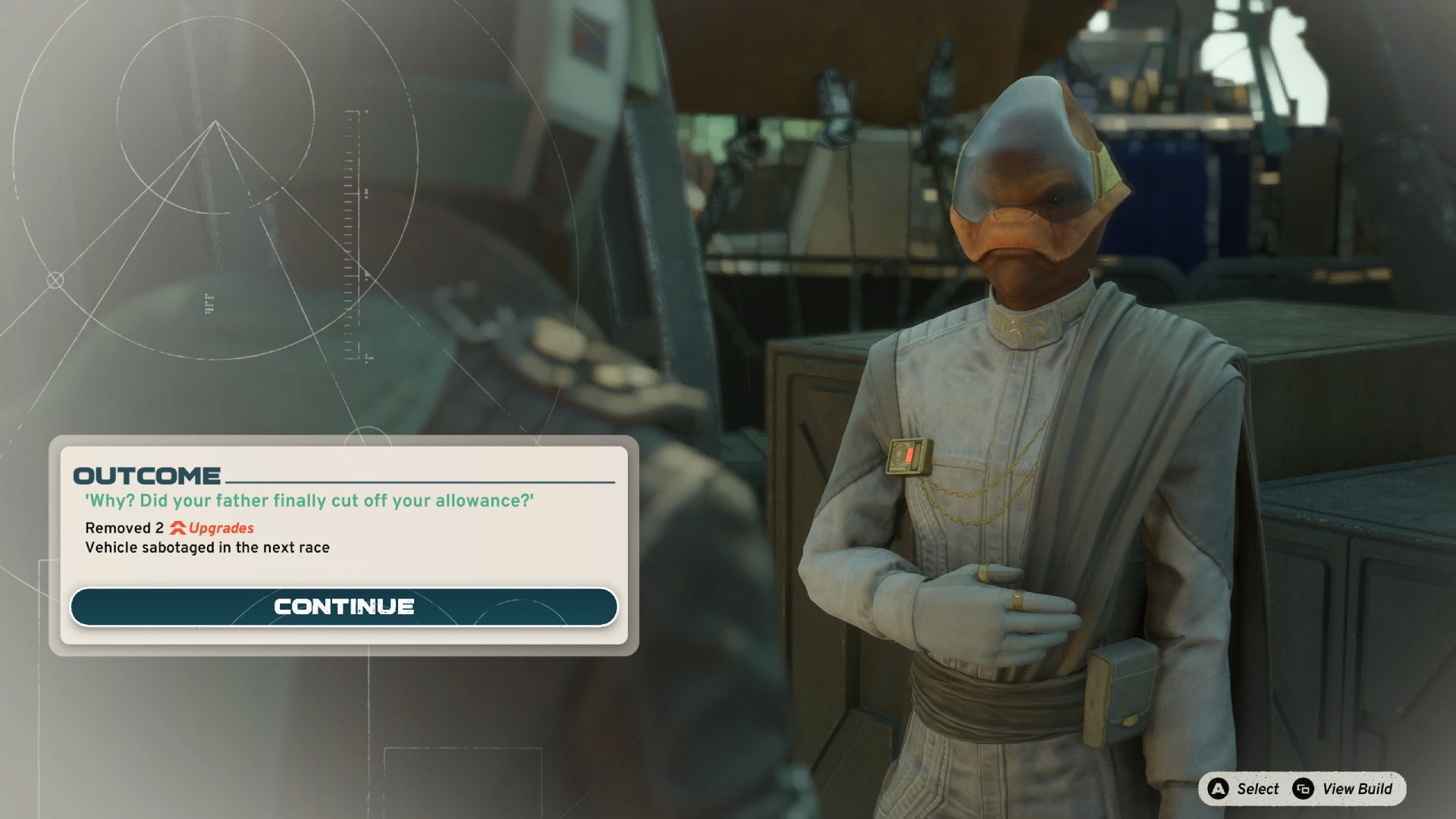
Then, there are mystery encounters. These see you confronted with a narrative choice by one of your fellow racers. Sometimes, it’s the offer of a high-stakes bet they can beat you in races. Sometimes, it’s a deal that’ll make certain upgrades or rewards more common at the cost of others. Sometimes, it’s baddie Kestar Bool demanding you pay for damage to his speeder or face having your ride sabotaged for the next race. Each of the planets in a run typically has you run through four events, so there’s plenty of scope to run into everything at least once on your way if you wish to.
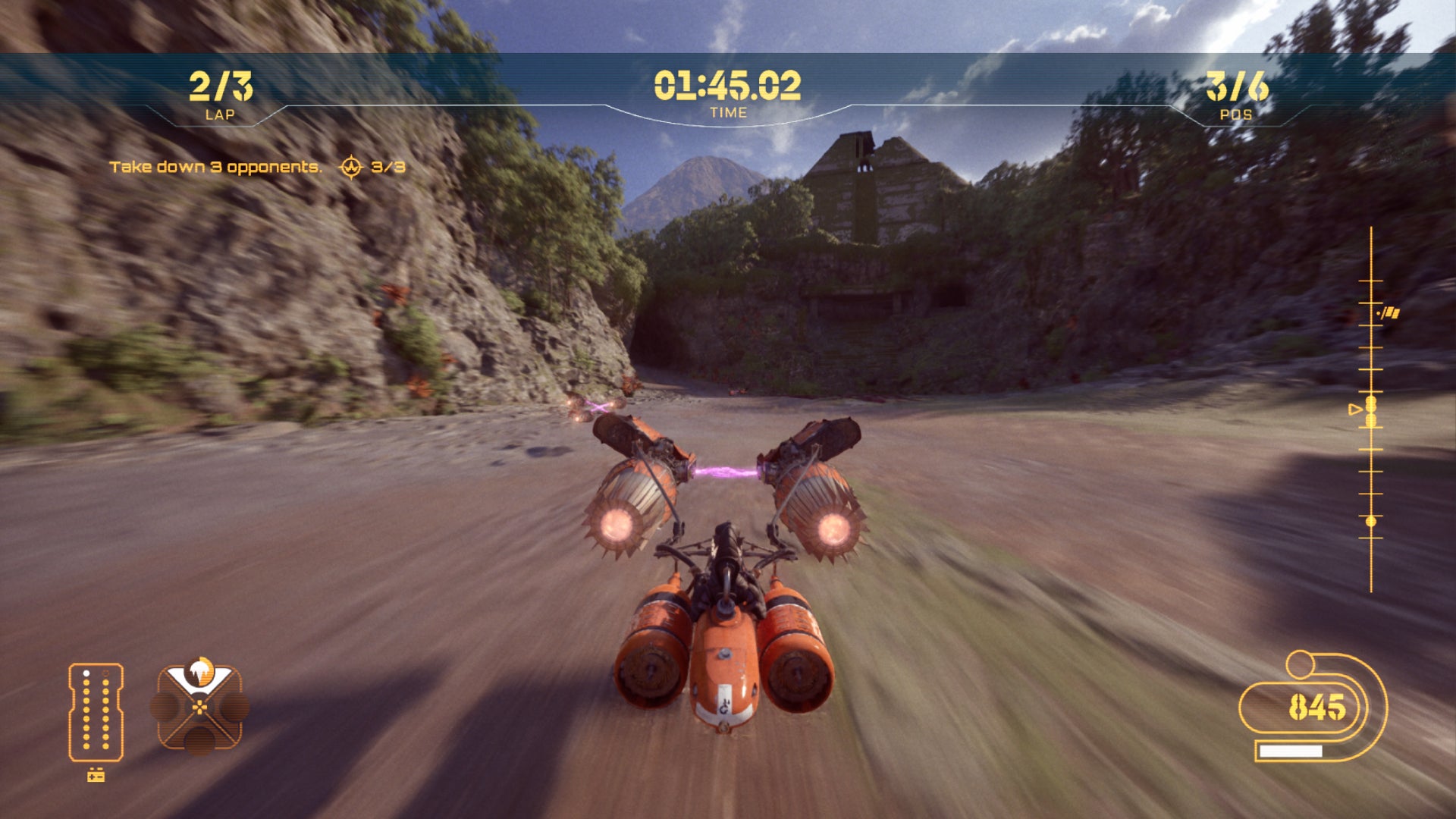
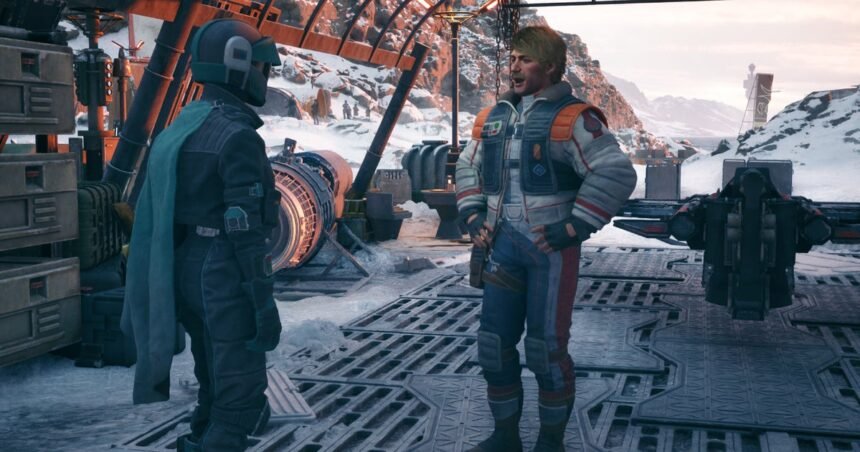
One thing you can’t avoid is having to learn to fly Galactic Racer’s fourth vehicle – the infamous podracer. These do a great job of offering a sizeable difficulty jump beyond the speeders, with much higher speeds and floaty, gangly forms that zip and carve around specially-assigned courses like pure-bred racers. If your concentration lapses for a millisecond, odds are you’ll immediately see protagonist Shade being thrown across the landscape in a shower of scrap metal. Unlike the speeders, however, you don’t seem to be able to customise your podracer’s appearance, so some cool points are being forfeited there.
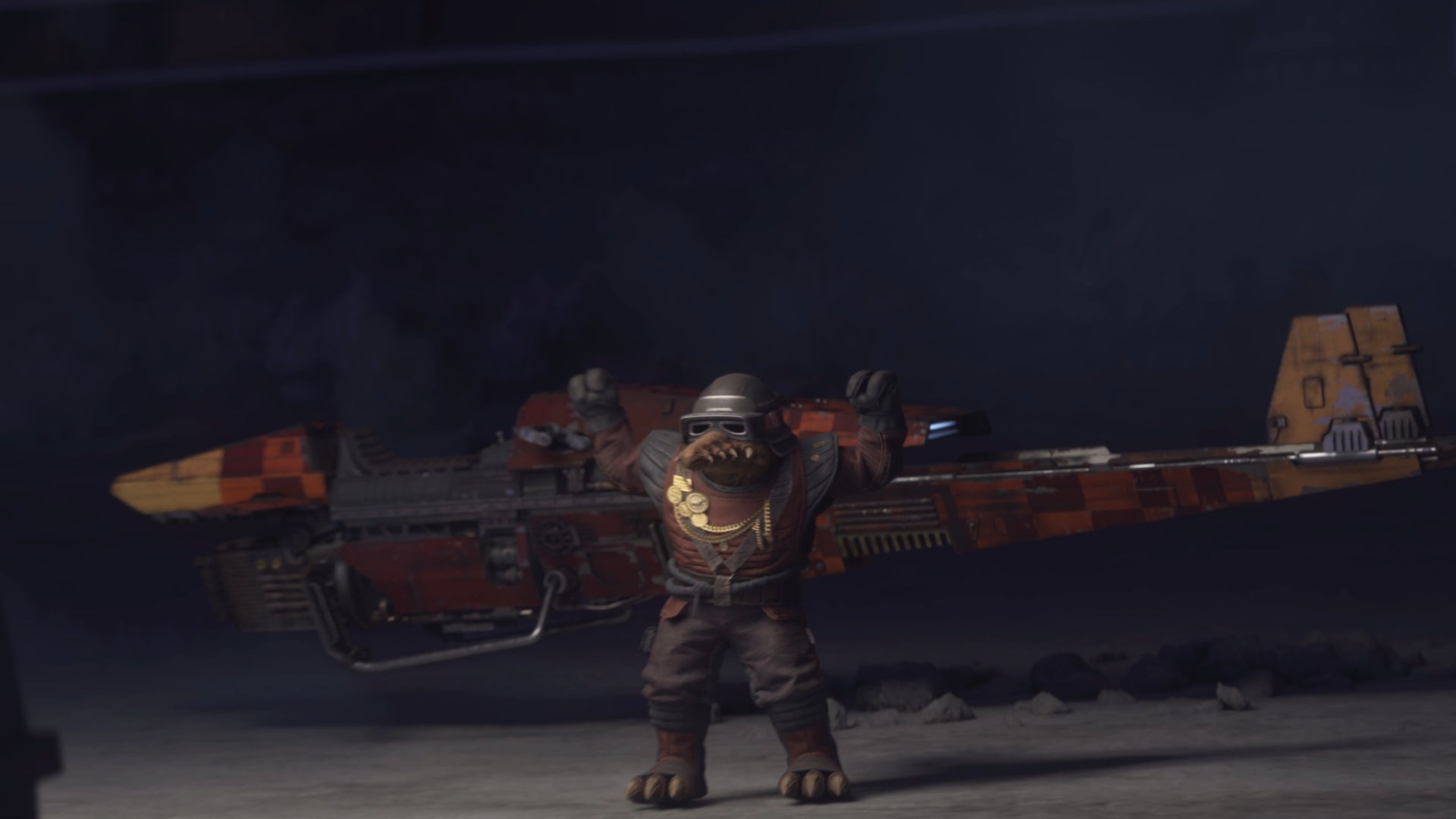
As with another of this year’s new arcade racers, Screamer, I’ve found Galactic Racer’s league of speed junkies to be a more endearingly engrossing cast of characters than I initially thought they might be. Built as a Mos Eisley Cantina worth of speed-obsessed Glup Shittos and gruff interstellar rogues, their constant screaming and taunting during races can verge on annoying at times, but generally speaking they add much needed colour to the fight for first place and the process of wandering around the paddock preparing for each planet’s gauntlet of races. Big up to Biddy Blas, a miniature crocodile-looking alien who angrily accuses you of cheating whenever you beat him, and Lyren Shok, a vain himbo Nautolan who’s convinced everyone wants to take a selfie with him. I also reckon Star Wars fans with nostalgia for podracing’s Phantom Menace roots will be pleased with the chunky role Anakin’s old nemesis Sebulba plays in the game’s story of nepo baby villain Bool fighting for control of the Galactic League with benevolent commissioner-type Darius Pax.
Overall, I applaud Fuse Games for opting to do something a little different by injecting some rogue-lite structure into their debut game. Rogue-adjacent games may have become a dime a dozen in the boom of the last half decade, but it’d have been very easy just to imitate the established formula of past arcade racers and call it a day. The result, given how strong Galactic Racer’s on-track mechanical foundations are, would probably still have been a very good racing game. However, regardless of whether it is a bit too skewed towards boost-heavy builds at present, the form they’ve gone for gives Galactic Racer a bit more of a unique edge within the racing genre, and is ripe for the sort of regular post-launch tinkering that typical roguelikes receive as their makers get a better grasp of how the land lies.
It’s made a good start, and has plenty left in its speeder’s ever-growing box of tricks to boost it onto the wishlists of folks who might not be immediately drawn in for a speedy taste of the galaxy far, far away.