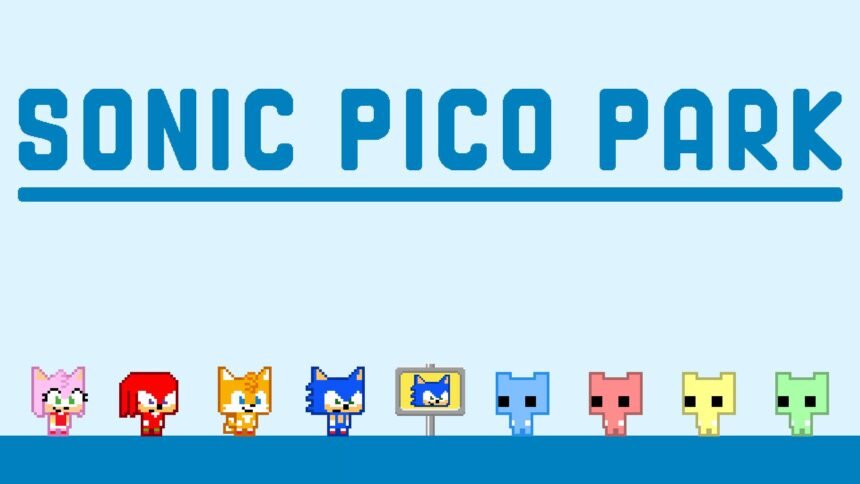
On first glance, you’d be forgiven for thinking Sonic Pico Park is just another entry in TECOPARK’s co-operative platform-puzzler series, simply re-skinned with characters from the popular mascot’s lineage. You might have even thought Sonic the Hedgehog and Pico Park are too unlikely a collaboration to work. And, look – their combination risked feeling performative rather than meaningful, but TECOPARK has side-stepped any potential pitfalls by imbuing Sonic’s platforming DNA thoughtfully into Pico Park’s party-game rhythm.
“Levels are dotted with spring launchers and loops, and they end with spinning signposts.”
For anyone who’s played classic 2D-era Sonic, Sonic Pico Park’s familiarity is immediate. Levels are dotted with spring launchers and loops, and they end with spinning signposts. Sound effects are on point too – spin dash’s woosh, rings clink, and the spring launcher’s “boing” is unmistakable. Each character has their own idle animation, showcasing their individual personalities. TECOPARK has clearly made earnest efforts to celebrate Sonic’s heritage in what is the Blue Blur’s 35th anniversary, and it isn’t long before the Sonic–Pico collaboration feels natural.
And, actually, how the game feels is also quite remarkable. See, classic Sonic platforming has always felt slightly loose. Older Sonic games, through Sonic Mania to Sonic Superstars, are not pixel-perfect platformers. Their slack responsiveness sits in deliberate contrast with something like Celeste, where precision is fundamental to the experience. Sonic’s handling, then, is distinctive, and, to me, Sonic Pico Park feels just the same as Sky Sanctuary Zone’s trickier sections that I remember as a kid.
“Sonic Pico Park feels just the same as Sky Sanctuary Zone’s trickier sections that I remember as a kid.”
To underpin further how much Sonic Pico Park feels like a Sonic game rather than simply a Pico Park game with Sonic characters, we can look toward character-specific abilities. Tails and Cream can fly, Knuckle and Rouge can glide. Now, if we’re talking about authentically celebrating Sonic’s legacy, then incorporating these moves seems like a no-brainer. But, the key thing here is they’re not used as decoration. Certain puzzles require these specific skillsets.
Elsewhere, rings retain their traditional defensive function, with some puzzles demanding at least one of your party carries a ring to absorb the damage of whatever trap lies ahead. And, where there are multiple rings, it makes no sense for someone to horde them all. You’ll need to share and work as a team, even though the puzzles remain generally straightforward.
Each short world introduces a central gimmick, too. Bungee cords might tie you all together through certain levels, while handlebars and disappearing platforms occupy your attention in others. Some mechanics incorporate Sonic-specific elements, such as carrying Chaos, while iconic Pico Park moves like standing on each other’s heads can often be the simplest solution.
And, simplicity here shouldn’t be confused with underwhelming or unrewarding. Unlike more cerebrally-minded puzzlers, you won’t feel like a genius for getting past trickier sections. But, that’s not the point. In Sonic Pico Park, there is no room for mercenaries. The experience, instead, is shared through communication, and it’s all-the-more fun for it.
That said, scenarios do get slightly more demanding, but only in terms of timing or experimentation. The game continues introducing ideas all the way through to the end without necessarily combining lots of previously established mechanics, and this, for me and my family, made the overall experience accessible.

“Simplicity here shouldn’t be confused with underwhelming or unrewarding.”
My son, for instance, joined me for large parts of this review. He understood the controls and puzzles without much difficulty, and he could contribute to solutions – and the chaos, which I’ll get to in a minute – without following my lead. Playing with my partner, meanwhile, revealed the sillier side of the experience. Riding on each other’s heads or deliberately dashing into one another brought a welcome degree of slapdash. See, without intellectual challenge, we were free to treat Sonic Pico Park’s short-lived levels as miniature playgrounds to lark around in.
When the three of us played together, the chaos revealed itself. My son thought it funny to endlessly bounce between spring launchers or insist on flying everywhere as Tails. Rolling with his impulses made the required coordination around the aforesaid disappearing platforms or environmental obstacles – things that weren’t especially challenging as a twosome – feel like a recipe for pandemonium. It was here I realised that eight-player sessions – the maximum for Sonic Pico Park – is potentially where the game will really shine.
Unfortunately, during my review period, I was unable to join a public lobby to test this out for myself. Despite searching through multiple regions and hosting my own session, I couldn’t find anybody. Now, to be clear, this is my experience during the review period. It is not a suggestion than online matchmaking needs fixing. I would just really love to tell you how bonkers eight-player multiplayer is, but alas, I haven’t experienced it. However, even in a three-player round with my family, the potential is clear.
And while my lack of online experience isn’t a criticism, there are a couple of drawbacks which I want to mention, although I should point out these were my personal experiences that weren’t always shared by my partner. For one, some puzzles rely on you failing in order to find the solution. I’m not a fan of this particular type of game design, but my partner told me she enjoys discovering the solution as if by accident. Occasionally, too, the game left us scratching our heads when it didn’t need to. Case in point is when a puzzle requires a character’s flying ability. See, if you didn’t have Tails or Cream in your party already, the game will make one of you swap your character. If, however, one of you is already playing as Tails then you wouldn’t necessarily know that flying is the solution.

“It’s a fun, charming little ditty that I’m sure will entertain me and my family for a while”
It’s a minor bugbear, all told. If you fail, well, retries are quick. There’s no substantial punishment for dying, so even if I’m not particularly fond of trial-and-error puzzle design, Sonic Pico Park makes the process relatively painless anyway. And, actually, the laughter I shared with my family when something did go wrong overshadowed anything negative in my mind.
So, genuinely, I don’t have anything significantly bad to say about Sonic Pico Park. TECOPARK has successfully incorporated Sonic’s mechanics, presentation, and distinctive gamefeel into an entirely different kind of experience. It’s all well-and-good, giving every character the ability to spin dash, but the Japanese studio has built-in these mechanics meaningfully, with Sonic and co’s suite of abilities often needed to overcome specific obstacles. The game is simple, yes, but its appeal comes fundamentally from co-operation and shared problem-solving. If I was to assess this game solely on what I believe the devs are aiming for – that is, to evoke the feel of vintage Sonic in their strangely unique Pico platformer – I’d say they’ve succeeded.
Of course, TECOPARK might have other goals which lie beyond my interpretation. Is Sonic Pico Park a solid platformer, for instance? Would it benefit from some slightly competitive elements akin to the accompanying battle modes? There are a few Sonic-related surprises which appear as you progress through the worlds. I won’t spoil them, but would the game be better if there were more?
While I recognise here that the devs might have achieved almost everything they set out to do, I’m not sure the game gives me everything I personally want. It’s a fun, charming little ditty that I’m sure will entertain me and my family for a while, but I can’t see it having the staying power in our household like Sonic’s mainline titles or the other chaotic party games that we like to play. Still, the joy of deliberately bouncing off a teammate’s head can’t be beat, even if that joy might be short-lived.
This game was reviewed on PlayStation 5.