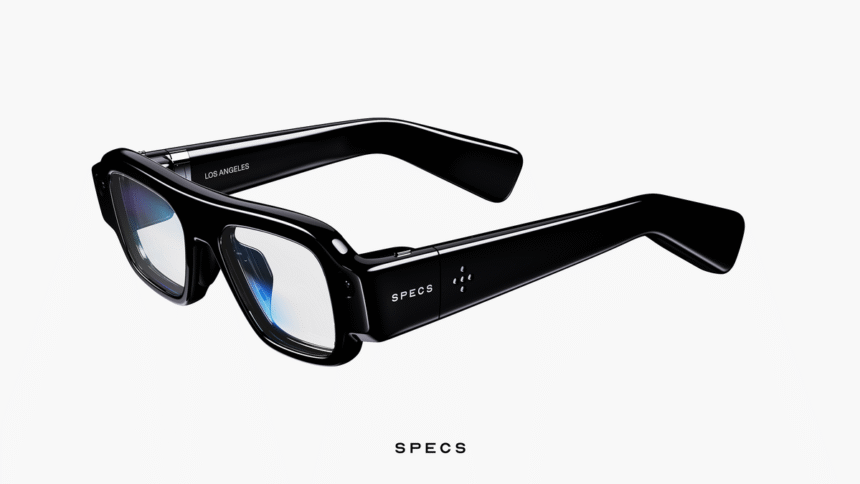
Snap just officially revealed and opened preorders for Specs, fully standalone true AR glasses shipping this fall in the US, UK, and France for $2195.
At last year’s AWE expo, the company behind Snapchat declared that it would ship fully standalone true augmented reality glasses in 2026, and at this year’s AWE, as announced by Snap CEO Evan Spiegel, the company is opening preorders to make good on its promise, beating giants like Meta, Apple, and Google to the punch.
It’s the result of around a decade of work on smart glasses at Snap and its over $3 billion of investment into augmented reality research.
Developers react to seeing Specs for the first time.
By “true AR glasses”, for those not familiar with this space, we mean glasses you could (at least theoretically) wear in daily life that can place virtual objects and interfaces into the real world. This is a major capability jump compared to HUD glasses like Meta Ray-Ban Display, which just add a small fixed display to your view, and a vastly different proposition to displayless smart glasses that focus on cameras and audio. True AR glasses are also different from display glasses like Xreal and Viture, which heavily darken your view and sit out from your face too much to be used as everyday glasses.
Snap has released two true AR development kits in its long buildup to Specs, called Spectacles, giving developers the hardware, all equipped with hand tracking, to build experiences and get ready for the arrival of consumer AR. The first Spectacles, in 2021, was given to a select few developers and had a field of view of just 26 degrees diagonal and active battery life of just 30 minutes. The second, in 2024, was rented to interested developers for $99/month and while it massively expanded the field of view to 46 degrees, and battery life to 45 minutes, it was also much bulkier and weighed 226 grams.
| Form Factor | Field Of View | Availability | |
| HoloLens 1 (2016) | Headset (579g) | 35° | Discontinued ($3000) |
| Magic Leap (2018) | Bulky Goggles (316g) | 50° | Discontinued ($2300) |
| HoloLens 2 (2019) | Headset (566g) | 52° | Discontinued ($3500) |
| Magic Leap 2 (2022) | Bulky Goggles (260g) | 70° | Product ($3300) |
| Snap Spectacles (2024) | Bulky Glasses (226g) | 46° | Dev Kit ($99/month) |
| Meta Orion | Thick Glasses (98g) | 70° | Internal Prototype |
| Meta Ray-Ban Display (2025) | Thick Glasses (69g) | 20° (Monocular) | Product ($800) |
| Snap Specs (2026) | Thick Glasses (132g) | 51° | Product ($2195) |
The consumer Specs have a slightly larger field of view of 51 degrees diagonal, similar to Microsoft’s HoloLens 2 and Magic Leap 1, yet bring the weight down to 132 grams for the 47mm frame size and 136 grams for the 51mm.
It’s definitely describable as a true glasses form factor, and much lighter than the Spectacles developer kit and the AR headsets of the 2010s. However, Specs are still significantly heavier than regular glasses and the less capable smart glasses on the market today. For comparison, Ray-Ban Meta glasses weigh around 50 grams, while Meta Ray-Ban Display, with its 20 degree monocular display, weighs 69 grams, and Orion, Meta’s unshippable prototype AR glasses with 70 degree binocular displays, weighs 98 grams.
Specs
Beyond the weight and field of view, Snap isn’t yet revealing many detailed specifications for Specs, an unusual move for a product available to preorder, and somewhat ironic given its name.
What the company will say, so far, is:
Displays
Specs use proprietary LCoS displays developed in-house (likely a result of its 2022 acquisition of Compound Photonics) that are capable of displaying 16 million colors per pixel, the same as a typical flatscreen. Snap is not yet revealing the resolution.
Exploded view of the waveguides in Specs.
The company directly confirmed to UploadVR that the 51 degree field of view figure is diagonal, and refused to give the horizontal and vertical values or aspect ratio.
Chips
There are two unspecified Qualcomm Snapdragon chips onboard, a main chipset for the OS and applications, and a secondary chipset for computer vision tasks, which includes head position tracking, hand tracking, environment meshing, and spatial anchoring.
Snap refused to provide the name of the chipsets.
Latency
Specs achieve a motion-to-photon latency of just 7 milliseconds.
That’s the lowest publicly stated latency claim for a 6DoF XR product we’ve ever heard, and a significant upgrade from the 13 milliseconds of the Spectacles developer kit.
Auto Tint & Opacity
Specs feature electrochromic lenses to rapidly automatically adjust to your environment, becoming clear glasses indoors and sunglasses outdoors in the sun.
Snap says the electrochromic tech can adjust to fully opaque in just 10 seconds, significantly faster than photochromic lenses like the Transitions in Meta Ray-Ban Display, which can take around a minute. It also solves the problem of photochromic lenses not working through UV-blocking glass like many car windshields.
The electrochromic lenses of Specs.
However, Snap isn’t claiming that Specs can become fully transparent. A major limitation of many last-decade AR devices was that they inherently blocked out a large percentage of light. Snap isn’t giving a transmissibility figure, but says that this is noticeably improved over the Spectacles dev kit.
Frame
The frame, which comes in two sizes, is made of Swiss TR90 polymer, which offers an appealing balance of low weight, toughness, and flexibility.
A closeup view of the frame of Specs.
That’s a key part of the company bringing down the weight to 132 grams for the 47mm frame size and 136 grams for the 51mm, compared to the 226 grams of the Spectacles developer kit.
Prescriptions
Specs handle vision correction through inserts, supporting an unspecified “wide range” of prescriptions.
This makes shipping a far less complex process compared to glasses that bake in prescription correction at the time of manufacturing like Meta Ray-Ban Display, and also allows for easy sharing of the glasses for demos.
Battery
Snap claims the glasses last for 4 hours of “mixed use”, which includes audio playback, video playback, AI assistance, and Bluetooth notifications.
It’s an extremely vague figure that isn’t directly comparable to the 45 minutes of 6DoF AR use of the Spectacles dev kits. I’d go as far as to say that it’s effectively meaningless, since the glasses will use vastly more power in AR experiences than when just playing audio.
Case
The charging case for Specs.
As with any good smart glasses, Specs come with a charging case, which the company says provides four full recharges.
Snap OS 2.0 Brings The AR Glasses Closer To Consumer-Ready
Snap OS 2.0 is out now, adding and improving first-party apps like Browser, Gallery, and Spotlight to bring the AR platform closer to being ready for consumers.
Specs run Snap OS, the same operating system as the Spectacles developer kit, which we’ve been closely tracking the progression of over the past few years.
While on an underlying level Snap OS is Android-based, you can’t install APKs on it, and thus developers can’t run entirely native code apps or use third-party engines like Unity. Instead, Specs run sandboxed “Lenses”, the company’s name for apps, developed using the Lens Studio software for Windows and macOS, where developers use JavaScript or TypeScript to interact with high-level APIs, while first-party frameworks handle the low-level core tech like rendering. This approach is crucial to how Snap is shipping 6DoF AR in a fully standalone device with limited compute, whereas some other companies are using compute pucks.
So what will buyers actually be able to do with Specs out of the box?
The Snap OS web browser, by a pool, in a car, and on a plane.
The Snap OS real-world navigation Lens.
The Snap OS measurement Lens.
Snap OS’s laptop extended screen casting feature.
Snap OS Spatial Tips contextual AI assistant Lens.
Snap OS whiteboard Lens.

Snap OS real-time translation Lens.
Out of the box, Specs will include first-party Lenses for web browsing, on-foot navigation, measuring real-world objects and spaces, adding a second screen to your laptop, whiteboarding, and translation. Snap also mentions support for a contextual AI assistant.
Specs can also be used for simpler non-AR tasks like listening to music, audiobooks, and podcasts, as well as getting notifications from your phone via Bluetooth.
Snap’s major focus in recent years with its Spectacles kit has been on the developer community, and building out the tools they use to build Lenses, many of which are games. Lenses will be available on a store on Specs, as you’d expect, though when asked by UploadVR whether all Lenses built for the Spectacles dev kit would run on Specs out of the box, Snap declined to answer affirmatively, seemingly suggesting that at least some degree of developer work will be required.
Lenses will be free to download for Specs owners, though to monetize, developers can include in-app payments or subscriptions via Snap’s Commerce Kit, so that they can “build real businesses”.
A selection of third-party Lenses for Specs.
Back in October, Snap confirmed a Lens from Synth Riders, a modified port of its popular rhythm fitness title on other XR platforms, as well as official minigames from Star Wars and Avatar: The Last Airbender.
They joined existing Lenses from LEGO (Bricktacular) and Niantic (Peridot), as Snap works to flesh out the third-party AR content in the buildup to launch.
Today Snap also announced an expanded capability for Lens development called the Native Development Kit. This lets developers bring native C and C++ code and libraries into Lenses, which the company says could be used for advanced spatial mapping, physics, audio, networking, and navigation.
Snap also announced a full agentic workflow for Lens development, with full MCP support for AI coding agents like OpenAI Codex and Claude Code.
Snap’s in-house custom waveguide manufacturing facility.
Specs are available to preorder now, with a $200 refundable deposit and the remaining $1995 paid when the glasses ship “this fall” to the US, UK, and France. Snap has not announced plans for availability beyond these markets.
Assuming it isn’t beaten to market by something we’re completely unaware of, Snap Specs should be a landmark moment for the XR industry, the moment where the long-promised idea of true AR glasses finally becomes truly available for those willing to pay for it, though its price and the inherent limitations of it as a first generation product mean that we expect most buyers to be tech enthusiasts and relatively wealthy early adopters, as with Apple Vision Pro.