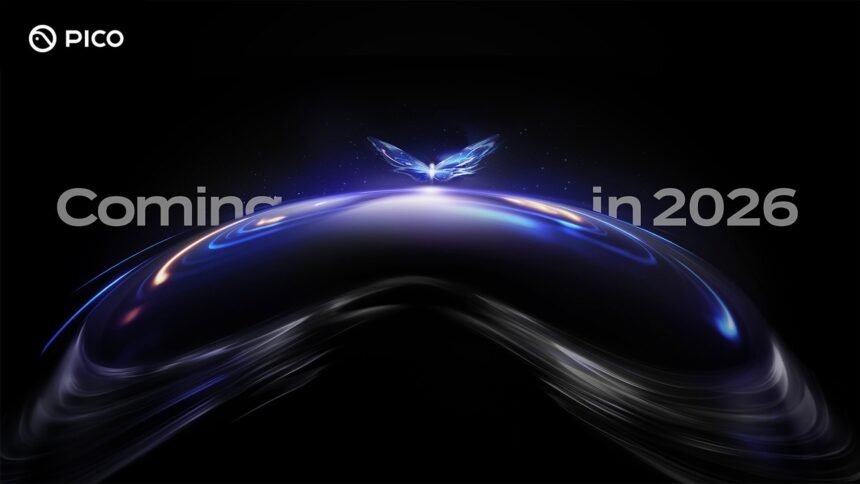
Pico today unveiled Pico OS 6, something the ByteDance-owned company calls its “most significant operating system update to date.” Additionally, the company teased a few new bits of info about its upcoming ‘Project Swan’ XR headset ahead of its “live demo” GDC 2026 session next week.
Project Swan is Pico’s next flagship headset, slated to launch globally sometime in “late 2026,” the company says. While there’s no price or finalized hardware specs yet beyond the list of features below, the company just showed off the operating system that will run Project Swan, Pico OS 6.
But first, a recap of Project Swan’s features:
- Display type: MicroOLED
- Pixel density: approaching 4,000 pixels per inch (PPI)
- Pixel per degree: Average ~40 pixels per degree (PPD), center sweet spot exceeding 45 PPD
- Dual-chip architecture: custom XR silicon for perception and imaging (claimed ~12 ms perception latency) and separate flagship SoC with “more than 2× CPU and GPU performance vs XR2 Gen 2”
Additionally, Pico announced it’s has launching a ‘Global Early Access Program’ at picoxr.com which will allow hand-picked users an opportunity to test of Project Swan and Pico OS 6.
That said, there’s still a lot to learn about Project Swan, although Pico offered a decidedly more detailed look at its OS 6 update, including a new system layer called ‘Spatial Engine’.
Pico says Spatial Engine is “designed to make different types of digital content work together more naturally,” which will allow standard Android apps to run directly within immersive environments, rather than appearing as separate layers.
“This means users can work with tools such as spreadsheets or design software while remaining fully engaged in a 3D space,” Pico says in a press statement. “For developers, the update provides a more consistent foundation for building experiences that blend familiar apps with immersive interactions in a smooth, responsive way.”
Users can also position multiple app windows around them using a 360-degree interface, which Pico calls ‘PanoScreen’, enabling multitasking within mixed reality, with input options including hand gestures, controllers, and keyboard and mouse.
We’re sure to learn more at Pico’s GDC 2026 developer session, which will also likely go deeper into Pico’s new Spatial SDK (‘Kotlin’) and UI system, which the company says simplifies design with component-based APIs and unified runtime adaptation.
Pico says its GDC 2026 it will al;so provide “an overview of Project Swan’s graphics performance, multimodal interaction system, and developer toolchain, as well as practical guidance on bringing existing apps or games into spatial computing workflows,” in addition to “concrete examples and live demos.”
In any case, we’ll be watching out when GDC kicks off next week, taking place March 9th – 13th at the Moscone Center in San Francisco, California.