Welcome to my review of the MSI Claw 8 EX AI+, a handheld PC that went on sale four months ago. And if you think that’s bad, tell it to the 2025-spec Lenovo Legion Go 2 I’ve left, neglected and unappraised, in the dusty heights of my utility cupboard.
This one, mind, is still worth looking at a smidgen late. It’s the first palmable PC to use Intel’s Arc G3 Extreme SoC, including the Arc B390 integrated graphics that’s already impressed in skinny laptops. Considering both the underwhelming framerate gains of previous handheld chip upgrades, like the Asus ROG Xbox Ally X’s second-gen Ryzen, and the fact that the last-gen Claw 8 AI+ was already a high performer, this here EX model could be the one to usher in a new standard in game go fast technology. Could, and ultimately, does – it’s more than twice as fast as a Steam Deck OLED in some games.
…Which you’d hope, given it costs about twice as much.
You know the routine by now: AI data centres, RAM shortages, component prices, pain. £1,399’s worth, in this case. As a result, the ‘AI’ in this handheld’s name seems less like it’s advertising a product feature and more like it’s whispering a name in a detective’s ear before passing out from its stab wounds.
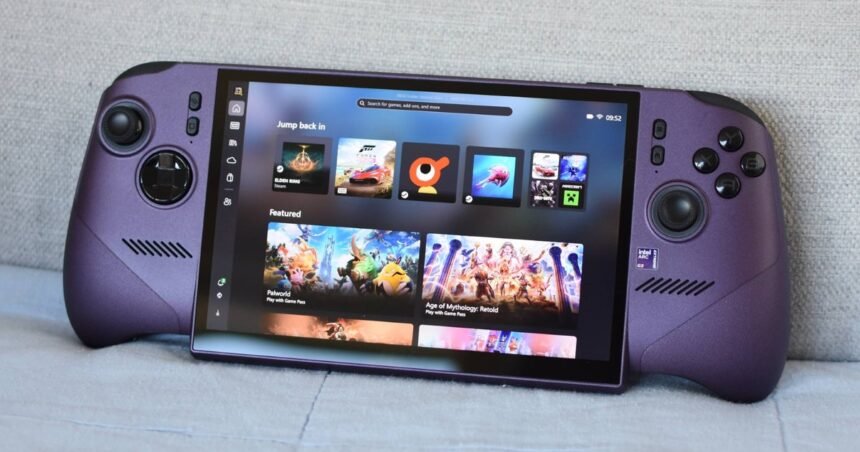
It is, at least, intentionally aiming for high-end spec glitz from the off. Hall effect thumbsticks flank a 120Hz, 1920×1200 IPS so vast it overshoots the bottom edge, and inside, that G3 Extreme chip is joined by 32GB of system RAM (might have shaved some 9s of the price with 16GB, but hey) and a nicely spacious 1TB SSD. It’s also, frankly, a lot better-looking than the grey faced Claw 8 AI+, with more rounded grips that sit a little better in the hand. It’s still an unpocketable slab, weighing 785g and stretching nearly an inch wider than its predecessor, but its gamepaddish sculpting does make it somewhat more comfortable to play.
It’s also true that the Claw 8 EX AI+’s pixel-pushing abilities are genuinely top of the line. Even while matching the 1200p resolution demands of other high-enders, it repeatedly biffs them around in Low-quality benchmarks, while making good on a real upgrade on the Claw 8 AI+. Even its smallest advantage, in Black Myth Wukong, will be visibly smoother to a trained eye.
Despite the handheld’s name suggesting some sort of artificially intelligent optimisation is going on, any machine-learned resource-juggling that the Arc G3 Extreme can do is focused on lightweight loads. Its game muscle is, therefore, almost purely thanks to that B390 GPU, which did well in a bunch of other games to boot. Resident Evil Requiem averaged 57fps on Low (with FSR on Quality mode), while Elden Ring usually stayed above 50fps on Medium at native 1200p. Subnautica 2 stuttered a little, but a combination of its Low preset and TSR Quality was enough to get it averaging 56fps.
Next to its Z2 Extreme-powered rivals, and especially the humbler Steam Deck, the Claw 8 EX AI+ is much more likely to enable glossier visual options as well. Big Walk, for instance, averaged 50fps on its High preset, so there’s no urgent need to de-prettify its sunny puzzle island. Forza Horizon 5 also scored 81fps on native-rez High, outspeeding the ROG Xbox Ally X and Legion Go 2 (see? I benchmarked it, before I exiled it) even when they only needed to run on Low.
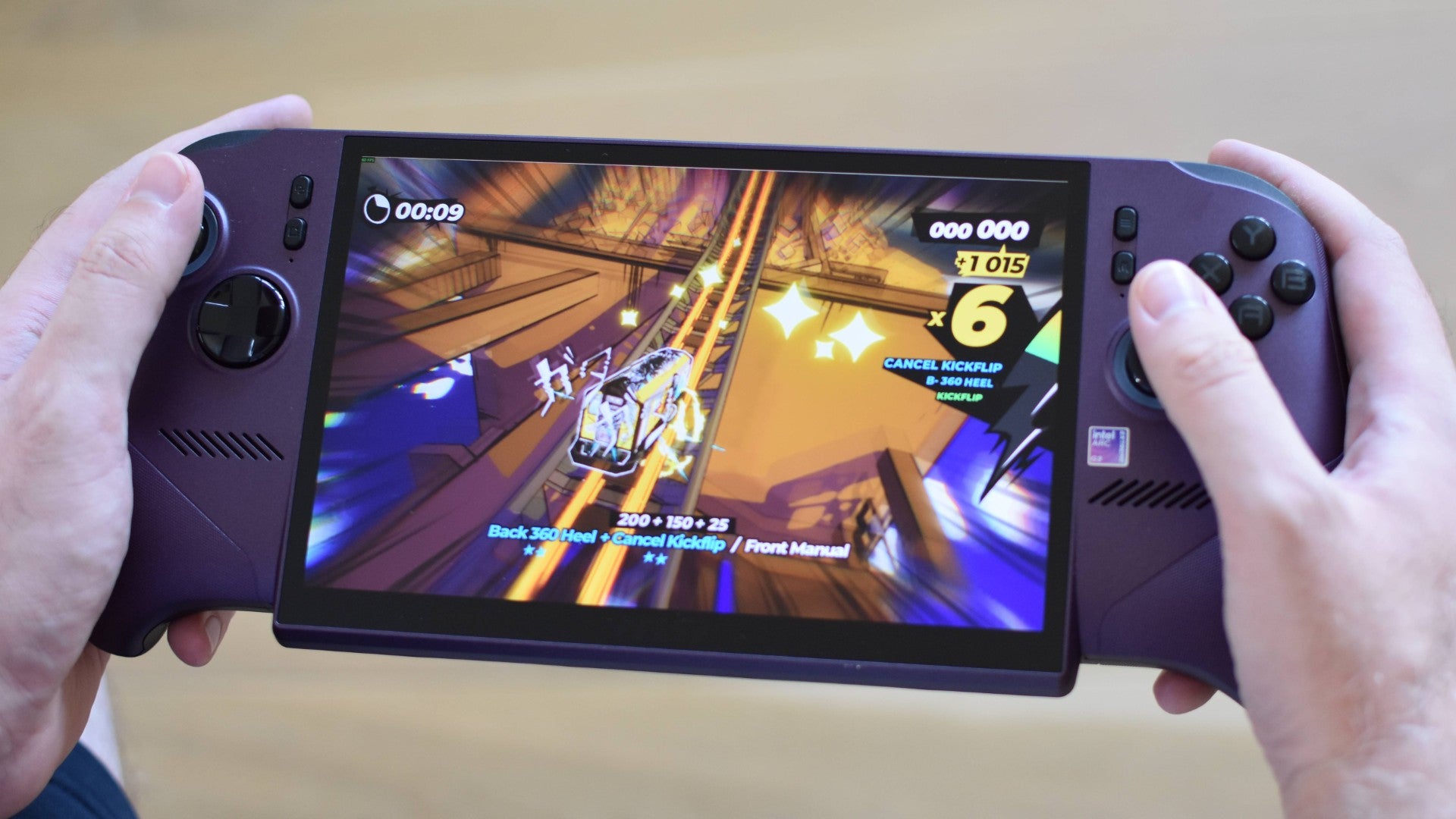
The best part, as the Claw 8 EX AI+ does still need to be a portable powerhouse, is that its performance doesn’t come at the cost of deafening fan noise or kneecapped battery life. Its cooling setup hums along, not quite silently, but hushed enough to avoid the Legion Go S sensation of gripping a tiny vacuum cleaner. And this is one of precious few handheld PCs able to give the Steam Deck OLED a fight on longevity: Valve’s machine still handles low-demand games better, lasting 5h 48m to the Claw 8 EX AI+’s 3h 37m in Portal 2, though the MSI’s 2h 29m in Elden Ring does edge the Deck OLED’s 2h 14m.
On top of being the most graphically beefy handheld PC on the market, then, the Claw 8 EX AI+ does well on basic usability qualities that too many Windows portables have been willing to sacrifice. On those grounds alone, what else could you call it but the best in its class? Maybe even such that its price, while hardly deserved, is at least understandable?

Even the finest hardware, however, can have an unsanded panel or an exposed nailhead. For the Claw 8 EX AI+, it’s the display that disappoints. Not because it’s bad – in many ways it’s quite a tidy screen, securing its vibrant colours by covering 99% of the sRGB gamut, and having a Deck OLED-beating refresh rate that (for once on a handheld) is paired with a GPU that might actually pump out enough frames to take advantage of it. Even so, the old one was better. In the same tests that snapped that 99% colour coverage, I recorded the Claw 8 EX AI+’s display reaching a contrast ratio of 1,291:1 and a peak brightness of 418cd/m2; as the Claw 8 AI+ hit 1,412:1 and 521cd/m2 in its respective tests, it would appear that MSI have switched to a duller, flatter LCD panel. Even putting aside how the much cheaper Deck OLED remains more vivid and inky than both, if this was an attempt at keeping the Claw 8 EX AI+’s price down, it clearly didn’t work.
Then there’s Windows. Ohhh, Windows, you never learn, and apparently handheld manufacturers don’t either. While SteamOS continues to gorge itself on user-friendly features, designed and tuned specifically for the hardware formats it appears on, Windows 11 remains deflatingly awkward as a portable operating system, still requiring regular touchscreen intervention to navigate. Even using Xbox Full Screen Experience, the more thumbstickable skin Microsoft began stretching over Win11 last year, the Claw 8 EX AI+’s software spat out multiple bugs: my Steam notifications would appear in the middle of the screen, rather than tucked away in the corner, and Cyberpunk 2077 mysteriously lost the ability to run in Fullscreen mode. Most annoyingly, Xbox FSE itself would lag on startup, robbing the Claw’s controls of any input response for several worrying moments.

If you’re even entertaining the possibility of blowing £1,399 on a handheld, there’s a strong possibility that you care less about Windows UX and more about big, fat framerates. Which to be sure, the Claw 8 EX AI+ delivers on. The future of fast portables is here, and even with AMD’s promises of new Ryzen chips and FSR 4 support, that future looks awfully Intel-shaped.
What makes the Claw 8 EX AI+ nice to use, though – at least once it finishes waking up – is the lack of friction that comes with that power. It’s quiet, and doesn’t burn out in an hour, and those qualities are what truly mark the handhelds that best understand their own form factor. They’re why I still use my Steam Deck OLED when I’ve got a Legion Go 2 lying around, anyway.
Still, that same lack of friction should really extend to the softer bits. Which is why, and I suspect I’d be saying this even if the Claw 8 EX AI+ was £800, I’d wait until Valve can do what they’ve done for previous Claws: get SteamOS running on it.