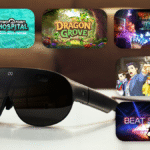
Meta has finally unveiled its next-gen mixed reality headset, Meta VR Glasses. While they could technically fit somewhere in its Quest lineup, Meta seems to be making a concerted effort to bridge the gap between its experimental augmented reality projects, like Orion, and its much bulkier Quest gaming platform.
Previously known as ‘Project Phoenix’, Meta VR Glasses are a compute puck-tethered device which are going on sale sometime in Spring 2027, priced at $1,300. You can check out the full specs and launch details here.
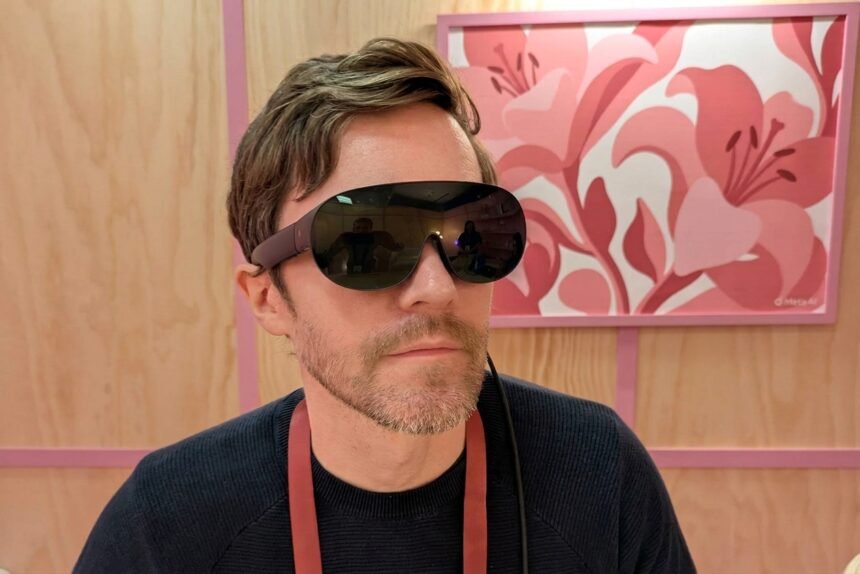
I got a hands-on preview of VR Glasses at Meta’s big annual Connect developer conference, giving me a chance to get to grips with the new gaze and hand gesture-based UI, get an early feel for ergonomics, and experience the most pixel-dense display Meta has ever sold.
Meta VR Glasses Visual Experience
After a long stint of LCDs from Meta, we’re finally getting proper micro-OLED panels. You’ll find the full specs here—but it bears mentioning that VR Glasses are visually impressive: 5.5MP (2,412 x 2,288) per-eye resolution at 37 pixels per degree (PPD), with a refresh rate up to 120Hz.
That class-leading pixel density comes at a tradeoff though: its 70-degree horizontal field-of-view (FOV) is noticeably smaller than Quest 3’s 110-degree FOV, which some may find frustrating on the face of things.
The display’s black are predictably deep, there’s no noticeable OLED smearing, and panels are sufficiently bright—maybe not as bright as I would have hoped, although I suspect that had more to do with the fact that I didn’t try it with the optional light blocker accessory Meta will ship when VR Glasses go on sale next year. Ambient reflections and lighting stole a little bit of the perceived brightness.
The color passthrough view on VR Glasses is the best I’ve seen on a standalone VR headset, as I saw no noticeable stitch lines, no appreciable latency, good color reproduction, acceptable brightness, and seemingly zero weird bendiness of the environment or near-field objects which is somewhat common of Quest headsets.

It’s really approaching the threshold of ‘passthrough as a genuine reproduction of the environment’. Combined with its sharp and much brighter displays, I’d consider Meta VR glasses streets ahead of the cadre of AR devices with birdbath optics that seek to achieve the same end with optical passthrough: using your world as a backdrop for content.
The impressively compact pancake optics of VR Glasses are also very clear, although the sweet spot isn’t as large as Quest 3, requiring you to find a good fit with the array of supplied nose pads and choose the actual Meta VR Glasses size that’s right for your head (between a ‘Standard’ and ‘Large’ variant of the device). No data yet on what that means substantively in real-world measurements. More on that below. IPD is easily adjustable by physically moving the lenses inwards or outwards independently, supporting 56-70 mm IPD in addition to prescription add-ons.
That makes VR Glasses the first Meta headset to support asymmetric IPD adjustment, though asymmetric adjustment can be difficult to calibrate correctly, compared to using an IPD dial on the outside of the headset.
Performance
That pocketable compute puck, which needs to breathe through a mesh grill at the top for active cooling, packs in a battery rated for up to three hours, powering a Qualcomm Snapdragon Reality Elite processor (XR2 Gen 3), which is up to 11% higher max GPU frequency vs Quest 3’s Snapdragon XR2+ Gen 2.

When they offered me to play Beat Saber, I thought “ah ha, my perfect apples-to-apples comparison,” but alas, it was actually a new hand-tracked mode coming to the game called ‘Flux’. This mode completely reimagines the gameplay, making it all about punching and garrote-wiring flying bars in half with an energy beam connected to both hands (as opposed to slashing blocks).
VR Glasses won’t come with controllers in the box, but it is compatible with the same Touch Plus controllers that Quest 3 and 3S use today. With them, the headset can play all existing content from the Horizon store, including the traditional block-slashing Beat Saber mode.
Back to performance: there was one graphically demanding scene that showed off the new chipset likely working at full bore; select film content will include an immersive theater of sorts, which are actually fully rendered bespoke environments that change according to what’s happening in the film.

I was watching a clip from Avengers: Infinity War, as Peter Dinklage’s character is forging the all-mighty Stormbreaker axe. It’s admittedly a cool gimmick, because I don’t expect all films to get this sort of treatment, but I was watching Dinklage forge from inside his forge. Star power blasting away, steam rising from grates, particles flying everywhere in a fully-rendered environment as the film kept up at what I suspect was probably somewhere south of 4K native playback.
Comfort & Audio
A half-hour demo is a poor basis for understanding long-term comfort for any device, even for a 100g headset that does its level best to be the all-day productivity headset… er… glasses. In Meta’s own words: “the weight is over.”

That said, I tried on both the small and large versions, notably two different SKUs, and found the large to be very comfortable. Initially, I started with the small, but it clamped too hard on the sides of my head, and kept slipping from my nose as a result. Both small and large are shipping with multiple nose pads, although I’m hoping Meta shores up their messaging on actual sizing before launch, since I would be pretty miffed if I bought the small and I had no reasonable way of finding out before buying.
Another thing I didn’t count on was the real value add of the downward-facing sensors. Sitting down, I could put my hands in my lap and do all of the UI gestures without having to Wingardium Leviosa in front of my face constantly. That includes looking to highlight, pinching to select, and swiping your index finger with your thumb to scroll, all of which just felt right.

Eye-tracking appears to only be for UI stuff for now, although I’m betting we’ll hear more about what sort of streaming and rendering tech has gone into the compute puck, and how eye-tracking informs that.
Audio is the same (or maybe even slightly better) experience you’ll have with Meta Ray-Ban Display, which include off-ear speakers that comes with the usual trade-offs. Less bass, acceptable mids and treble, and the usual audio bleed. If I were on a plane (where this thing wants to be) I would most definitely opt for headphones and the optional light blocker, which clips in for a more immersive (and less light bleed-y) experience.
Value Proposition
Meta seems to be forging a new path with VR Glasses. While they could conceptually fit somewhere in its Quest lineup, they appear to represent a more concerted effort by Meta to bridge the chasm between its Display glasses, experimental augmented reality projects, like Orion, and its much bulkier Quest gaming platform.
Meta VR Glasses are an interesting mid point between the still elusive all-day AR glasses of the near future, and the much heavier, and less compact VR headsets of today. It’s attempting to bridge that gap by being slim and light (~100g on-head weight), and by offering some of the best color passthrough I’ve seen on VR device yet.

In the end, it feels like Meta purposefully reframed the device by not calling it something like, I don’t know, ‘Quest Air’.
And at $1,300, the appeal is pretty clear: Meta wants prosumers and productivity-minded people to look at VR Glasses not only as a jack of all trades, but one that doesn’t take up half of your carry-on, or weigh too terribly heavy on your head like its main competitors, Apple Vision Pro and Samsung Galaxy XR.
Disclosure: Meta provided lodging for one Road to VR reporter to attend Meta Connect 2026 where information for this article was gathered.