It’s been well over a week since my final swing of Virtue and a Sledgehammer’s righteous whacking stick, and I’m still finding it difficult to shift the game from my thoughtspace. Having tempted me in with promises of cathartic, base-instinct vengeance against a town of roboticised arseholes, it’s since had me picking through the rubble of my own demolition spree, not so much looking for meaning as trying to parse the abundance of it. I’d gladly invite you to join me in the wreckage.
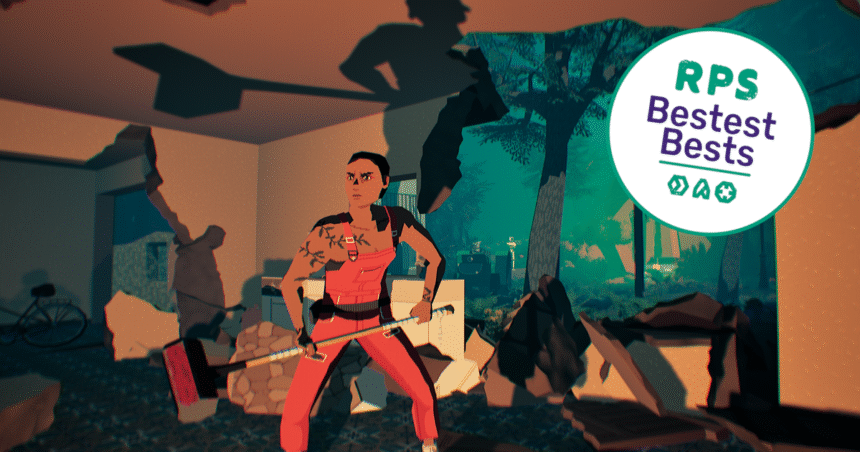
Virtue’s developers, Selkie Harbour and the apparent nominative determinists at Deconstructeam – previously of The Cosmic Wheel Sisterhood – say it’s a “narrative exploration” game. Which is accurate, on both counts. As pictured sledgewielder Pratelle, your most urgent interactions involve breaking shit, be it the walls of your childhood hometown or the android copies of its former inhabitants. Really though, you’re bashing with purpose beyond your (or Pratelle’s) own satisfaction: hammering away masonry will open up new nooks and paths to explore, which in turn leads to more flashback story scenes, better contextualising a rampage that might otherwise seem lacking in justification.
This is not a swift process. Pratelle’s swings are slow and deliberate, each one needing at least some charging-up, and end on a similarly lengthy recovery animation. While this imbues encounters against the more aggressive bots with some timing-based challenge, the game’s sluggishness also serves to lend some emotional weight – a means of holding your head towards the crumbling homes and the clattering humanoids. Nothing dies here unless you absolutely, intentionally will it, and once you commit, there’s scant chance to do anything but watch as it hits the dirt.
On an initial playthrough, the techniques of fellow low-polyist Mouthwashing may come to mind: that game conveyed the cruelties of its main playable character through similarly slow, purposeful interactions. As Virtue gives up more of its secrets, though, it becomes clear that while it wants you to feel Pratelle’s rage, it also considers her crashout entirely legitimate. To explain fully would mean practising in spoilers, but those narrative shards seriously are worth tracking down, each scene laying on depth and tragic complexity to Pratelle and her family – the latter being the reason she’s back in town to begin with.
Non-chronological, but coherently written and arranged flashbacks run an impressively wide gamut of wholesomeness, unease, and horror. And they wisely take place before the sci-fi element becomes prevalent in the present-day storyline, keeping the darker moments more compellingly, uncomfortably grounded. Even with a tendency towards quip-speak, especially from the mouth of Nina, Pratelle’s smug genius of a sister, the mixing of fond memories with traumatic ones heightens the impact of both. It’s naturally awful to watch Nina coldly kick Pratelle out of their mother’s hospital room, or to see that mother inflict physical abuse on the sisters, but the hurt hits different when a later scene shows all three warmly chatting at home. Based on the chatter of their robot avatars, many of the family’s neighbours are/were variously racist, homophobic, or outright murderous, but it’s the pain and betrayal seeded in those past moments that drive Pratelle’s stomping, bludgeoning campaign of violence.

Crucially, Virtue does not introduce these humanising moments to manipulate you into manufactured, Far Cry 3-ass, you-are-the-real-monster guilt, and in-story attempts to play this trick on Pratelle herself are quickly called out as such. The wrongheaded people are wrong, the game knows it, and there’s no ulterior motive beyond the suggestion that those we love (and are loved by) can be corrupted by ego, ambition, or inherited trauma. Still, that central, lamentable family dynamic, and how skillfully its members are built up and broken apart in such short vignettes, are largely why I’m still pondering the game so much. I also confess to having replayed the entire thing, in far less brutal fashion, in the hope – proved vain – that it might help change some of their fates.
For better or worse, fury is the only language this town understands, and Pratelle is a fluent speaker. The long windup of attacks is at least met by an equal and opposite reaction of object-mangling: walls blast open with an appreciably exaggerated shower of debris, and taking out a building’s corners will cause a thunderous collapse of the entire structure. Thwacking robots isn’t quite as satisfying, in part because of the underwhelmingy dull ‘thunk’ of the impact sound, but a solid hit will still send them tumbling backwards with a deserved lack of grace. In some delightfully fortuitous melees, a clobbered bot would ragdoll hard enough into an adjacent wall to crack it open, revealing a memory shared I could have otherwise missed.

I briefly wondered if having me collect all these was necessary, given the game has no problem auto-triggering regular cutscenes at points. Except, it kind of is. Pratelle’s journey is cathartic, but it’s also a labour, the weight and sorrow of what she must do mirrored in her leaden footsteps and determined but joyless sledgehammering. It’s entirely appropriate, then, that uncovering her full story takes some extra effort, just as that effort is entirely rewarded.
Virtue and a Sledgehammer stands against much. It’s anti-prejudice, anti-ambivalence, and in not very subtle terms, anti-AI: its depiction of a soulless (albeit human-driven) machine takeover, complete with whining about how hard life was before, throws up gladly smashable parallels to the chatbot infestation of creative and public spaces.

For all its violent opposition, though, it’s also earnestly, maybe even optimistically pro-human. While drawing a line at intentional and misguided evils, it’s accepting of our imperfections and the role they have in shaping us – remember you’re fighting about 600 identical automatons – and only plumbs the depths of true despair when humanity isn’t adequately defended. Rage is vented and steam is let off, but not in a purely spiteful, fuck-the-world manner, and even Pratelle is only tearing her past down so she can move on from it. Maybe one day I will too, if I can ever get her stupid, fascinating game out of my head.