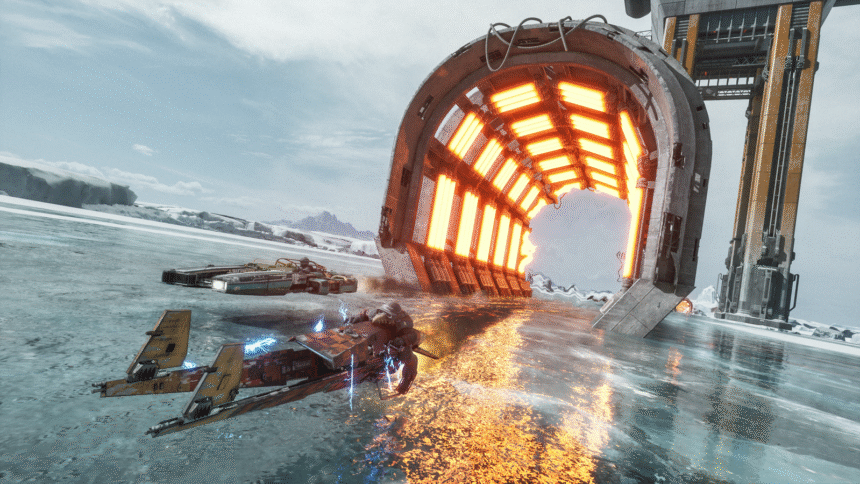
For the past few weeks, I’ve been playing Star Wars: Galactic Racer pretty much nonstop. The arcade racing game, spearheaded by former Burnout developers, makes great use of the Star Wars universe to create a thrilling game filled with high stakes and even higher speeds. It’s not exactly breaking new ground in terms of its racing, mind you, but there is something innovative hidden beneath its spectacular crashes: its roguelite single-player campaign, a modern twist that nevertheless feels rooted in arcade history.
At a distance, that sales pitch might sound a little odd. When I first played Galactic Racer this summer and described how it worked to other members of the press, I was met with some knee-jerk revulsion at the idea. A roguelike racer? Huh? But not only does the idea work better than you might expect, it’s also a sensible match for the traditional structure of the genre.
In Galactic Racer’s single-player campaign, you take on the role of Shade, a rookie racer who gets entered into an unsanctioned — and definitely unsafe — racing league. Your goal is to make your way through the ranks of the Galactic League and take down your rival, Kestar. To do that, you need to win (or at least survive) several races in a row to get a shot at the grand prize. All things considered, that’s a pretty basic racing game setup.
What’s unusual, though, is that it’s all laid out as a roguelite. By spending a token, you’re dropped into a new run. You can choose what events you want to tackle on a branching event map, not unlike Slay the Spire, and get upgrades with each victory. You’re creating a build as you go, fine-tuning your car’s stats and experimenting with synergistic upgrades. There’s a touch of meta progression on top of that, as you can earn a currency in races that allows you to give your cars permanent stat boosts. Otherwise, you start from the bottom of the league every time you lose. It’s a brilliant idea for a genre that frankly hasn’t had a creative shake-up in generations.
As fresh as that idea is, what I actually love about it is how classical it secretly is. Strip away the word “roguelike” and consider how Galactic Racer’s campaign works at a foundational level. You complete a bunch of races in sequence, and if you lose, you start it again. It’s a traditional Grand Prix structure, modified by the fact that you get some rewards and temporary boosts with each victory. What happens when you don’t finish in first place in a Mario Kart cup? You try again until you get gold!

And while the permanent stat boosts help make future races a little easier, they’re almost a bit of a placebo. Sure, they help, but completing a run ultimately comes down to skill. You need to spend time perfecting your driving abilities and internalizing the exact nuances of every track. The roguelite structure is a clever way to give you more practice laps, testing how well you fare in eliminator tournaments, time trials, and challenges that test your boost control.
This is what I love about the roguelike as a game structure, and the developers who understand its potential. Though it feels like a modern concept, the roguelike is the closest thing we have to old-school arcade design in today’s video games. It’s that old idea, kicked off by 1971’s Computer Space, of dropping a quarter in an arcade cabinet, seeing how far you can get before dying, and starting over. That was a design philosophy built to get more money out of players, but it’s also one that both pushed some players towards mastery and made others comfortable with a casual kind of play where winning wasn’t the point.
Get gamexplore’s Wishlister newsletter
A weekly cheat sheet to what you’ll eventually love to play. No buying, no
commitment — just saving for later.
Sign up free
Free. Unsubscribe anytime.
I can feel both sides of that dynamic at play when I sit down with Galactic Racer. On one hand, I feel myself sharpening my skills with each loss. I’m determined to nail down my cornering in Lantaana’s tight caves to make it out with nary a scratch and live to win another race. But at the same time, the structure has me appreciating the act of racing over the thrill of winning. I know that I’m likely to lose, often. With that in mind, I’m really able to focus on enjoying the moment-to-moment joy of racing. I’ve come to appreciate all the little nuances as I play chicken with my ramjet boost and work out ways to smash my opponents against a wall so I can enjoy a glorious slo-mo explosion.
I don’t know if I’ll beat Galactic Racer any time soon, but I’m not really itching to. I’m currently engaging with it like a true arcade game, getting in one or two good runs every day and walking off happy that I got to spend a bit of my day playing an immaculately well-designed racing game. In a landscape where I so often feel pressured to see a game through to its final boss, I’m happy to kick it old school with a game that I’ll always be happy to return to.