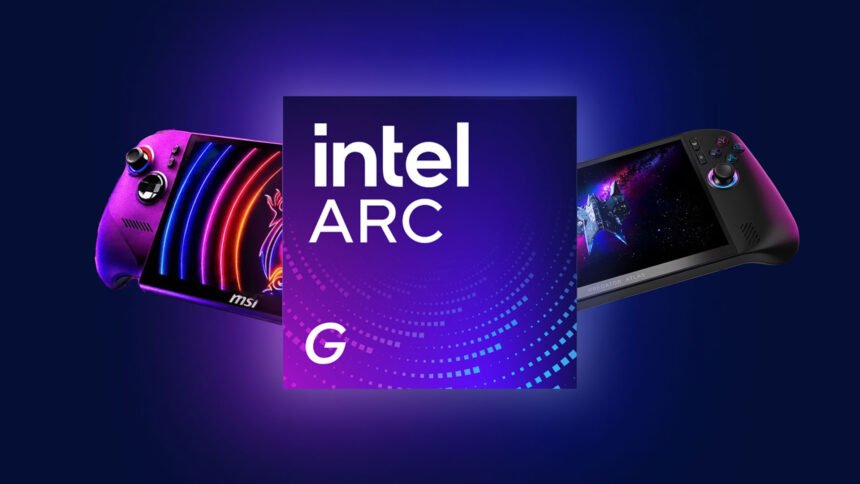
Intel has taken a big swing at AMD and its dominance of the gaming handheld market, as it is launching a new range of gaming CPUs exclusively for use in Steam Deck rivals. The new Intel Arc G3 range is designed to “set a new standard for handheld PC gaming” thanks to its powerful Arc B390 GPU and highly power-efficient CPU. Given Valve issued a Steam Deck price rise of as much as $300, the arrival of new Intel-powered gaming handhelds couldn’t have come at a better time.
Intel has previously tried to push into the handheld market, with devices like the MSI Claw 8 AI+ using an Intel Lunar Lake chip. However, it has failed to establish itself as a builder of CPUs for the best gaming handhelds, with top options such as the Steam Deck/Steam Deck OLED, Asus ROG Ally, Xbox Ally X, and Lenovo Legion Go sticking with AMD options.
Intel Arc G3 will hope to change that, primarily through the addition of its B390 GPU in these chips. This is the same integrated GPU as used in the company’s Panther Lake laptop CPUs, which have already proven to be a massive improvement on previous Intel integrated graphics, with performance that rivals the Nvidia GeForce RTX 4050 and obliterates the B890M GPU in AMD’s Ryzen Z2 Extreme – as used in the Xbox Ally X.
In tests by Club386, they showed the B390 in the Intel Core Ultra X9 388H outperformed the B890M in an AMD Ryzen AI 9 HX 370 by 79% in Cyberpunk 2077. Meanwhile, this Intel GPU could generally deliver playable frame rates at 1080p in modern games.
That’s with this GPU running on a powerful, 16-core laptop CPU, so it remains to be seen just how powerful the Arc G3 Extreme proves to be, but it will certainly be making AMD sit up and pay attention.
The full specs for the two Intel Arc G3 CPUs are:
| Intel Arc G3 Extreme | Intel Arc G3 | |
| Total cores | 14 | 14 |
| Performance cores | 2 | 2 |
| Efficient cores | 8 | 8 |
| Low power efficient cores | 4 | 4 |
| Max Turbo frequency | 4.7GHz | 4.6GHz |
| Base power | 25W | 25W |
| Turbo power | 80W | 80W |
| GPU name | B390 | B370 |
| Xe cores | 12 | 10 |
| GPU max frequency | 2.3GHz | 2.2GHz |
| GPU TOPS | 113 | 90 |
Along with this impressive GPU performance, Intel is highlighting the “Right-sized compute” of these CPUs, referring to the balance of just two performance cores in its CPU, along with eight efficient cores, and for low-power efficient cores. This combination should provide plenty of power when needed but have the ability to really scale back power draw. Intel is also keen to note the chips are made in the US, using its latest 18A manufacturing process.
Along with CPU and GPU power, the chip also contains all the connectivity needed by a device like a gaming handheld, with Intel Wi-Fi 7 R2, dual Bluetooth 6, and Intel Thunderbolt support.

The new chips also support Intel’s XeSS upscaling and frame generation tech, which isn’t quite as good as Nvidia DLSS, but is largely at least as good as AMD FSR.
Intel is also highlighting the addition of its pre-compiled shaders being supported by these new chips. This tech has Intel download and, well, pre-compiles the shaders for games, which it then downloads in the background so that when you start a game for the first time, you don’t have to wait for the shaders to compile. It’s early days for this tech, with only a few games supported, but it could prove very useful for getting a game running quickly while out and about.

As for which devices will be using the new Intel Arc G3 series, Acer has already announced the Predator Atlas 8, while the MSI Claw 8 EX AI+ has been leaked in a post by Videocardz and is expected to be announced at Computex 2026. OneXPlayer has also been announced as another partner with an upcoming device.
Both the Acer and MSI devices use 8-inch screens, making them larger than the Steam Deck and other best-selling handhelds, such as the ROG Ally and Xbox Ally X. It remains to be seen if all Intel Arc G3 handhelds opt for a similar larger format.