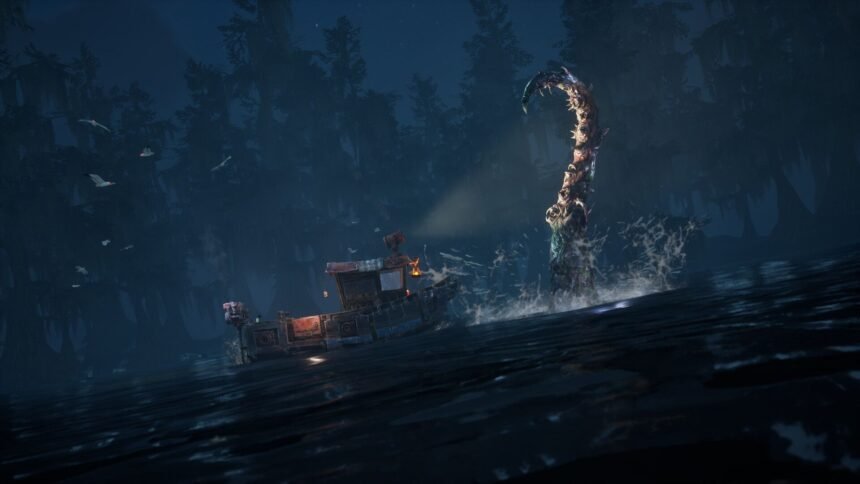
It should be no surprise that fishing as a sub-genre has gotten quite a bit of traction with horror fans, with indie games like Dredge, Lure, and many others gaining quite a bit of traction. Much of the appeal comes from the contrast between the quiet routine of fishing and the unsettling possibility of something dangerous lurking beneath the surface. Dream Dock’s Dreadmoor is the latest entry in this subgenre, offering a strong first impression that its current Early Access build struggles to sustain.
“It’s difficult to overstate how good Dreadmoor looks.”
Right off the bat, it’s difficult to overstate how good Dreadmoor looks. Despite being an indie title, the production values are impressive. The world itself manages to walk the fine line of being gorgeous while also maintaining an air of creepiness over everything, and things like the lighting system go a long way in establishing the atmosphere regardless of the time of day.
At its core, Dreadmoor is a lot like Dredge. After a short narrative section that sets up the story going forward, you’re given long-term objectives along with plenty of freedom in what you want to do, as long as what you want to do is fishing. The opening area does a great job of showcasing the variety of fish you can catch and their role in the local economy. The gameplay loop largely revolves around setting off on your boat, catching some fish, and coming back to the local settlement to sell the fish and using the money to buy upgrades.
The comparisons with Dredge don’t end there either; the 2023 horror game has been an obvious inspiration for Dream Dock, right down to the inventory system. Since the room you have in your ship’s holds is limited, you often have to move fish around to make sure that you can catch some more before having to sail back to town. Each fish being in a different shape also plays a major role, bringing in an element of what I like to call inventory Tetris; you’re going to have to rotate the fish in your inventory to make sure that you have enough room for one more catch, all in a bid to make a little more profit off your latest excursion.
“While the core loop never really changes, each type of fish has its own quirks when it comes to actually catching them.”
The economy itself is a bit more complex than simply selling fish to buy upgrades. One of the biggest considerations when setting off on your boat is how much fuel you have, which means that you will have to make sure that you always have some fish meat on hand. This fish meat can be fed to a larva, which in turn produces fuel that can help you on future excursions. Similarly, many fish also offer upgrade materials like Chromatic Scales, which play a vital role in the overall progression system. This means that selling every single fish you manage to catch is typically a bad idea.
Speaking of fishing, the gameplay system in Dreadmoor is relatively simple. You head out to one of the many schools of fish that you can easily spot on your map, get out your fishing rod, attach the appropriate lure, and cast your line. Once you get a bite, you start reeling the fish against the direction it’s trying to swim to tire it out, all while making sure you aren’t over-exerting your own fishing line, since that can lead to your catch getting away and you being out of a good lure. Once the fish is tired, you simply reel it in before it can muster up the energy to resist again.
While this core loop never really changes, each type of fish has its own quirks when it comes to actually catching them. When on the hunt for peaceful fish, for example, you don’t have to move your lure around; it’s simply a matter of patience while waiting for a fish to bite on the hook. Carnivorous fish, on the other hand, are only attracted to moving lures, so you’ll have to find the perfect balance of keeping the lure moving and giving the fish enough time to catch up, all while making sure that your lure isn’t floating still for too long, since the carnivorous fish might lose interest.
Since you will eventually want to make your way further and further away from your home base, and potentially even head out into the dangerous waters at night, you will have to upgrade your ship, and this is where many of my problems with Dreadmoor come into the spotlight. The act of upgrading your ship is quite tedious; the first-person perspective and emphasis on doing everything yourself means that upgrading – an act that could have simply been a menu – is instead an entire process where you have to take the old part out and replace it with a new one. If this process had more depth to it, like having you hook up wires or something else, it would have been a lot more palatable. As it currently stands, however, the ship upgrade process simply feels like unnecessary padding.

“The story itself is solid enough, and the world-building tends to be quite interesting.”
What isn’t quite as bad is how you progress through the tech tree to gain the ability to craft more upgrades. Throughout the time you spend exploring The Submerged Land, you will find research notes that can then be spent on getting your hands on upgrade recipes for your tools and your ship. While quite simplistic, the process itself feels good, and I’m always happy to get my hands on more research notes since that means I can finally upgrade my ship’s engine to go even faster without consuming as much fuel.
In a break from other popular games of the genre, Dreadmoor even features a bit of combat. While far from the most complex system out there, you will find yourself getting into fights if, for instance, you decide to head out into the waters at night. These combat encounters, while far from difficult, do a lot to add tension to the overall gameplay loop. Nighttime tends to be when the most valuable fish are out, after all, so you often have to decide whether such an excursion is worth it at the risk of losing it all due to an unfortunate encounter with a tentacle in The Submerged Land.
Dreadmoor also places more of an emphasis on its narrative. The player takes on the role of Malcolm – a fisherman who, in a ruined world, is simply trying to find a safe place for his family. This leads him to a dock at the nearby port, and infects him with a strange disease that seems to be turning him into a fish-like creature. To stave off this infection, Malcolm needs to find a steady supply of Essence, which an opportunistic merchant named Gill is happy to lend him. However, Malcolm has to work this debt off, which means that he will once more have to pick up his fishing rod and make Gill some money, all while also trying to get to a large, seemingly safe settlement named Sludge Bet.
The story itself is solid enough, and the world-building tends to be quite interesting. There are plenty of questions that are raised throughout the story regarding things like the mental state of many of the characters you meet throughout your time in the Submerged Land, the nature of the deal between Gill and Sludge Bet’s leader, known only as the Baron, and even the nature of the strange ailment infecting Malcolm, and the effects it might be having on his own mental state. However, the story is far from complete for now, and since Dreadmoor is an Early Access game, the narrative will likely pick up in major ways with coming updates.

“When it comes to other aspects, Dreadmoor can feel like a janky game.”
In the meantime, however, the story also suffers quite a bit from being little more than an extended tutorial sequence. Much of the pacing comes to a screeching halt, for example, when a character refuses to let you continue with the story until you get them some fish. The few puzzles and combat encounters the story throws at you also aren’t particularly interesting.
When it comes to polish outside of the visuals, Dreadmoor can be something of a mixed bag. The performance, for example, is great. Running the title on an AMD Ryzen 7 7800X3D CPU, a Radeon RX 7800 XT GPU, and 32 GB of RAM, I faced no performance issues despite maxing out just about every graphics setting and playing at a resolution of 2560×1440. Throughout my time with it, I didn’t even experience any hitching, and my frame rate stayed above 90 FPS.
However, when it comes to other aspects, Dreadmoor can feel like a janky game. For example, I often faced strange physics-related bugs when trying to solve puzzles. One memorable example happened early on for me; when trying to get my boat lowered into the water with a crane, I was suddenly and without warning flung through the nearby structure’s walls, leaving me unable to move. Fortunately, an autosave from a few seconds earlier let me reload and recover. Audio is also quite shoddy; while the atmospheric sounds can be fine, the voice acting is often unconvincing. Characters often sound more annoying than colorful, and the writing can be groan-inducing, with many characters rambling about unrelated subjects instead of getting to the point.
In its current state, Dreadmoor isn’t an easy game to recommend. Its stronger points, like its excellent art direction and addictive core gameplay loop, have already been done better elsewhere, and its narrative is still too far from complete to offer a satisfying experience on its own. Along with this, the general lack of polish across things like voice acting and game physics, as well as the tedium behind upgrading the ship, makes Dreadmoor an easy title to stay away from, at least for now.
This game was reviewed on PC.