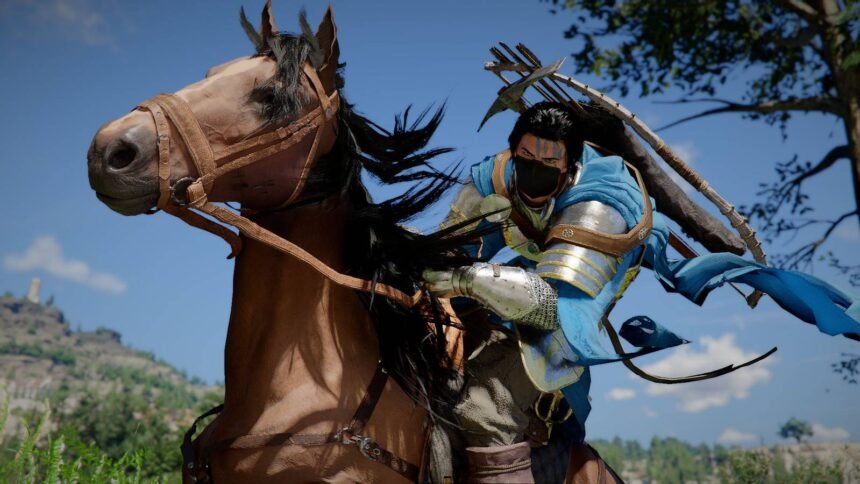
It’s difficult to play Crimson Desert and not compare it to other games. Its map design smacks of Red Dead Redemption 2. The combat design and attention to detail are just like an Assassin’s Creed game. For me, it took less than 30 minutes of playtime to see The Legend of Zelda: Breath of the Wild imprinted in the core design of the game. However, Crimson Desert‘s mistake is to believe Breath of the Wild‘s appeal lies in its technical achievements instead of its mysteriously alluring and culturally rich world.
Crimson Desert proudly displays its vast map, filled with diverse landscapes to visit and countless things to do. Despite the presence of a main questline, the game was designed to entice curiosity, encouraging us to explore every corner and leaving no stone unturned. Like Link in Breath of the Wild, protagonist Kliff gains access to many skills that serve as exploration tools. One of the first ones is the Axiom Force. Although it serves a similar purpose to Link’s Magnesis, a large energy magnet that connects to objects and allows you to move them, Axiom Force is also useful in combat — pulling enemies, directing magical energy toward them, and even allowing you to perform some over-the-top action moves.

I quickly grasped the potential of the tool, automatically developing the habit of shooting the grappling hook at everything I found, from trees, houses, and debris to suspiciously large rocks. I realized, just as quickly as I learned how to use Axiom Force, that there was almost nothing surprising to discover with it. After an initial tutorial puzzle in which the game introduces Axiom Force, it took me hours until I found a situation outside of combat where I could effectively use it.
Fearing that players might ignore the mysteries that are actually present on the map, Pearl Abyss marked them with large question marks as if screaming, “Hey! Keep looking! You might find something interesting!” By chasing these, I eventually learned that they are called abyss cressets, magical mechanisms scattered across the map and that function as fast-travel stations — just like BOTW‘s shrines. Using them is crucial when traversing the game’s enormous map, and the loading time is surprisingly fast. But unlike Zelda‘s shrines, which were each brilliant puzzles unto themselves, abyss cressets feel mundane.
After 15 shrines in Breath of the Wild, I had a general idea of what to expect from each of them, but they never ceased to seem mysterious and appealing. From their majestic architecture to the cryptic message you get from a Sheikah monk upon completion, Breath of the Wild’s shrines are eerie objects of another time that offer a glimpse of a world we can only imagine.
On the other hand, Crimson Desert‘s abyss cressets are presented as decontextualized objects. Why do they exist? Who put them there? Are they ancient artifacts from a lost civilization? Nothing in the environment or design suggests anything about their origin nor do they invoke any grander sentiment. While Zelda‘s shrines are steeped in the history of the game’s world, abyss cressets are displayed as generic, plastic totems, devoid of culture and history.

Above the clouds, I hoped to find meaning in Crimson Desert‘s world. Right at the beginning of the game, Kliff is taken to the abyss temples, alien-looking structures in the sky, where you come across high-fantasy elements, like a mysterious entity called the White Crow, and an interconnected network of magical bridges and circuits that work in inexplicable ways. The abyss is one of the few places in the game where I felt there was magic in this world, but, while visually stunning, the land above the clouds is as empty as the hills and caves at ground level.
Designed as an archipelago, the abyss is merely a collection of large puzzles and busy work. In the Root’s End, there is a long line of moving platforms. Watching them move — not to mention how quickly the vast world of the game appears when I miss my jump and fall — is impressive. But despite what Pearl Abyss is technologically achieving there, the platforms have no reason to exist other than as something for players to do. Although the sky level in The Legend of Zelda: Tears of the Kingdom is similar in purpose, the shrines still carry the history with them. There is meaning to their existence.

From the character’s skills to landmarks, Pearl Abyss has followed the manual. It created versions of BOTW’s features to suit its medieval-esque setting and pushed the boundaries of game design by making gigantic intricate structures that smoothly move in the sky. However, Pearl Abyss seems to believe that, by recreating the same elements that gave players memorable experiences in other games, it can achieve the same subjective effect with Crimson Desert. It’s a blind faith in technology over meaning.