Guest Article By Julian Reyes
Julian Reyes is an award-winning XR producer, with more than two decades of experience spanning immersive media, storytelling, music culture, and technology. He is the Founder and Director of the Virtual Worlds Museum, where he leads efforts to preserve, explore, and showcase the history, culture, and future of virtual worlds. This June, he’ll speak at the AWE USA 2026 panel discussion, “How We Can Preserve Online Worlds and Why It Matters”.
There is a particular kind of grief that comes when a virtual world sunsets.
It is easy for some to frame these closures as the disappearance of a product, a platform, or a failed business model. But those of us who have spent time inside virtual worlds know better. When a world goes dark, we do not simply lose connectivity. We lose places. We lose rituals, relationships, events, art, architecture, memory, and the transcendent sense of belonging that only emerges when a community spends enough time together to turn a platform into a home.
That is why the recent announcements from across the immersive landscape have struck so deeply:
- Rec Room will shut down on June 1, 2026 at noon PT, sunsetting a platform that has connected more than 150 million players and creators.
- Spatial will sunset its Spatial Creator Platform’s Free and Pro tiers on July 27, 2026, citing the growing cost of hosting open multiplayer 3D worlds.
- Multiverse officially closed this month, citing the difficult economics of operating a social VR platform. (Multiverse member ‘LarkAfterDark’ created this online memorial to the world and its community)
- Occupy White Walls and Nowhere, which also enjoyed some buzz a few years ago, have already sunsetted.
- In Meta’s ecosystem, the uncertainty surrounding Horizon Worlds has become a symbol of a broader instability facing immersive communities. Even when the future of a platform is not fully settled, mixed signals and shifting priorities can leave world builders and residents unsure whether the spaces they have invested in will remain available to them. The problem is made worse by incessant tech news coverage which confuses Meta’s Horizon Worlds (one platform) with the metaverse, a concept that’s been instantiated across many platforms.
Taken together, these cases point to a deeper problem:
Virtual worlds can hold years of social, creative, and cultural life, yet too often they are still treated as temporary products rather than places worthy of stewardship. For the people who gather inside them, these are not disposable apps. They are lived environments.
This is not abstract to me. It is personal, and it is historical.
I have lasting memories of hosting events with Celeste Lear in BRCvr, now BurnerSphere, and AUREA Award after-parties in AltspaceVR. Thankfully, I recorded some of those events, but countless unrecorded hours of community life on the platform are now gone except for what its residents remember.
Three years ago, however, the communities and world builders of AltspaceVR were abruptly displaced when Microsoft shut the platform down on March 10, 2023. In its earlier years (around 2017), the platform saw roughly 35,000 monthly participants.
Yet the story did not end with the shutdown. A committed community carried its spirit forward into VRChat, which achieved a new all-time high of nearly 158,000 concurrent players earlier this month. Former Altspacers recreated familiar spaces in VRChat, continuing to gather, and recently hosting commemorative events marking three years since the loss of AltspaceVR while celebrating the builders, friendships, and cultural life that survived its closure.
That experience taught a lesson that our industry still needs to take seriously: platforms may close, but communities fight to endure. The question is whether the broader ecosystem will give them a meaningful path to do so.
It’s Not Just About Losing 3D Spaces: Itemizing What Disappears When Virtual Worlds Sunset
So what does the loss of a virtual world actually mean? It means the loss of digital culture in living form.
A virtual world is not merely code on a server. It is a social fabric woven from thousands or millions of moments: a first concert, a memorial gathering, a classroom experiment, a dance floor, a comedy club, a holiday celebration, a support group, a business, a community ritual, a world someone spent months or years building by hand. When that world disappears, all of those moments become harder to access, harder to document, and harder to pass on.
The losses happen on multiple levels at once:
- We lose cultural expression: performances, architecture, customs, and shared practices.
- We lose social continuity: communities, friendships, recurring events, and other forms of belonging.
- We lose historical context: the record of how people lived, created, experimented, and connected inside these digital spaces.
A screenshot may survive. An exported asset may survive. But the social meaning that gave those artifacts life often does not survive intact.
Sometimes the world itself vanishes. Other times the deeper loss is less visible but just as profound. A community may migrate elsewhere, but the original atmosphere, affordances, etiquette, and cultural norms do not transfer perfectly. Migration preserves people, but it does not always preserve place.
For an apt real world analogy, imagine if the annual Burning Man festival unexpectedly closed down. It wouldn’t just be the end of the festival itself, but the end of hundreds of camps (worlds) and thousands of Burners coming together every year.
That is why sunsetting hurts so much. It reminds us that virtual worlds are not trivial entertainment, and they are not culturally neutral infrastructure. They are part of our shared digital record. As more education, performance, identity, collaboration, and community life move into immersive spaces, the loss of a virtual world is no longer a niche concern. It is part of the larger challenge of preserving digital civilization.
And yet, alongside the grief, we also see something else: resilience.
When Virtual Worlds Sunset, Their Communities Create Solutions
Again and again, communities try to emigrate to other worlds together; sometimes companies help assist with that exodus:
VRChat recently invited displaced users from Rec Room and Horizon Worlds to come over, offering not just a new platform, but a social refuge. After the virtual world There shut down (despite having one million registered users at its end in 2010) Second Life creator Linden Lab created a ‘Therian’ avatar name, giving former There users a recognizable identity marker so they could find one another again.
Former AltspaceVR users organized themselves, formed their own VRChat groups, and rebuilt worlds inspired by the spaces they had lost. They even held a week-long memorial in VRChat to commemorate the three-year anniversary of AltSpaceVR’s shutdown. These acts may not fully restore a vanished platform, but they show that continuity is possible when communities are given tools, welcome, and recognition.
In some cases, communities go even further. They attempt to reverse engineer the worlds they loved in order to preserve or revive them. We have seen this spirit in communities surrounding Club Penguin, There, and now, there’s groups of users working to do this with Rec Room.
These efforts arise from a profound truth: when people feel that a world mattered, they do not simply let it disappear. They rebuild it, emulate it, archive it, and carry it forward however they can.
That should be a signal to the industry. The demand for preservation is already here. The need for transition pathways is already here. The desire for continuity, interoperability, and cultural memory is already here. What has often been missing is not community will, but institutional support.
How Companies & Communities Can Create Better Solutions for Future Worlds
We need to do better at planning for the full lifecycle of virtual worlds. That means creating stronger migration paths for users and creators. It means building export options, archiving systems, and community handoff processes before a shutdown occurs. It means treating virtual worlds as places with social and historical value, not just as services that can be switched off without consequence.
Here are some specific practical suggestions for companies to consider—and for communities to consider demanding from the virtual world platforms they’re supporting:
- Enable integration with Discord and other third party social platforms: Giving virtual world communities easy means to communicate with each other outside the immersive space is crucial for growing virtual world usage, enabling people to remain lightly engaged while away from their main device. It’s also a great way of helping ensure that these communities can persist even if a particular world is sunsetted. (As a promising example, VRChat recently enabled deep integration with Discord.)
- Favor architectures that are open, portable, and independently hostable: Examples include self-hosted platforms like OpenSimulator and Overte, browser-based systems like Mozilla Hubs and Custom WebXR, and open engines like Godot. These approaches do not eliminate fragility, but they reduce dependence on a single corporate owner and improve the chances that worlds, objects, and communities can persist, migrate, or be reconstructed.
- Explore Gaussian Splats and other export technology: While Unity-based virtual worlds enable some offline/backup capabilities, we need solutions which work across the many 3D engines on the market. We are seeing some promise with Gaussian Splat-based recreations of virtual world spaces. As an example, my team created this experimental Gaussian render of the Horizon Worlds central hub on Marble, the new platform from WorldLabs.
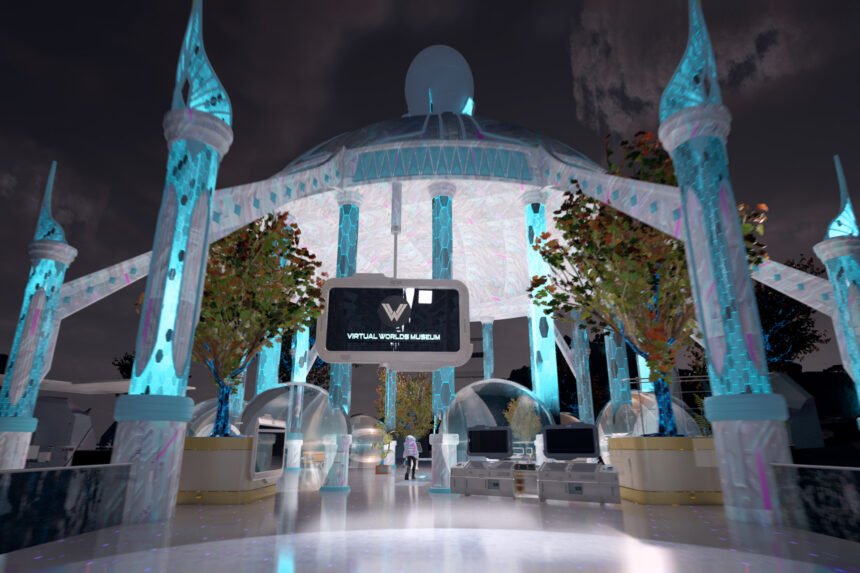
My own organization, the Virtual Worlds Museum, was founded to help encourage virtual worlds preservation through documentation, exhibits, and community storytelling. Our Sunset Exhibit preserves the memory of worlds that have disappeared, and our Teleportal helps visitors discover virtual worlds across the ecosystem. To better rally the virtual world community before Rec Room’s demise, we recently launched this crowdfunder to support these efforts.
But preservation alone is not enough. If the immersive industry wants to mature, it must begin treating virtual worlds not as disposable experiments, but as cultural spaces with legacies, responsibilities, and communities worth protecting. Because when a virtual world sunsets, what we lose is not only a platform. We lose a piece of human history written in digital space.
And if we choose to preserve that history, honor those communities, and build better paths forward, their light can still guide the future of virtual worlds.