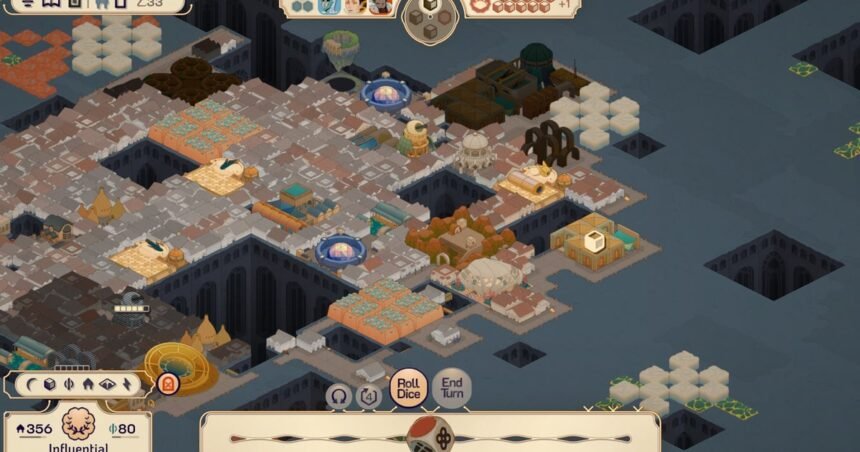
The key thing to know about Amberspire is that it isn’t a city-builder in the SimCity sense, but a turn-based boardgame puzzler in which you don’t so much ‘build’ a city as you do manage a tumult of unpredictable, city-flavoured agencies. Created by Lunar Division, developers of The Banished Vault, it takes place on the surface of a moon-sized mausoleum – a vast Venetian graveworld whose fractured isometric crust reveals level after level of archways and catacombs, sinking beyond sight.
The all-pervading presence of the crypt reminds me of London’s old church cemeteries, crushed like dandelions between mishappen skyscrapers, refusing to be written out of the tale. It also immediately undercuts your primary objective of building a city populous and advanced enough to win recognition from other planets. However high your towers rise, your city is just another layer of debris and pollution applied to a strangely fruitful necropolis. This isn’t a lesson in humility. It’s an invitation to enjoy city-building as the act of dancing with a deathly ecology.
Watch on YouTube
Amberspire is deceptively rudimentary. At bottom, it’s about putting buildings near other buildings that provide them with construction and manufacturing materials, or trade goods. You start with kilns, furnaces, and crystalisers that produce bricks, metal, and glass. Later, you’ll erect observatories that harvest starlight, and teahouses to fuel the haggling at your bazaars.
The range at which buildings can share resources is indicated by stretchy lines. There are no separately functioning couriers or whatever to transport materials to farflung corners, though there are structures like scrapyards that increase the resourcing range of buildings nearby. This limitation strongly defines expansion, and will probably mean that you’ll need to play at least twice with foreknowledge of the adjacency requirements, if you want to ‘optimise’ your city – though I’m not sure that’s playing the game ‘right’.
The materials and goods themselves aren’t just tangible equivalents for wood or stone. As your city’s sophistication grows, you’ll output hazy luxuries and outright abstractions such as “void”, “tides”, and “ritual”, a gentle display of how unearthly the concept of ‘value’ may become, as culture travels further and further away from the ‘bare necessities’. Many of these goods can be traded at marketplace buildings for Influence points, which unlock new city ages and thereby, new building types. Other materials can be funnelled to launch pads and similar transport hubs to expand your city’s population: this is necessary both to advance between ages, and so that your various factories have enough workers within their catchment area.
Importantly, you have no say about where exactly your citizens build their individual houses within the zones created by transport hubs. They’ll pop up unpredictably, depriving you of sites for your lighthouses and armories and libraries, which in turn forces you to push outward; you are somewhat at the mercy of your city’s fertility.
That last observation aside, all of this may seem broadly familiar. The other major complexity is that buildings don’t produce things directly. Instead, they produce dice, each with two, three, or four possible outputs. To begin with, you can select and roll up to six of those dice each turn. So even if you have buildings in range of a construction project, there’s no guarantee you’ll get the materials you need – a design choice that, at its more successful, charges routine city-building with enjoyable peril, while nudging you to reconsider your strategy when the bones disappoint you. Perhaps you’ll start a new construction instead of completing one, or spend a turn focusing on population growth.
There’s a bit of leeway to jiggle the odds. Turns are grouped into rounds of four. Each round, you’re allowed four re-rolls, and it’s better to keep a few in reserve for calamities. On which note, we should talk about the unruly weather and the fragile catacombs underfoot.
Every fourth turn in a round belongs to Amberspire, the moon you’re earnestly transforming into Coruscant. Amberspire also loves to gamble, using two dice varieties of its own germination. Firstly, there are weather dice, which guide the map’s four kinds of procedural terrain: fields of faded blue silica, rashes of rust, clouds of fog, and pools of marbled green ooze.
These restless entities will destroy or sabotage your buildings, so you’ll need to position and regularly operate special structures, such as drainage silos, to keep them in check. You’ll also have to deal with ‘seasonal changes’, like the shocking of dust from sarcophagi miles beneath, which exacerbate different kinds of weather. Most importantly, you’ll need to consider the risks of being overly productive, because all of your building dice have a chance of adding another weather die to the planet’s reserve.

The other kind of dice Amberspire plays with are instability dice. These determine the rate of collapse of the vast mausoleum underfoot, together with building loss due to everyday activity. Instability dice are produced primarily through player action, created when you demolish buildings, or do other things that trouble the foundations. Some of your resource dice are sneakily painted blue: spend three of those within the city, and you’ll face a branching quest scenario – a containment breach, a crashlanding – that often asks you to choose between spending a lot of Influence, or handing more instability dice to Amberspire.
If you really screw up during a bad season, Amberspire may come away with dozens of dice to roll, spilling across several rounds. The effect on the city can be a sight to behold. Gaps appear across the layout, permanently depriving you of construction sites near your hubs and thus forcing you to sprawl even further, which may only add to your problems. Meanwhile, turbulent ecological agencies form a fungal rainbow rind along the outskirts, looming over the oddly fearless flecks of citizens whose own dwellings spread like weeds.
I’m characterising Amberspire as an opposing gambler, here, but it’s better to think of the moon as a collaborator. The goal of building a city worth of the stars creates antagonism between player and map – there is no way to achieve it, without further poisoning and destabilising the landscape – but that antagonism is playful and surprisingly forgiving. One thing you realise early is that however clogged and holed your city becomes, it’s very hard to engineer an actual catastrophe. This isn’t Frostpunk. There are a few soft guardrails against total failure: you might lose a major structure to one of those quest storylets, but I’ve never lost one to the rolling of instability dice in themselves.

In general, the audible merry chatter of city-dwellers far below encourages you to think of eruption and collapse as just part of life’s rich tapestry. Colourful intervals, in the development of an organism that is at once too grand, too humble and too grotesque for any notion of historical progress, or firm division between nature and culture.
It’s a pleasure to watch the terrain tiles flourish, sometimes obstructing and consuming each other, and it’s a pleasure to nest your sunmirrors and chapels in amongst these swirling, polluted colours. The crust’s disintegration is similarly entrancing, like the slow unwrapping of a gift; the quest and event writing, which features work from former RPS contributor Holly Nielsen, encourages you to boggle over what might be lurking down there.
Amberspire is a lot easier than the developer’s previous The Banished Vault, but there’s still room for frustration. The dice ecology/economy is an acquired taste, especially if you come in thinking of this as a traditional, and more predictable city-builder. Often, the dice cheat you and there is nothing to do but end the round and watch Amberspire mutate around your stumpy efforts. Later in the campaign, you attract the attention of otherworldly races, who serve as positive and negative modifiers. Their disapproval may severely obstruct you: there’s a faction who limit the dice rolled each turn to four if you rub them up the wrong way, and finding an opportunity to fix your reputation is itself down to chance. Again, it’s a game you’ll probably want to play twice, once you’ve figured out the rules.
But perhaps it’s more appropriate to just play it once, and embrace the disorder. My current city is an absolute disgrace, with teahouses and crystalisers, forts and fogbreakers scattered all over like flies in a knotted cobweb. Still, I love being here. I look at the little bridges the townsfolk have built over some of the pits, at the rust that clings amorously to my habitat layer, at the loaves of spaceships lifting off from the pads, at all the dents and compromises inflicted by the dice. And I think: what an amazing place we’ve all built together.