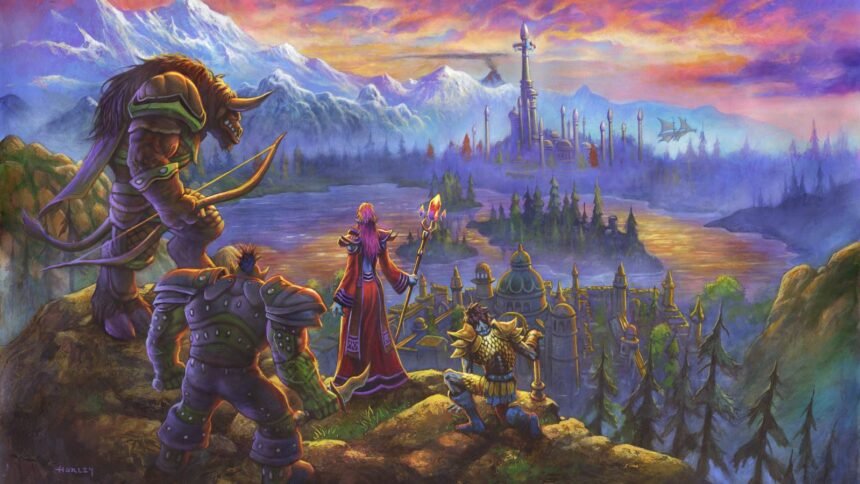
It’s the final day of the beta test for World of Warcraft: Forever — Blizzard’s new reimaging of classic, 2004-vintage WoW — and the servers are buzzing. In the village of Goldshire, a busy scrum of players has gathered, eager to tackle Super Hogger, a new, kaiju-sized boss version of the famous low-level elite gnoll. Outside the gates of the city of Stormwind, there’s a festival atmosphere. Streams of players pour back and forth across the bridge, some of them three times their normal size.
I’m standing amid this hubbub as a silent, invisible observer. The Forever development team has invited me to an in-game tour on the live servers. I’m asked to roll an Alliance character; I hold my nose and do so. The team magically boost me to level 30 (the beta’s cap) and make me invisible to other players and in-game monsters. My guides then teleport me around the game’s vast map, including into new zones not yet unlocked in the beta.
It’s like being invited behind the curtain by the Wizard of Oz. This is no siloed development environment; it’s a live server being enjoyed by hundreds of thousands of players. We walk among them like gods, unsuspected, and cast our eyes over lands they cannot yet see. It’s never occurred to me before that, when I’m lost in an online game world like WoW‘s, its creators might be right there alongside me, silently watching.
My guides for this strange, magical experience are Tim Jones, lead Classic designer, and Kris Zierhunt, principal game designer on WoW: Forever. Both are Blizzard vets. Jones worked in Blizzard’s testing department for a long time before joining the development team of WoW Classic, the 2019 recreation of the game (almost) exactly as it was at launch in 2004, which has since moved through several later expansions. Zierhut, for his part, started working on World of Warcraft all the way back in 2005.

“I was the first designer hired after they shipped the original game,” Zierhut says. “I always loved how it was back in the beginning, but didn’t love as much what it became,” he confesses. He drifted away and stopped playing, but “fell in love with the game all over again” when Classic came around. “It wasn’t specific details, but there was something special about the way the game worked, and just the overall pacing, and the way combat works, the mechanics, everything fit together.”
Zierhut was convinced there was a large audience of players that, like him, “loved not the game as it was, but the way it played,” and would gravitate to new experiences in that style. He dreamed of an alternate-history version of classic WoW that had been given a little more time before being thrust into the world. “Imagine if that team from 2004 — you know, Jeff Kaplan, and Eric Dodds, and Tom Chilton, and Scott Mercer, Pat Nagle, all those people — they’ve given them two more years to develop the game and add more stuff to it and perfect it. What would they have done with the time?”
But the mandate from the Classic community was clear: no changes. The game must be exactly as it was. “The [WoW Classic] team was built to accommodate that,” explains Jones. “The only design direction that really existed was: Don’t change anything.” That even extended to technical anachronisms like the server “heartbeat” that updated the world and players’ combat status every two seconds, instead of continuously. (Forever has no heartbeat tick.)

Zierhut was frustrated: “I was there when we made some of these decisions,” he says. “I had those discussions with Tom and Jeff and Scott. And I knew some places where we made mistakes.” He mentions that tradeskills had originally been intended to be as good a source of powerful items as any other content, but that didn’t pan out because — in his recollection — designers of other content branches, like quests and dungeons, didn’t play fair. “Eric Dodds, the crafting designer, was always very responsible and followed the rules, and other people cheated a little bit.”
When it comes to live games, change has a way of happening whether players think they want it or not. Despite the community’s purism, the WoW Classic team eventually ended up adding some quality-of-life tweaks, like a device that could save world buffs for later, and some non-canon difficulty changes to dungeons and raids. A new mode, Season of Mastery, came from a desire to do harder versions of raids from the original “vanilla” game. At the same time, both the team and the community started fantasizing about what the community called “Classic Plus”: the original game, with new stuff.
The first step toward this came with Season of Discovery, a lightly remixed version of WoW Classic which the team used to explore “the boundaries of what is too much and too far” in terms of changing the spirit of original WoW. The Classic team was still small at the time; Jones remembers that, with next to no art budget, they had to “kitbash,” or cobble together, new assets. But, halfway through the project, the team felt confident enough to pitch something bigger, the real Classic Plus: WoW: Forever. Jones calls it a “permanent home where we could promise players they could live in the vanilla world, and we would continuously expand upon the content in it forever.”

The community had a lot of ideas about what this should look like, but there was “no uniform consensus,” Zierhut says. So the team had to make up its own mind. “Wouldn’t it be so cool if we went to Dalaran, we did Grim Batol, we went to Gilneas, and we went to Mount Hyjal? We’re doing some of those things now, some of those things later. Wouldn’t it be great if all nine of the classes were just as good to play, right? And some of the classes, like Druid or Shaman or Paladin, that had really big problems. What if we had fixed them?”
Improving balance wasn’t just a priority for the classes. Zierhut says the team was focused on balancing gameplay styles, “making exploration gameplay just as valuable as raiding, keeping PvP and raid progression at a more equal pacing and value.” They rejected PvP arenas and flying mounts as potential vibe-killers, not chill or grounded enough. They focused on new social mechanics, like the camping system, and approachability for new players, even if that sometimes clashed with the need to keep the game familiar to veterans. “Usually, working [those conflicts] out leads to a better design than not,” Zierhut says.
While Jones and Zierhut talk me through all this, they teleport me from Goldshire and Stormwind to the pirate port of Booty Bay, where I can watch the sun’s dazzling reflection in the ocean, and to Dalaran, the magical city that was trapped under a purple bubble in the original game because, according to Zierhut, “the dev team did not have enough time to build it.” In Forever, it’s rendered in all its splendor by Andrew Matthews, the environment artist who first built it in the Wrath of the Lich King expansion, and serves as a dungeon and player hub.

The sights keep coming. Riverlands is a new zone inspired by the classic Warcraft strategy games, all pine forests, logging, and stone fortresses. Jones shows me a walled Alliance town, custom built from the models of ruins in the original game. The Forever artists have to get their head around building with tiny polygon budgets, to preserve the game’s look; it’s a challenge, but one the WoW Classic teams are used to. “We’ve been kind of conditioned to this,” Jones says.
By now I’m being teleported to higher-level zones, bereft of players in the beta. The smoldering, volcanic hellscape of Burning Steppes takes my breath away; with Forever‘s new rendering engine, which excels at lighting and environmental effects, it looks unrecognizable from the original, despite sharing the same textures and geometry. Finally, I’m taken to Mount Hyjal, home of the World Tree Nordrassil: a place of legend in Warcraft lore, and a gaping hole in the original World of Warcraft map. Forever fills it with a new adventure zone beneath the towering tree, which can also be seen from other zones, clear across the map.
“We wanted to deliver the game the way you remembered it, not necessarily the way it actually was,” Zierhut says. But remastering the original art assets was out of the question. It would be an unimaginably huge task, and in any case, the team wanted to preserve their distinctive art style. The solution to updating the visuals for a new audience was the rendering engine, with its lighting, shadows, fog, water effects, reflections, and weather. Zierhut thinks it makes the game “spectacularly more beautiful,” and I agree; it’s staggeringly effective.
“It was not actually as trivial as it sounds to do,” Zierhut says. It took an engine team of five or six programmers, plus artists redoing lighting for the entirety of the world, across every zone and at every time of day. One of the lead artists, Matthew Heyman, worked painstakingly from a reference client of the original game, “really making sure that the colors and the warmth of those locations got perfectly captured and then accentuated.”
WoW: Forever seems like a very big deal, both because it enjoyed pride of place at BlizzCon in September, and because it has clearly clicked with players at scale. (Zierhut says the beta has reached “literally tens of thousands” of players who have never played WoW before.) But the sense I get from Zierhut and Jones is that, internally, it still feels a bit like a bootstrapped, skunkworks project, born of pure enthusiasm. And the team is keen to keep it that way; Zierhut says the Forever team is only about 50-60% bigger than the team that built Season of Discovery.
“We think there’s a huge value in having a smaller, tight-knit team, where everybody knows everybody else and there’s a lot of collaboration and cross-pollination from different groups,” Zierhut says. “You know, designers don’t always work on encounters; sometimes they work on quests, sometimes they work on classes. And sometimes an engineer can work as a designer, and a producer can have some input in how algorithms work with engineers, et cetera. So we don’t want to grow too much, but there’s still room to grow before we get too big.”