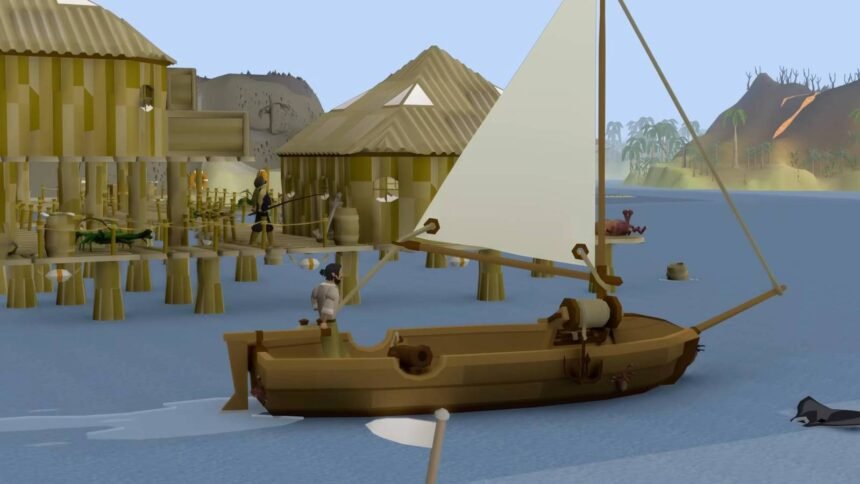
The RuneScape franchise turns 25 this year. Old School RuneScape (OSRS), which launched in 2013 using the 2007-era source code from RuneScape, is at the height of its popularity right now, peaking at 240k concurrent players in 2025. Last year, OSRS got its first-ever new skill in the form of sailing, which brought waves of players (sorry not sorry for the pun) back to the game. Somehow, the team at Jagex implemented water-based movement into a game with a 25-year old foundation, where characters walk using a grid-based system. And it has been a roaring success with players.
Later this year, sailing will expand even further, with multiple quests, a Barracuda Trial, and activities around the Red Reef. At a recent press event to mark the big anniversary, I spoke to OSRS design director Kieren Charles about the ins and outs of sailing and how new skills and mechanics are introduced. For Charles, adding a new mechanic to a 25-year-old game was a formidable challenge, but also an enticing opportunity.

“If the tech doesn’t support it at a fundamental level, it probably doesn’t fit the game that well anyway,” Charles explained. “But with enough work, we can make most things happen, it’s just a matter of time, effort, and energy to do it. Sailing feels very different at the basic level because you’re on a boat and you’re moving a vessel rather than a player. It felt right that it needed work, but at the same time it came out still feeling very old school. You click on a tile, your boat moves in that direction; it feels like a natural evolution of player movement.”
Don’t expect another new skill anytime soon, though. As one devoted player noted on Reddit, “Crazy that a skill I remember talking about with my friends in middle school nearly 20 years ago is finally releasing.” That’s because while it wasn’t in development for anywhere near that long — it initially passed the community vote in August 2023 — it was one of those early-internet era forum rumors that spread like wildfire. For longtime players, to see it finally come to fruition after all this time is incredible.
“We’re not chomping at the bit [to introduce another new skill], we need a break,” Charles said. “We need a rest after what’s been a lot of effort, but I think the players also need a rest from it. I don’t think players want a new skill tomorrow either, because this process has been so collaborative. We’ve gone through so many back-and-forths with players through the early design stages of [deciding] what skill it should be, crafting what sailing should be, and then through development with alphas, betas, and such. So we can’t dominate everything by talking about a new skill immediately because we want to do the collaborative process again.”
Charles isn’t ruling out adding another new skill to OSRS at some point in the future, but notes that the team intends to focus on new additions and improvements to other aspects of the game in the near term.
“The game is more than a sum of its parts. You’ve got all these different aspects: quests, skills, bosses, raids… we need to spend time on all of the above. A new skill probably will happen one day, but what it’ll be and when it’ll be? Who knows. It’ll be driven by when it’s needed and when players shout for it,” he explained. “Right now I’m thinking about the 2026 additions: the raid, new quest, league, all those things, and even beyond that, in 2027 and 2028, there probably won’t be a new skill in that time span. Old School RuneScape has survived and thrived without it, so it’s not something we’re going to shoehorn in. It’ll be something we do because it’s actually going to solve a problem or fill a gap and bring us forward.”
Major updates like sailing can help attract new players to OSRS and retain existing ones. But there’s no denying the MMO space is crowded: World of Warcraft, Final Fantasy XI and XIV, Elder Scrolls Online, Black Desert Online, Guild Wars 2… the list goes on. And it’s fair to say that all of those games look more impressive than OSRS. According to Charles, listening to players and keeping them happy is a major factor behind the game’s longevity, even amid stiff competition.
“Our principles of embracing and protecting players’ progression and achievements, and respecting people’s time feels very much of that [earlier] era of games. We stick by those things, he explains. “We also have a deep understanding of what people want, so we make sure we try and nail it. The game’s just bigger and better because the way we add content isn’t to replace stuff, it’s to literally add new things.
“So whilst on the surface it looks similar, I think that’s important because it’s familiar and pays respect to the past knowledge people already have… but the game’s just fundamentally better now. To a new player who joins today, it’s a better prospect than it was in 2007.”
And for some of us, OSRS’s old-timey graphics aren’t a bug, they’re a feature. Like many players, I drifted back to the game during COVID. All those years later, I was standing atop Lumbridge Castle again, with an inventory full of salmon and two million coins in the bank. (Once upon a time, that would’ve made me rich… these days, not so much). They say you can’t go home again, but in OSRS, you kind of can. Charles says that’s a big part of the game’s enduring appeal.

“The graphics create that sense of familiarity; if you played RuneScape in the past, coming back, it’s an immediate warm feeling,” he explained. “Standing in front of Lumbridge Castle, it looks and feels the way you remember it. That needs protecting, but at the same time, we keep expanding it and it genuinely is better now.”
It’s clear the team at Jagex has figured out how to honor RuneScape’s history while adding modern comforts and innovations. But what does the future hold for OSRS? Unsurprisingly, it’s complicated. But it boils down to finding the right balance between adding new content that feels authentic to the experience and sticking with the tried and true.
“We have hundreds of quests, tens of bosses, we’re implementing our fourth raid. How do you evolve and make that new one special and stand above the rest? I think that’s something OSRS has done remarkably well at,” said Charles. “The other temptation — and this has also been a big learning point — is just to always go bigger and better. How do you beat the last raid or quest? Bigger, better, more features, more complexity. But that’s a mistake. It’s sticking to the simple rules, the same things that made all the original content popular.”
Jagex’s strong relationship with the OSRS community will also play a critical role in the game’s future. “We learn a lot from the players because they tell us what they want. We talk to them regularly, we survey them, they get so many opportunities to tell us where the problems are and what they’re excited by. Then concepts like Leagues, Deadman, and Grid Master allow us to throw all caution to the wind, where nothing matters anymore. We can fundamentally experiment and try something so wild that you would never be able to do in the main game,” Charles says.