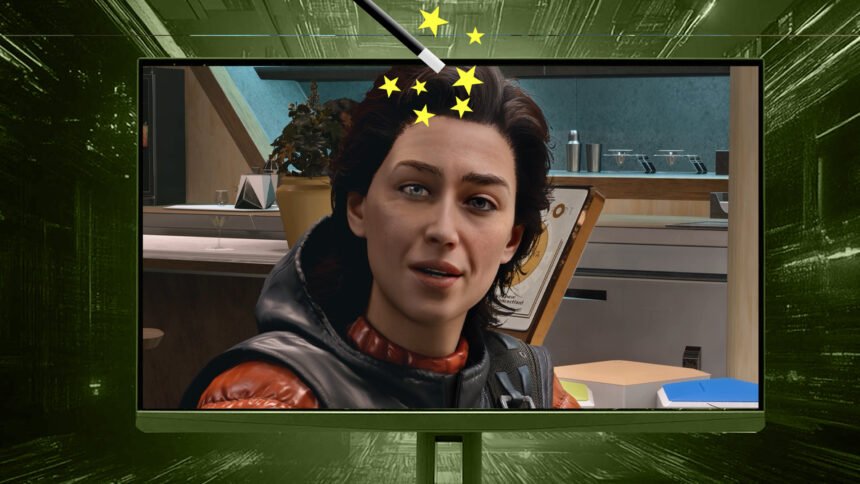
Nvidia DLSS 5 really is as ‘simple’ as some feared, according to the company’s latest info. After being asked to confirm if the new AI image quality-enhancing technology takes into account 3D geometry and other underlying game engine data, the world’s most valuable company admitted that the only input data the new DLSS 5 receives is the final rendered frames from the game and motion vectors that inform the algorithm of the direction the player and objects in the scene are moving.
The reason this matters is that a lot of the criticism of the technology so far has been around how its output has an ‘AI filter’ look to it that is reminiscent of countless other beautification and novelty image manipulation tools. This not only creates a look that can seem a bit off, but many reactions have expressed concern that it betrays the underlying artistic intent of the game – essentially, it’s just DLSS 5 making up stuff. However, if Nvidia’s new technology had been shown to be using deeper in-game assets, it could be argued it’s more sophisticated and artistically grounded than just another AI filter.
Nvidia confirmed these details while replying to questions from tech YouTuber Daniel Owen. After asking GeForce Evangelist, Jacob Freeman, whether DLSS 5 just takes a single 2D frame and motion vectors as its input, Freeman responded, “Yes, DLSS 5 takes a 2D frame plus motion vectors as input.”
Owen also asked whether DLSS 5 is aware of the underlying geometry, textures, and other 3D engine components of the game, to which Freeman replied, “DLSS 5 is trained […] to understand complex scene semantics such as characters, hair, fabric and translucent skin […] all by analyzing a single frame.”
It all goes to paint a clear picture that DLSS 5, while clearly computationally intensive enough to require an entire second RTX 5090 to run smoothly right now, really is just an AI filter, with all the positive and negative connotations that entails. On the plus side it could, in theory, allow it to be retroactively activated on all sorts of older games, with minimal game integration required. However, on the downside, it means the likelihood of inconsistency, wild hallucinations, fundamental deviations from the intended look of a game, and much more could affect the final result.
However, Nvidia did also confirm that while game integration is fairly limited, there are some key developer controls. These consist of: Intensity, which controls the mix of the original output image and the DLSS 5 enhanced image; Color Grading, which provides simple adjustments for saturation, contrast, and gamma; and Masking, which lets the developer completely remove the DLSS 5 result from certain parts of the image.
It remains to be seen just how much Nvidia can fine-tune DLSS 5 to produce less obviously completely made-up, AI-looking results, and, perhaps more importantly, how much it can optimize the technology to run smoothly on single and more modest GPUs. If, in six months time, you can run it on a single RTX 5070 and developers choose to implement it in a subtler way that just feels right, in terms of maintaining a more similar look and feel to the original game, it could be the revolution that DLSS upscaling turned out to be… after many years of trying.