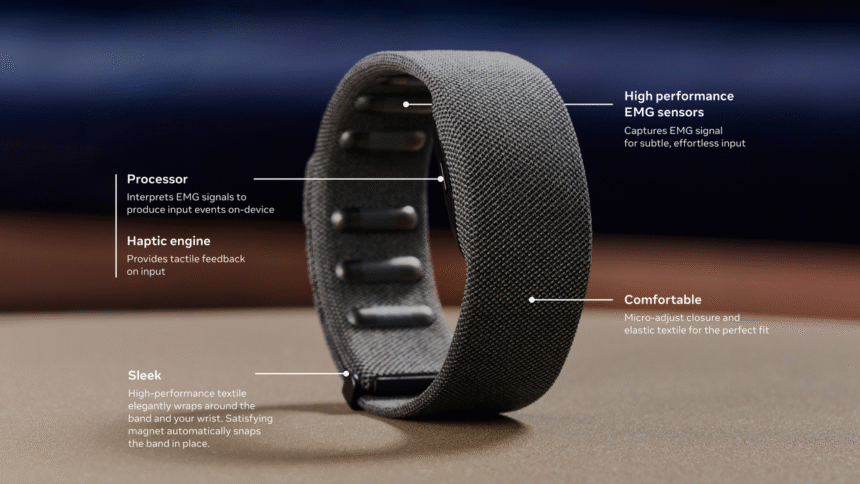
The Utah NeuroRobotics Lab is exploring Meta’s Neural Band as an accessibility tool instead of relying on chin joysticks, head switches, and sip-and-puff controls.
Surface electromyography (sEMG) is already being used to interpret intended hand and finger movements for people with limited mobility, but the technology currently used for research can be bulky, awkward, and relatively expensive. The Neural Band is a slim, stylish mass-produced sEMG wristband bundled with the Meta Ray-Ban Display glasses, making it a great option for future research.
Neural signals captured at the wrist can often be detected even when physical movement is limited or impossible. The research includes participants with spinal cord injuries and motor impairments, exploring how reliably those signals can be translated into digital input across different users. It’s early-stage work, but it targets a long-standing problem in human-computer interaction.
Accessibility Research Areas
The Utah NeuroRobotics Lab develops assistive technologies for people with neuromuscular impairments such as stroke, spinal cord injury, traumatic brain injury, ALS, and limb loss. The possible solutions are quite diverse, ranging from robotics and prosthetic limbs, exoskeletons, adaptive wheelchairs, and adaptive skiing systems that restore mobility or sensation.
The benefits could be substantial. Rather than chin joysticks, head switches, and sip-and-puff controls, the Neural Band could decode a person’s motor intention from nerve and muscle signals to control this technology intuitively. The goal is to leverage the Neural Band to control computers, smart devices, and physical devices, greatly expanding ease and functionality.
The University of Utah partnership is focused on understanding signal quality, consistency, and long-term viability. It’s unclear when or if Meta’s Neural Band will launch as a standalone accessory to connect to computers and assistive devices. However, the data gathered here could influence multiple categories of assistive and adaptive technology in the near future.
Testing this technology with users who have atypical neuromuscular signals could increase adaptability. That kind of robustness benefits accessibility first, but it also improves the experience for everyone else.
The Neural Band Is Already Assistive
We recently covered how Meta’s Neural Band can translate subtle signals into text input, effectively enabling handwriting-style interaction without a physical keyboard. Neural Band handwriting recognition focuses on productivity and AR use cases, but the accessibility implications are already clear.
If a system can detect intent rather than completed physical motion, it could enable users to access a variety of devices to type, navigate menus, and interact with interfaces without touchscreens, controllers, or large hand-waving gestures. Neural input offers a silent, private alternative to voice control, which is important in shared and public spaces.