Verdict
If you have $200 budgeted for your next gaming CPU, buy the Intel Core Ultra 5 250K Plus. Unless AMD dramatically drops the prices of its own competing options at this sort of price range, this is by far the best option overall. That is, unless you prioritize ultra high frame rate competitive gaming, in which case AMD’s X3D chips still hold a strong advantage.
- Matches AMD Ryzen 5 9600X for gaming
- Obliterates AMD competition for multi-thread
- Low power consumption
- Dead-end LGA1851 platform
- Still lags behind AMD X3D chips for gaming
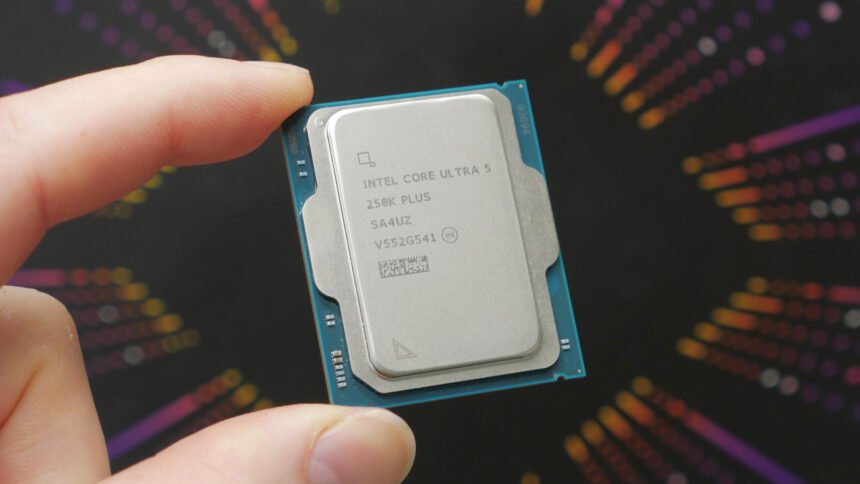
Intel has just dropped two of the most exciting CPUs in recent years, in the shape of the new Intel Core Ultra 200S Plus range. The cheaper of these two new chips is the Intel Core Ultra 5 250K Plus, which comes in at just $199 yet packs performance that puts many more expensive chips to shame. AMD’s latest X3D CPUs still rule the roost for peak gaming performance, but for a more balanced option at a great price, the 250K Plus is hard to beat.
This balance of price and performance immediately lands this Intel chip a place on our best gaming CPU guide as the top option for around $200, and the best for those seeking a CPU that’s a capable choice for gaming, but who also want some serious multi-core processing power for other workloads. Read on to find out exactly which tasks it excels at, which it doesn’t, and for whom it’s best suited.
Specs
| Intel Core Ultra 5 250K Plus specs | |
| P-Cores | 8 |
| E-Cores | 16 |
| P-Core peak boost clock | 5.3GHz |
| P-Core base clock | 4.2GHz |
| E-Core boost clock | 4.6GHz |
| E-Core base clock | 3.3GHz |
| L2 cache | 30MB |
| GPU | Intel Xe, 4 x Xe cores, 4 x RT cores, 2GHz boost clock, 300MHz base clock |
| Hyper-Threading | No |
| Memory support | Dual-channel 7,200MT/s DDR5, up to 192GB |
| PCIe lanes | 24 |
| Base power | 125W |
| Max turbo power | 159W |
| Neural compute engines | 2 x Gen 3 |
| Claimed NPU performance | 13 TOPS |
| Socket | LGA1851 |
| Price | $199 |
As I admit in my Intel Core Ultra 7 270K Plus review, the 200S Plus range isn’t, on the surface, the most exciting pair of CPUs. It seemingly is just part of a refresh of the company’s underwhelming Core Ultra 200 lineup. However, along with ultra-aggressive pricing for these two new CPUs, Intel has managed to squeeze some useful extra performance out of its old design.

Confusingly, though, both the 270K Plus and 250K Plus have seemingly misplaced names. Intel is insisting that the “Plus” part of the name is the thing buyers should focus on, with it denoting CPUs that have been “Pushed further for enthusiasts.” However, break down the numbers in the model name, and they sit in an odd place compared to existing chips.
For instance, the Core Ultra 7 270K Plus has as many cores as the Core Ultra 9 285K and is faster in many instances, yet it has a lower model number. Meanwhile, the Core Ultra 5 250K Plus has more cores than the 245K, as you’d expect, but it’s faster in many instances than the Core Ultra 7 265K.
What ultimately matters, though, is that the Core Ultra 5 250K Plus is an 18-core chip, with eight of Intel’s more powerful P-Cores and 12 of its slightly slower E-Cores. This makes for a total multi-core processing power that vastly exceeds anything AMD has to offer in anything close to this price range. The ~$200 AMD Ryzen 5 9600X has just six cores, and even though each of these can handle two process threads at once – so it looks to your PC like a 12-core chip – its actual performance is nowhere close to a true 12-core chip.

Then there’s the Ryzen 5 7500X3D, which is AMD’s cheapest chip to include its X3D technology, which is so revolutionary for gaming performance. It is fast for gaming, but also has just six cores (that can handle 12 threads), an older architecture, and slower clock speeds than the 9600X, and is priced at $299. Step up to the eight-core Ryzen 7 9700X, and you’re also looking at spending $299 while still being well short of the multi-core performance of this chip. This all means that the 250K Plus should absolutely monster AMD’s competition for multi-thread workloads, such as video encoding.
In terms of comparisons to earlier Core Ultra 200 series Intel processors, the key focus for Intel in re-engineering the two new 200S Plus chips has been on boosting internal clock speeds. So, the die-to-die (D2D) clock speed that determines the pace at which the cores of the chip communicate with each other has been increased by a massive 900MHz.

Meanwhile, the DRAM communication link has been bumped up by 400MHz, which unlocks the ability for these CPUs to support 7,200MT/s memory, up from 6,400MT/s. The all-core clock speeds have improved, too – the all-P-Core speed being up 200MHz, while the all-E-Core speed is up 100MHz. That should mean faster performance in a wider range of situations, compared to having just one core able to run at a high clock speed.
The 250K Plus can fit into any existing B890 or Z890 motherboard using an LGA1851 socket, but you will need to update the BIOS to support the new chips. Like with the 270K Plus, it’s worth noting that Intel hasn’t committed to any future CPUs fitting the LGA1851 socket, though, so future upgrades will be limited to other existing CPUs. In contrast, AMD has committed to at least one more generation of chips fitting in its current AM5 motherboards.
How we test
I’ve subjected the Intel Core Ultra 5 250K Plus to our usual benchmark suite, which consists of a range of gaming tests and some pure CPU performance tests. We also check power consumption and peak temperature of the CPUs while under load. All games are tested at 1080p, as this reduces the load on the GPU, exposing whether the CPU is holding back performance. We also then test at some other resolutions and sometimes at a range of graphical settings, to showcase how this can change the difference in performance across CPUs.
The 250K Plus was mounted in an Asus Z890 TUF Gaming Plus WiFi motherboard and paired with 32GB of (2 x 16GB) G.Skill TridentZ 5 Neo RGB 7,200MHz, CL34 RAM, a 2TB PCIe 5 SSD, and an Nvidia GeForce RTX 4080 Founders Edition graphics card. The system is powered by a Corsair RM1000x Shift PSU, and the CPU is cooled by a Corsair H100x 240mm AIO cooler.

All tests were conducted using Windows 11 24H2, with the motherboard flashed to the latest BIOS version. Comparison Intel LGA1700 CPUs were tested using an Asus Z790 Dark Hero motherboard for LGA1700 CPUs, and an Asus TUF Z890-Plus WiFi was used to test the LGA1851 chips.
Game benchmarks
Cyberpunk 2077 kicks off our game benchmarks, with the first test using the Ultra ray tracing preset that puts quite a lot of demand on the GPU, but still showcases some clear differences between CPUs. In this test, the 250K Plus falls behind the 270K Plus, as expected, and can’t beat AMD’s most powerful X3D chips, such as the 9850X3D, 9800X3D, and 7800X3D. However, it does manage to beat the 265K, despite that chip being retested to use the performance-boosting 200S update released last year. The 250K Plus also just pulls ahead of the Ryzen 5 7500X3D. The margins overall aren’t huge, but it’s a strong start for this $199 chip.

It’s a similar result in our less demanding High detail/no ray tracing Cyberpunk benchmark. Overall frame rates are higher, but the 250K Plus sits solidly middle of the pack, behind the top X3D chips but ahead of the 9600X and 7500X3D.

Our next game test is Total War: Warhammer 3, and, as ever, it shows a very mixed set of results. The more demanding Mirrors of Madness test has a huge number of characters on screen, putting quite a load on the CPU, which is why fast multi-core chips like the 9950X3D come out on top. Meanwhile, mid-range chips with fewer cores can see big drops in frame rate. Intriguingly, though, despite its decent clock speeds and 18 cores, the 250K Plus does struggle somewhat in this test. It’s joint last for average frame rate, some 45fps/50% behind the best. However, it is still on par with the 9600X and 7500X3D.

In the less demanding Battle test, the tables completely turn, with the 7500X3D topping the chart and the 250K Plus coming in second place. The margins are tiny, though, with just 9fps/4% separating all the CPUs.

Moving on to F1 24, this is another test where differences are very small, so the fact that the 250K Plus only comes in fourth from bottom isn’t a big deal, considering the fastest chip is only 5fps/3% faster.

The sternest test for this CPU, though, proved to be our least-demanding game, which is CS2. The 250K Plus still churns out a plentiful 314fps when running at 1080p with high detail settings, but AMD’s X3D chips are upwards of 200fps faster. If you own a 360Hz+ monitor and play CS2, Fortnite, and other competitive games that support ultra-high frame rates, you’ll want to opt for one of those X3D chips instead.

Application benchmarks
Where the Core Ultra 250K Plus really shows why it’s such a compelling option at its price is in workloads outside of gaming, where AMD’s X3D tech isn’t so impactful. In our Cinebench R24 single-core benchmark, the 250K Plus is the fourth fastest CPU we’ve ever tested, coming in just behind the 270K Plus, 265K Plus, and 9850X3D. Meanwhile, the 7500X3D is floundering in last place, and the 9600X is some way behind.

This difference is even more stark when we try a multi-threaded test. In Cinebench R24’s multi-core test, the 250K Plus nearly doubles the score of the 9600X and more than doubles the 7500X3D. It can’t compete with the likes of the 270K Plus and its 24 cores, or the Ryzen 9 9950X3D with its 16 cores (32 threads), but those are chips that cost considerably more than this one.

Power draw
The good news continues when it comes to power draw. Under full load, with all 18 cores at capacity using the Cinebench multi-core benchmark, this chip uses just 239W of power, which is nearly half that of the old 14900K. AMD’s competing options at this price range are even more frugal, but they deliver around half the performance in this test, too.

It’s a similar story when gaming. Our RTX 4080 draws the bulk of the power seen in the chart below, but there’s still a clear difference between the most power-hungry and the most efficient CPUs. The 250K Plus is among the best.

Temperature
An anomalous result in our overall testing of the 250K Plus was that it hit a surprisingly high temperature in our all-core Cinebench R24 test. A mark of 94°C is still well below the rated 105°C limit of this chip, but it’s surprisingly high considering we’re cooling this CPU with a 240mm AIO cooler. You won’t want to skimp on your CPU cooler if investing in one of these chips.

Thankfully, when gaming, the 250K Plus’ temperature is far less extreme. In fact, at just 66°C, it’s the second-lowest temperature we’ve recorded for a modern CPU during gaming, even surpassing the impressively efficient 7500X3D.

Price
The Intel Core Ultra 5 250K Plus price is just $199 at MSRP, making this an incredible value CPU. Assuming you are consistently able to buy it for that price, it’s by far and away the best value option in its price range.
Alternatives
AMD Ryzen 5 7500X3D
If you just want peak frame rates at as low a cost as possible, the Ryzen 5 7500X3D is your best bet, instead of the 250K Plus. It can deliver very fast frame rates in games like CS2, allowing you to make the most of very fast refresh rate gaming monitors to gain every competitive advantage. Plus, it opens the door to being able to upgrade to a 9850X3D or 9950X3D at a later date. It is more expensive, though, and is far slower at basically everything else.
AMD Ryzen 5 9600X
Overall, the 9600X isn’t much of a contender to the 250K Plus. It’s effectively as fast in games as the 250K Plus, but is around half as fast in multi-threaded application workloads. However, it is readily available for under $185. If Intel can’t actually deliver the 250K Plus in decent numbers at its MSRP, it could still be the best buy for gaming at under $200. Plus, like with the 7500X3D, it gets you started on AMD’s AM5 platform, which the company has committed to support for at least one more generation of CPUs, making for an easy future upgrade.

Verdict
Intel really has set the cat among the pigeons with the launch of the 270K Plus and 250K Plus. AMD is going to have to respond with some price cuts on key products, such as the 9700X, 9600X, and 7500X3D, as, right now, these new 200S Plus chips are the kings for their price range.
The 250K Plus absolutely obliterates the competition from AMD when it comes to multi-threaded performance, making this chip fantastic for getting some serious work done. Meanwhile, its gaming performance is solid enough to not significantly hold you back, which simply wasn’t the case when the Core Ultra 200 series launched with the 265K. That chip has also seen significant performance improvement over time, but the 250K Plus is faster in some instances, and far more competitively priced.
The only caveat here is if you have a very high refresh rate monitor and want to play competitive games. AMD’s X3D chips are still the clear choice in this scenario, with huge gains in peak frame rate to be unlocked with those chips. This will only matter if your monitor can hit well over 360Hz, though. If 240Hz/fps is enough for you, this CPU delivers the goods.