More than two million people have played Dispatch, the narrative-driven superhero game from AdHoc. That’s countless millions of choices made across each run, with dozens of variations and scenarios only a handful of people might’ve seen so far. Now that the finale’s wrapped up and people have spent more time with the game, gamexplore asked Dispatch narrative director Pierre Shorette and creative director Nick Herman which choice stats surprised them the most. It wasn’t whether folks cut Coupé or Sonar (though they were not expecting more people would cut Sonar than Coupé, when content creator Charlie “MoistCr1TiKal” White voices the former) or which romance interest they opted for. The biggest surprise was just how damn nice most of you are being.
“Very often, people pick the most boring thing,” Shorette jokes. “Everyone wants to be nice, [so] a lot of times we’re trying to keep it entertaining for them. [But] I’m so disappointed in so many choices.”
Shorette admits some of the incongruity between what AdHoc hoped for (a broad range of good, bad, and middling outcomes) and what players chose (almost always the polite choice) comes from challenges inherent in making games like Dispatch. The protagonist here has a distinct personality that may be out of sync with yours, and he’s not just here as an empty vessel for you to fill, but that’s on purpose.
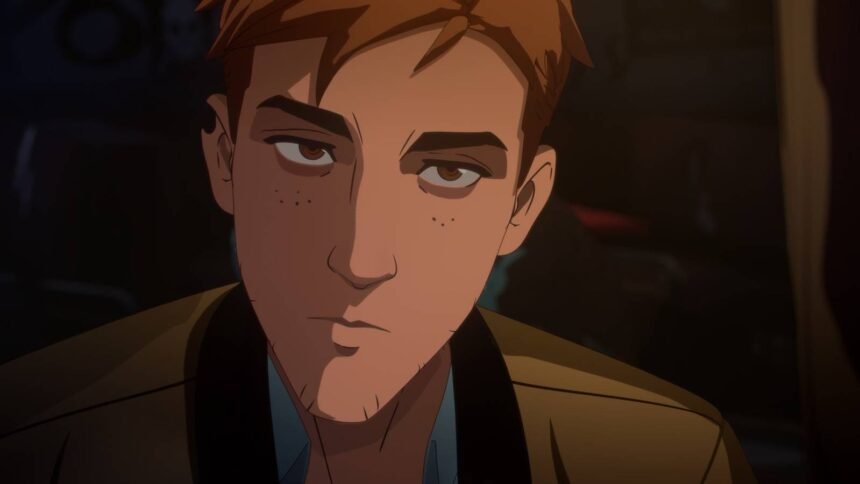
“Robert is a character,” Shorette says. “You roleplay as Robert, and this is going to piss some people off, but this isn’t about you. It’s about you and Robert, about you roleplaying as this type of person.”

Robert’s “type” is generally decent and friendly. He jokes, he flirts, he wants the best for almost anyone he meets. It’s easy to just keep that attitude going in each episode. But he doesn’t have to be that way, nor does he have to do the thing you would do in real life.
“You can express what version of Robert you want,” Herman says.
One scene in episode four stands out for Herman and Shorette. Robert helps Mandy, aka Blonde Blazer, fix her dress before she heads out for a date with her alien boyfriend Phenomaman. A common trend the team noticed is that players had formed strong opinions about Mandy by this point, for whatever reason, and are firmly on Invisigal’s side. When Mandy asks Robert how she looks, you have the option to be kind, helpful, or rude and dismissive. No rewards for guessing what the most popular choice is.
“You talk a big game on stream, and then the second you get the opportunity, you do the boring thing,” Herman laughs.
This scenario is particularly surprising to the team, as players tend to form unreasonably antagonistic attitudes toward Blonde Blazer. Shorette says a sizeable number of people play Dispatch and expect Blazer to be secretly horrible, that she’ll resent Robert for choosing Invisigal, or that she’s following some secret corporate agenda. For a variety of reasons, from the prevalence of cynical superhero media like The Boys to the general level of cynicism in society more broadly, they struggle to imagine someone just being decent. Yet they still don’t act on those beliefs or assumptions, wrong as they may be, which Shorette sees as a missed opportunity for some deeper self-reflection.
“These games are a chance to explore the versions of yourself that maybe aren’t really there,” Shorette says. “Maybe you are too afraid to say the thing or make the joke or to step up and defend yourself in real life. But I think that if we give you these little practice runs, maybe next time, you can.”

There’s also a more practical issue: People aren’t seeing a lot of the content AdHoc put into Dispatch. Shorette uses one early example where Golem, one of Robert’s team members, is behaving atrociously. You have the option to boot him out of the conference room during a meeting or try to make peace and offer him a chair. (Yes, Golem can’t fit in the tiny chair, another case of Robert’s methods and yours not aligning, even if the intent is the same.) Most people are being nice and only see that version of Robert — without knowing what happens if you kick him out. (The answer is that Robert establishes a bit more authority, and Golem gets pissy and refuses to take orders during the next shift.)
There’s a not-insignificant collection of other examples, but the one that’s shaping how a lot of people see the game involves romance choices. Namely, the fact that most critics and players don’t realize Dispatch lets you ignore romance altogether.
“You don’t have to kiss Mandy ever,” Herman says. “Invisigal might fall for you, but you can say ‘no,’ you know.”
Invisigal’s story has multiple endings as well, and her “good guy” outcome isn’t tied to romancing her. Instead, it evolves from choices you make supporting her as a person, not as a love interest, and even the jobs you send her on during each shift play a role in how she eventually sees herself. You can fall in love with her and still have Invisigal end up a villain, support her without being her lover — there’s a lot more going on Dispatch than most people have realized yet, Herman says. Even some late-game scenes play out with significant differences depending on the choices you made earlier and who is or isn’t around as a result. You just have to actually make choices that get you out of your comfort zone first.
AdHoc admits that some of these issues may stem from design choices, and Shorette says the team is considering an update to give players a clearer idea of a choice’s immediate consequences. Other issues are built too deeply into the game to fix, though, like making Invisigal so present in Robert’s daily life. Shorette and Herman say they realize it was a mistake to keep Mandy so distant and to not let players see her on-screen as often, which makes them naturally more inclined to form an attachment with the latter. So while they’re disappointed that folks don’t give Blonde Blazer more of a chance, they do understand.
Whether AdHoc gets a chance to put these lessons into practice is still up in the air. Shorette and Herman would love to work on Dispatch season two, though they said there’s no guarantee they can yet. Hence why they adopted a “burn the boats” mentality for Dispatch‘s big finale in case this was the series’ first and last hurrah.