Verdict
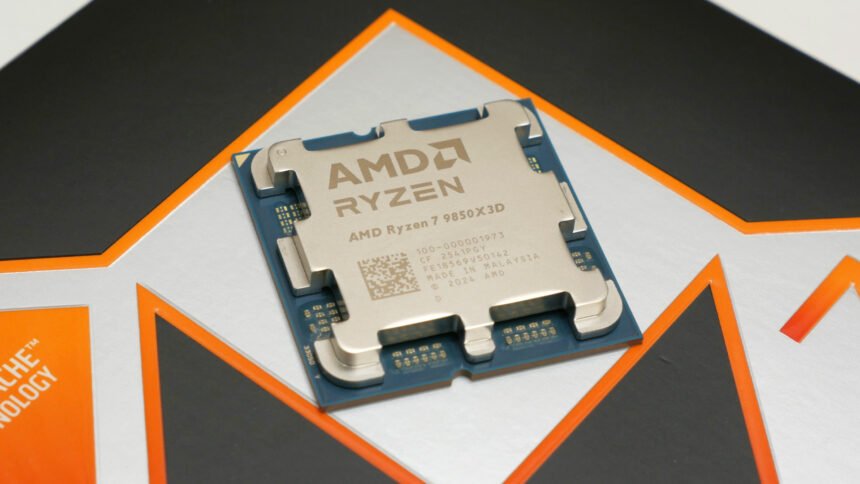
AMD takes the gaming performance crown again, with the AMD Ryzen 7 9850X3D continuing the company’s run of “fastest gaming CPU in the world” titles. The performance uplift isn’t always huge here, but it’s definitely noticeable, and only comes with a small bump in price. The 3D V-Cache tech in this CPU also helps reduce the impact of slower RAM, potentially saving you what would currently be a costly RAM upgrade. Still, this is an expensive CPU for just eight cores, so it isn’t such an obvious choice unless gaming frame rates is your sole focus.
- Chart-topping gaming performance
- Solid overall performance
- Impressively cool-running and power frugal
- Only eight cores
- Only slightly faster than 9800X3D
- Expensive
With the AMD Ryzen 7 9800X3D having sat at the pinnacle of the gaming CPU mountain for over a year now, it was about time AMD really shook things up and released a barnstorming new processor to show it’s still the CPU maker to beat. But instead, we got the AMD Ryzen 7 9850X3D, an identical CPU but with a peak clock speed that’s just over 7% faster than before. And, you know what, that is enough, and it still makes this the top choice for PC gamers.
What makes this the new best gaming CPU around is not just that AMD’s latest Zen 5 processor is a tiny bit faster than before, but that AMD has only charged a teeny weeny bit more for that extra speed. Many gamers won’t see the benefit, but if you absolutely want the best chip to maximize your frame rate, this is it, and you won’t be paying a wild markup compared to slightly slower options.
Specs
| AMD Ryzen 7 9850X3D specs | |
| Cores | 8 |
| Threads | 16 |
| Peak boost clock | 5.6GHz |
| Base clock | 4.7GHz |
| L2 cache | 8MB |
| L3 cache | 96MB (32MB on-chip, 64MB 3D V-cache) |
| TDP | 120W |
| Architecture | AMD Zen 5 |
| Socket | AMD Socket AM5 |
There is very little to unpack when it comes to the specs of the AMD Ryzen 7 98050X3D. It really is just the Ryzen 7 9800X3D with a slightly higher clock speed. Both chips have a base clock of 4.7GHz, but whereas the 9800X3D tops out at 5.2GHz, the 9850X3D pushes on to 5.6GHz. That’s it. That’s the difference: a 7.6% increase in peak clock speed.

While that might not sound like much of a change, the 7.6% clock speed increase has at least the potential to make for a fairly direct increase in frame rates in situations where a game is strongly single-thread CPU-limited. Games such as CS2 that are run with basic detail settings at hundreds of FPS could see notable gains.
As for the rest of this chip’s specs, the Ryzen 7 9850X3D is an eight-core CPU meant for use in AM5 motherboards alongside DDR5 memory, and it’s based on AMD’s Zen 5 architecture that debuted in August 2024. Under its heatspreader cover, it uses a single eight-core chiplet die (CCD), which is the part that does all the processing, alongside an IO die, which deals with functions such as communication with the PCIe bus and USB devices.
Crucially, underneath the CCD is a second slice of silicon containing 64MB of extra cache. It’s this extra 3D V-Cache chip that gives this chip the X3D part of its name, and which makes it so good for gaming. The extra stash of fast cache means the CPU doesn’t need to access relatively slow RAM as often as conventional CPUs.

Not only can this generally benefit frame rates, but it can also be beneficial for systems that have slower RAM, as the extra cache reduces the CPU’s dependence on having fast memory access. That makes these chips potentially ideal for anyone stuck with slightly older, slower DDR5, but who doesn’t want to pay the currently hugely inflated prices for a RAM upgrade.

As with other recent AMD CPUs, and unlike Intel’s current Arrow Lake CPUs, such as the Core Ultra 7 265K, the eight cores in this CPU can each process two app threads at once (via a technique known as Simultaneous Multi Threading [SMT]), effectively making this CPU appear to your system like a 16-core processor and speeding up multi-threaded tasks. It’s not as powerful as a true 16-core chip, but it’s a useful speed bonus compared to a strict eight-core/eight-thread CPU.

This relatively modest core count means this isn’t an absolute multi-thread processing monster, but it also comes with the advantage of a relatively low power consumption. Rated to just 120W thermal design power (TDP), it will be quite happy with the “best for most” choice on our best CPU cooler guide, which is the $35 Thermalright Peerless Assassin 120 SE ARGB.
How we test
I’ve put the AMD Ryzen 7 9850X3D through our usual benchmark suite, mounting it an Asus X870E ROG Crosshair Hero motherboard. All the CPU test rigs use the same 32GB of (2 x 16GB) G.Skill TridentZ 5 Neo RGB 6,000MHz, CL28 RAM, as well as a 2TB PCIe 5 SSD, Corsair H100x 240mm AIO cooler, Corsair RM1000x Shift PSU, and an Nvidia GeForce RTX 4080 Founders Edition graphics card.

All our tests were conducted using Windows 11 24H2, with the motherboard flashed to the latest BIOS version. The comparison Intel CPU tests in the graphs below were conducted using an Asus Z790 Dark Hero motherboard for LGA1700 CPUs, and an Asus TUF Z890-Plus WiFi was used to test the LGA1851 chips.
Game benchmarks
Diving right into what is basically the de facto standard game test of our time, in Cyberpunk 2077 this CPU leapt straight in at top spot, beating the 9800X3D by a 3%. This was with the game running at 1080p using the ray tracing Ultra preset, and with DLSS upscaling set to Quality. It’s a small lead but a larger margin than the 9800X3D enjoyed over the 7800X3D, and it equals the advantage that chip had over the 9950X3D.

Meanwhile, the closest Intel competitor remains the now three-year-old Core i9 14900K, with the latest-generation Intel Core Ultra 265K lagging well behind. Crucially, while we are only running at 1080p, this is still a mostly GPU-bound test, thanks to the use of ray tracing, so these results aren’t some extreme CPU-bound outlier.
In fact, the gap closes slightly when we look at our test without ray tracing and using just the High quality preset, although this time we aren’t engaging DLSS. Here, the frame rates all jump up to over 200fps, and the gap between bottom and top is just 13%, or 27fps. Crucially, the 9850X3D remains on top, with all of AMD’s X3D chips dominating the top of the chart.

Our next game test is Total War: Warhammer 3, and here we see a quite topsy-turvy set of results. In the more demanding Mirrors of Madness test, the 9850X3D comes up with a decent enough lead over the 9800X3D, which is closely followed by the 9950X3D. There’s then a notable step down to the 14900K and the rest of the pack.

However, in the less demanding Battle test, the 9850X3D strangely lags behind, even if the margin is just 10fps, or 5%. In fact, this whole chart is rather peculiar, as the 14900K sits right at the bottom of the chart, yet the 9950X3D and 9800X3D still perform solidly. Overall, though, the margins are fine enough that most gamers shouldn’t quibble over this test.

Moving on to F1 24, and we again see the 9850X3D slip slightly, as it comes in just behind the 9950X3D, by a single frame per second, or less than 1%. Otherwise, it’s a tight run race, and the 9850X3D is the second fastest CPU we’ve ever tested in this game, though again it’s only a single fps ahead of the 9800X3D.

As for an ultra-high frame rate game, such as CS2, the 9850X3D pulls out a noticeable lead over the 9800X3D, with the former’s 567fps being 5.8% faster than the 536fps of the 9800X3D. It’s unlikely to mean the difference between winning and losing most rounds, but could just sneak that tiniest advantage once in a while.

Application benchmarks
Looking at application benchmarks, the 9850X3D delivers slightly stronger performance than I expected in the Cinebench R24 single-core test. It pulled out a 5% lead over the 9950X3D and a full 9% over the 9800X3D, which are both results that are ahead of the clock speed increase of this CPU over those models.

As we’d expect, though, the 9850X3D is far less of a heavyweight when it comes to multi-threaded workloads. Its eight cores simply can’t compete with the 16 of the 7950X3D and 9950X3D or the 20 cores of the Intel Core Ultra 265K. As we’ve seen above, this has minimal impact for gaming but, if you’re regularly using apps that do some serious number crunching, such as encoding video, running local AI, or the like, there are plenty of other more powerful choices.

Power draw
A last-minute failure of my power meter means I only have a fresh result for the 9850X3D, with our other CPUs tested using a different meter. As such, the numbers seemingly don’t quite line up, as I have the 9850X3D recorded as drawing slightly less power than the 9800X3D, which doesn’t make much sense. The results were very close, though, so still made for a useful comparison. We can see below that the 9800X3D and 9850X3D draw very similar amounts of power during a Cinebench R24 multi-thread test.

Likewise, during a Cyberpunk test run, the two chips were very close. This is definitely a reasonably power-hungry chip compared to some of AMD’s slightly slower Zen 5 offerings, but it’s considerably more efficient than Intel’s fastest competing chips.

Temperature
As we’ve come to expect from AMD’s eight-core X3D CPUs, the 9850X3D is relatively easy CPU to tame, when it comes to heat. Even with all its cores maxed out during a Cinebench R24 run, it only hit 84°C, equalling the 9800X3D. This is with a fairly powerful 240mm AIO cooler, but is also with a sustained all-core load. When we look at a slightly more realistic gaming test, this chip really shows how efficient it is.

While playing Cyberpunk at our 1080p Ultra ray tracing settings, this CPU hit just 69°C. That’s a couple of degrees hotter than the 9800X3D but still plenty manageable and far below the ridiculous temperatures of Intel’s fastest gaming chip, the 14900K.

Price
The AMD Ryzen 9 9850X3D price is $499.99 at MSRP, making this an expensive eight-core CPU. For context, the AMD Ryzen 7 9700X’s launch MSRP was $359.99. However, because X3D is so effective for gaming, and the 9850X3D is the fastest overall gaming CPU out there right now, it understandably comes at a premium.
Crucially, while the 9800X3D’s price has dropped as low as under $400 during some offers, and has regularly been under $450, its MSRP is still $479, so the 9850X3D only has a $20 (or 6.4%) premium over that chip. In fact, that’s actually ever so slightly lower an increase than the 7.6% clock speed boost you get with this chip over the 9800X3D, making it technically better value based on MSRP. However, the real-world effect of that extra clock speed isn’t always obvious, and the 9800X3D can be had for slightly below MSRP.
Alternatives
AMD Ryzen 7 9800X3D
If you’re looking for nearly the best, but don’t want to pay that last extra premium for the very latest and greatest, the 9800X3D is still the CPU to get. Right now, it’s not hitting the low prices we’ve sometimes seen over the past year, but it’s still readily available for $469. For the sake of sub-3% frame rate gains in most games, I’d recommend most gamers save their $30 and put it towards another part of their system.
Read our full AMD Ryzen 7 9800X3D review.

Verdict
AMD has done it again with the Ryzen 7 9850X3D. The gaming CPU crown remains firmly in place upon an AMD-branded processor, ensuring you’ll get the highest frame rates possible from your graphics card. So, if you simply want the best, it’s the one to get.
Along with chart-topping gaming performance, the 9850X3D follows in the footsteps of the 9800X3D, 7800X3D, and 5800X3D before it, also offering a great balance of all round performance, thanks to packing in eight CPU cores. That’s enough to make most multi-tasking a breeze and bring a decent dose of speed to multi-threaded workloads. Most games still don’t need eight cores, so in some ways this chip is overkill, but at least you don’t have to fork out for a flagship, monster, many-core CPU like the 9950X3D or 14900K.
Still, the 9850X3D is undeniably pricey, and its advantage over the 9800X3D is often vanishingly slim, so the older chip is the better buy for most, even if the price difference is only small. It’s also worth bearing in mind what types of games you play and how much you tend to find your games are GPU-limited. If you’re struggling to hit 30fps while trying to play at 4K, spend your money on a faster GPU, but if you’re already hitting 100fps+ while also getting stuttering or inconsistent frame rate, a faster CPU could be the cheaper way to unlock a smoother experience.