The machine before me looks like Frankenstein’s homebrew version of Guess Who. Its main panel is composed of three rows of portraits. Some show men in 1930s suits, others women in flapper dresses, still more are simply blue people-shaped silhouettes. Below each portrait is a simple on/off switch. To the left of the portraits is a slide selector alongside a list of locations. Above that is a radio dial and filament lights indicating a current setting. At the bottom of the machine is a readout displaying a cryptic code ’01-QU-1-11′. And, to the right, most enticing of all, is a big red lever.
It may not be much to look at, but calibrated correctly, this machine lets me hear the dead. It’s a good thing, too, because there are plenty of corpses at Galley House.
I will try to avoid any spoilers and only use screenshots from the games opening half hour. Though, as with other deduction games such as Her Story and TR-49, The Incident At Galley House is a game best played blind. If you like those games, I can recommend this, though I have some reservations you may want to read after playing through the game for yourself.
The Incident At Galley House opens with you arriving at a boarded up manor. An aged newspaper in your bag reveals that on a March evening in 1936, multiple people staying in the home turned up dead. While some showed an obvious cause of death – a gunshot here, a heavy fall there – for most of the victims it remains a mystery.
The device you’ve brought to Galley House, the Guess Who machine, allows you to observe the events of that night. Though, it’s not as easy as switching it on and watching the deaths unfold. You must tune into a scene using key pieces of identifying data: its time code, location, and, most importantly, who was present.

Turning the radio dial on the machine sets the time code, the left-side slider sets the location, and flicking portraits on and off locks in who you think was there. Settings configured, you drag up the red lever and, if your deductions were correct, you’re rewarded with a fly-on-the-wall view of the scene. Overhearing the dead, you can begin to piece together what happened on the night and listen out for clues to identify other scenes. Does one of the characters say where they were before? Or say who they were with? Or where they’re going? All of this is useful information.
Like Her Story and TR-49, The Incident At Galley House is a deduction game. One of the ones best played with a cup of tea to one side and a notepad you’re prepared to desecrate with scribblings you wouldn’t want a loved one to stumble upon on the other. Scribblings like ‘Murder?’, ‘Moustache did it’, ‘Murder!’, ‘Did the piano do it?’, ‘Not murder?’, ‘Are there olives in the pantry?’, and a web of names, their links labeled with pencilled in relationships, some crossed out, others added again.
As you learn more about the cast, their reasons for being at Galley House that night, and where they are at each moment in the timeline, you’ll build a picture of events. It becomes easier to identify gaps, such as who is missing from a scene and where they might be in the house, giving you potential scene codes to enter into the machine. Deduce hard enough and you might even find out why they’ve all been offed…

The Incident At Galley House started life as last year’s Type Help, a text adventure by William Rous that remains freely available on Itch.io. While much of the story and the puzzles remain the same, its reimagining as a visual game by The Roottrees are Dead developer Evil Trout does much more than simply add pictures to the words.

In Type Help, much of the administration of collating evidence falls to you. You need to make notes of the location designations, character IDs, and the event timeline in a notebook or, more likely, in a spreadsheet outside of the game, just to keep track of where every character is at any point in the evening. While Type Help appears as a command line interface, and so this off-screen labour is both engaging and keeping with its stylings, it is easy to make a mistake in your notes that then trickles out into all your workings. For some players that may be part of the fun, but it can also become frustrating.

In the Incident At Galley House, much of that administration is automated on a second in-game computer terminal. You can view a timeline of events, which you can click into to see a list of scenes taking place at that moment; you can click on a character and see a time-ordered list of the scenes in which they feature, making it easy to see gaps you’ve yet to fill; and you can click on locations to see what scenes take place there. It’s a clever change and one that lightens the mental load, letting you focus on the story instead of updating your spreadsheet.

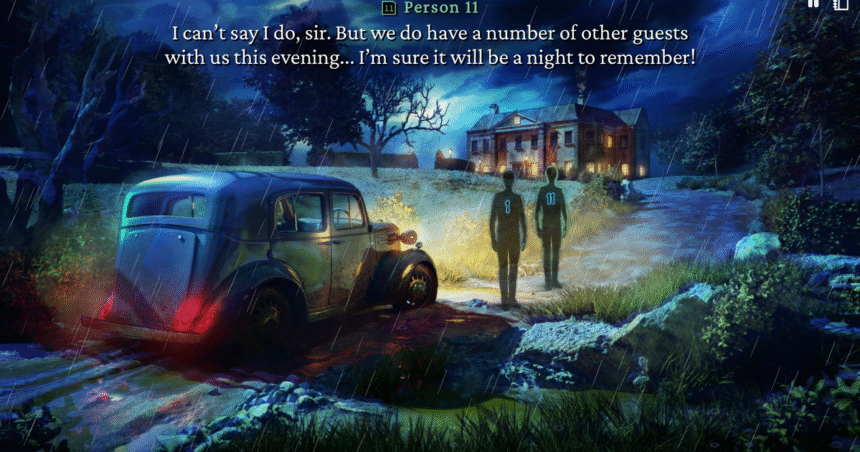
Another gain in the transition from text adventure to something more akin to a visual novel, is that rather than just read the transcriptions from scenes, you also now hear and see them. Though this does involve some additional puzzle solving. When you first arrive at Galley House, the scenes are played out by a cast of silhouettes. It is only when you edit their character profiles and assign a victim photo lifted from the police report that you see characters appear in the scenes. With the photos unlabeled and only cursory details about the state the body was found in, this is a welcome additional thread of deduction layered on top of Type Help.
Also new is an optional hint system which highlights scenes with dangling threads linking to other scenes. Starting as gently cryptic, you can ask for clearer advice if needed. And a final piece of help comes from the event timeline in the second terminal, which flags how many clues to unfound scenes are left to be discovered. This more overt aid can be switched off in the options menu.
A second word of warning. I’m writing around the story at the heart of The Incident Of Galley House, focusing on the mechanics of puzzle solving and what it’s gained in its reimagining because it is that central mystery which is the reason to play. If you’re intrigued by the game, at this point I’d like you to leave knowing how it works but not what you’ll discover. I’m not planning on revealing the story in my closing paragraphs, but I’m going to talk about its structure and deduction games more generally, and it may be something better read after you’ve experienced it for yourself.

I found the first hour of The Incident At Galley House enthralling. As I deciphered the workings of the machine and began to discover new characters and locations within the house, I found thread after thread to be followed through the events of the evening. Each correctly deduced code gave me a thrill. My notepad filled with scribbled clues to follow up, as there were so many they threatened to be forgotten. I hopped about the timeline trying to grasp the contours of the night, unsure if I had found all of the characters. But then that flurry petered out and the action shifted to become more methodical and, at times, tedious.
Once you have worked out the dimensions of the mystery by locating all the rooms and meeting all the characters, you are now focused on tracing their movements across the evening to make sure there is no point in their night you’ve missed. There thrils shifted for me to feel more like box-ticking than mystery solving. It doesn’t help that while some of those scenes open up new lines of inquiry, several are simply a character stood on their own, talking to themselves or lying in bed.
This is a structural issue I’ve run into in most deduction games. TR-49, Telling Lies, and, even The Return Of The Obra Dinn hit dips where I felt I was just crossing off a to-do list. It may just be an intrinsic challenge of the genre.
Happily, The Incident At Galley House has a clever device that reignites that early excitement and mystery in the late game, but there were a few hours in the middle where it lost its lustre.