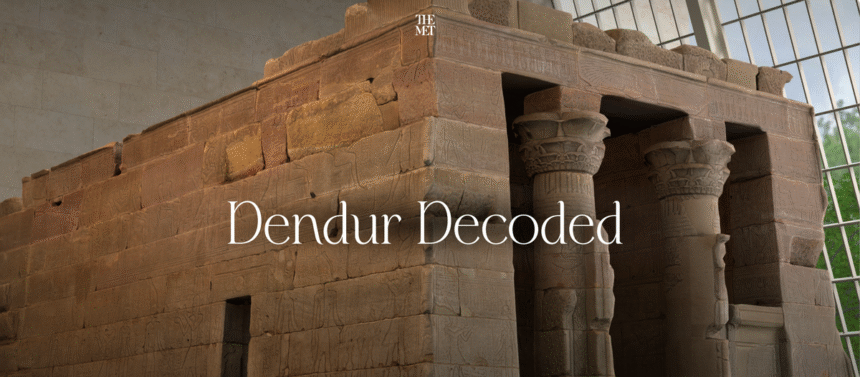
I visited The Metropolitan Museum of Art last year with my daughter as part of a trip to New York City to celebrate her birthday. Like many visitors, I spent time exploring the museum’s vast collection, including the Temple of Dendur, the ancient Egyptian monument that has become one of The Met’s most recognizable attractions.
What I didn’t fully appreciate at the time was how the temple arrived in New York City. Surrounded by crowds and moving between galleries, I never stopped to consider that the massive structure before me had been carefully dismantled stone by stone in Egypt and reconstructed inside the museum.
It wasn’t until I explored Dendur Decoded, a new immersive experience from The Met, that the story truly clicked.
Developed in partnership with immersive exhibition platform Atopia, the immersive exhibit is available as a free VR experience through the Atopia app on Meta Quest headsets, while also being accessible through a standard web browser. It allows visitors to explore the Temple of Dendur from anywhere in the world through interactive storytelling, historical context, and digital reconstruction.
That deeper understanding was exactly what The Met hoped to achieve.
“We have been telling the story for a long time about why it was at The Met, and it just isn’t clicking for a lot of people,” Brett Renfer, Project Manager for Emerging and Immersive Technology at The Met, told UploadVR. “Let’s bring it to a new medium. Let’s do a lot more showing rather than telling.”
Why Dendur?
The Temple of Dendur wasn’t chosen at random.
According to Renfer, the monument consistently generates some of the most common questions visitors ask at The Met. Many wonder whether the structure inside the museum is real. Others question how an ancient Egyptian temple came to reside in New York City.
Those questions helped make Dendur a natural starting point for The Met’s first internally developed immersive experience. Rather than asking visitors to absorb the temple’s history through exhibit text and displays, the project places them inside the story itself.
For The Met, the project serves a broader purpose than visitor engagement alone.
The same digital assets used to create the immersive experience can also support conservation, research, documentation, and future interpretation of the collection. Renfer described the work as having multiple lives, serving both public-facing experiences and the museum’s long-term preservation goals.
The Temple of Dendur, The Met, New York City
Building The Met’s First Immersive Experience
While Dendur Decoded is delivered through the Atopia platform, Renfer said The Met played a central role in shaping both the experience and its educational goals.
The project began as an exploration of how the museum’s growing archive of 3D assets could be used in new ways. Renfer created early prototypes using The Met’s existing scans to demonstrate how visitors might interact with digital representations of artifacts and environments in immersive spaces. Many of those assets were created through photogrammetry and other 3D capture techniques originally developed for conservation, research, and documentation purposes. In the case of the Temple of Dendur, The Met’s imaging team combined more than 28,000 photographs to create a detailed 3D model of the monument.
“We had never done an in-house VR project,” Renfer said. “We did all the content and the concept and all the scanning.”
3D scanning the Temple of Dendur, The Met, New York City
Atopia ultimately became both a development partner and distribution platform. According to Renfer, the collaboration combined The Met’s curatorial expertise and archival research with a team that brought experience from game development and immersive design. The two organizations worked together to translate historical research, photography, audio, and 3D scans into an experience designed specifically for virtual environments.
The collaboration also extends beyond Dendur Decoded. The Met’s second immersive experience, Oceania: A New Horizon of Space and Time, takes a different approach. Rather than recreating a physical museum space, it places visitors inside a purpose-built immersive world inspired by the cultures and landscapes of Oceania, connecting artworks to the broader geographic and cultural context from which they emerged.
The partnership also reflected a practical reality of museum technology projects. While The Met maintains extensive 3D capture programs for conservation and research, those highly detailed scans are not automatically suitable for real-time rendering in VR. Atopia’s team helped optimize and adapt those assets while preserving their historical accuracy.
For Renfer, the project was as much about building institutional knowledge as it was about launching a single experience.
“We need to build this tacit knowledge,” he said, describing the project as an opportunity to learn how audiences engage with immersive content and how the museum might approach future initiatives.
Trailer: Dendur Decoded
Why The Met Prioritized Reach Over Hardware
One of the more surprising lessons from the project had little to do with virtual reality itself.
While Dendur Decoded and Oceania: A New Horizon of Space and Time are available on Meta Quest headsets, The Met deliberately avoided treating VR as the primary destination for the experiences.
Instead, the museum focused on accessibility and reach.
“We need to pick the platform that just has the biggest reach,” Renfer said. “A lot of people have been like, ‘Don’t you think the content was better for the Vision Pro audience?’ I hear you, but we were doing our first thing and then there’s the reach kind of thing.”
That decision appears to have been validated by the data.
According to Renfer, roughly 85% of traffic to the experiences comes through web browsers rather than VR headsets.
For a project built around immersive technology, the numbers reinforce one of The Met’s core goals: reach. While VR headsets offer a uniquely immersive way to experience the content, web access makes it possible for far more people to engage with it.
The web-first approach also aligns with The Met’s broader mission of accessibility. Renfer said the museum wanted to ensure the experiences could reach students, educators, and curious visitors regardless of whether they owned a headset.
That philosophy also influenced the design of the experiences themselves.
As someone who spends a significant amount of time in VR, one of the first things I noticed was how approachable the controls felt. Navigation options were clearly explained, interactions were straightforward, and the onboarding process never assumed prior VR experience.
Examples of UI/UX in Dendur Decoded (no audio)
According to Renfer, that simplicity was intentional.
The Met conducted extensive user testing throughout development and embraced a universal design approach aimed at welcoming newcomers without creating barriers for more experienced users.
“We really believe in universal design,” Renfer said. “Something that’s good for helping any user into it is good for everybody.”
The result is an experience designed to welcome newcomers without alienating more experienced VR users.
The experiences also make room for quieter moments of reflection. In Dendur Decoded, visitors eventually find themselves alone with the temple beneath a moonlit sky, while Oceania: A New Horizon of Space and Time concludes with a peaceful ocean vista at sunset. Neither sequence is primarily focused on teaching historical facts. Instead, they encourage visitors to pause and absorb what they have just experienced, using atmosphere and presence in ways that traditional exhibits cannot easily replicate.
Trailer: Oceania: A New Horizon of Space and Time
Taking The Long View
Unlike a startup chasing the next hardware cycle, The Met approaches immersive technology with a very different timeline.
The museum’s 3D imaging teams are already creating detailed digital records of artifacts and environments through photogrammetry and laser scanning, often for conservation and research purposes rather than public-facing experiences. Those digital assets can then be repurposed for projects like Dendur Decoded while continuing to serve archival functions behind the scenes.
That long-term perspective also influences how the museum evaluates emerging technologies.
During our conversation, Renfer discussed growing interest in technologies such as Gaussian splats, which have become increasingly popular for creating highly detailed 3D representations of real-world environments. While The Met is experimenting with the technology, its preservation teams remain focused on standards and formats that can remain useful for decades.
“The team is really focused on what is the standard because everything we’re doing is trying to be archival,” Renfer said.
The same philosophy shapes how the museum thinks about platforms.
Although Dendur Decoded and Oceania: A New Horizon of Space and Time were developed with Atopia, The Met was careful to ensure that the work would not become permanently tied to a single vendor.
“We built this as our IP,” Renfer said. “Everything we built in the platform came back to us.”
For a museum that traces its history back more than 150 years, that level of portability is important.
“We’re a 155-year-old institution,” Renfer said. “Let’s make this and then we’ll use it somewhere else in five years.”
Recreating the re-construction of the Temple of Dendur in New York City in the 1970s
Beyond The Museum Walls
When I visited the Temple of Dendur with my daughter, I saw an extraordinary monument. It wasn’t until I explored Dendur Decoded at home that I fully understood the journey that brought it to New York.
That outcome reflects what The Met hopes immersive experiences can accomplish. Projects like Dendur Decoded and Oceania: A New Horizon of Space and Time are designed not to replace the museum experience, but to extend it, giving visitors new ways to engage with art, history, and culture beyond the gallery walls.
“We have been telling the story for a long time about why it was at The Met, and it just isn’t clicking for a lot of people,” Renfer told UploadVR. “Let’s bring it to a new medium. Let’s do a lot more showing rather than telling.”
Dendur Decoded and Oceania: A New Horizon of Space and Time are available free through the Atopia app on Meta Quest VR headsets and can also be accessed through a web browser.