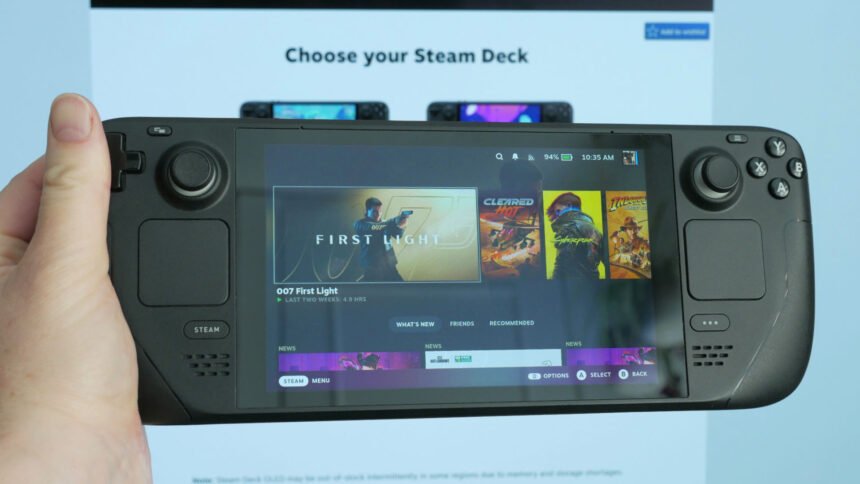
Valve has just increased the Steam Deck price by as much as $300, making what has long been one of the lowest-cost and best-value gaming handhelds now more expensive than several more powerful alternatives. Despite what amounts to a 46% price increase, though, Steam Deck stock has already sold out again in some regions, making today doubly troubling for those who had been waiting to buy one.
Steam Deck stock has been a constant source of strife for those looking to grab the best gaming handheld around. However, a huge part of the reason it so readily sold out appeared to be its low price compared to other gaming handhelds. What today has proven, at least in the US, is that, when it comes to the Steam Deck, price doesn’t seem to matter.
Valve hasn’t made an official statement regarding the Steam Deck price change. Instead, the device simply appeared in stock again on its US store, but with the updated prices.
The 512GB Steam Deck OLED has gone from $549 to now costing $789, which is an increase of $240, or 44%. Meanwhile, the Steam Deck OLED 1TB has gone from $649 to $949, which is a $300, or 46% rise. As per Valve’s announcement last year that the Steam Deck LCD is being discontinued, so that cheaper model is no longer available at all, other than via its refurbished units channel.
Regardless of which model you’re interested in, though, stock has already sold out again in the US. Other regions, such as the UK, do still have stock, but are equally affected by the new prices.
Such large price increases are not unprecedented for a product that is already over two years old, but they’re pretty extreme. For instance, the PS5 notoriously had a price increase earlier this year, going from $549.99 to $649.99 for the standard version and from $749.99 to $899.99 for the PS5 Pro. However, these only amount to 18% and 20% increases, respectively.

Elsewhere, we’ve seen some graphics cards increase significantly in price, with the RTX 5090 nearly doubling and the RTX 5080 often selling for roughly 50% higher than its MSRP. However, these are ultra-premium options with pricing also reflecting demand from a wide range of sources, such as cryptocurrency miners, AI users, and more – it’s not just gamers buying them.
As for other handhelds, the likes of the Xbox Ally X and Legion Go 2 have gone from original MSRPs of $999 and $1099 to currently selling for $1,249 and $1,399, respectively.
As for why prices have changed so dramatically, it comes down to the huge spike in memory prices we’ve seen in recent months. The end of last year saw DDR5 prices quadruple in just a couple of months, while DDR4, NAND flash for SSDs, and VRAM for graphics cards have all also been affected. These increases have, in turn, been driven largely by demand for these products from AI data centers. The entire cutting-edge semiconductor chip industry is at capacity, and prices are being pushed ever higher as demand rises.
These price issues are also expected to affect the Steam Machine when it arrives. When Valve first announced the mini living room gaming PC, it was just weeks before those RAM prices really kicked in, and the tone of the announcement, and the expectation surrounding it, suggested it could arrive at a Steam Deck and console-rivalling price of well under $1,000.
However, given that the Steam Machine specs are considerably more powerful than the Steam Deck, it’s now looking likely that this won’t be the case. Indeed, the ~$950 starting price suggested in this Steam Machine price leak from a few months ago seems positively optimistic compared to what the final price could be.
Thankfully, one product not overly affected by RAM prices is the Steam Controller. It might be regularly selling out, but its $99 price is great value for the features and performance it delivers.