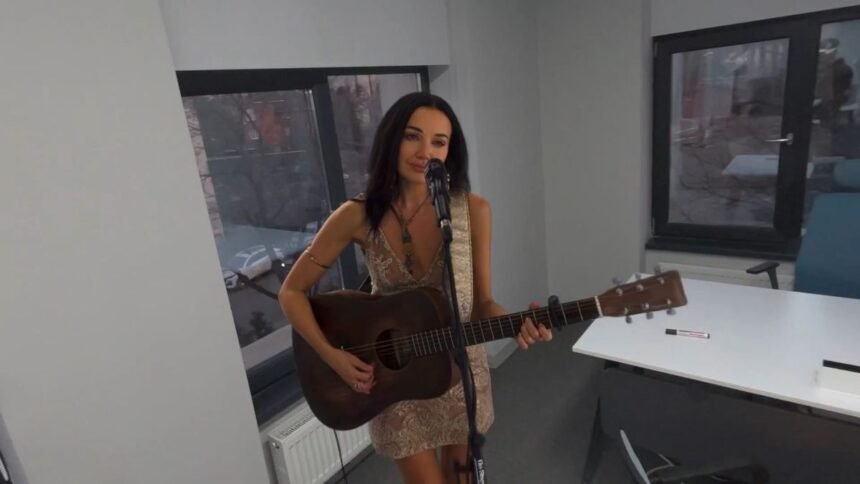
Gracia’s moving fully volumetric captures can now be streamed, including to mixed reality on Quest 3, with no app or content download required — and an Apple Vision Pro app is coming soon.
Gracia first launched in 2024 as a Quest app for viewing static photorealistic objects, and, far more notably, a PC VR app for moving photorealistic scenes, otherwise describable as volumetric video.
And to be clear, this is not just simple parallax like you’d get from stereoscopic 3D video, nor limited-perspective synthetic depth like the spatial scenes of Apple’s visionOS 26. Gracia goes much further, offering fully volumetric content that you can physically walk around in VR or in your room via mixed reality.
Gracia Moving Volumetric Scenes Now On Quest 3 & Pico 4
Gracia’s moving volumetric scenes, dynamic gaussian splats, are now available on Quest 3 and Pico 4 headsets standalone.
As with almost all of the remarkable advancements in 3D reconstruction over the past few years, the technology behind Gracia is Gaussian splatting – fitting millions of semitransparent colored blobs (Gaussians) in 3D space so that arbitrary viewpoints can be rendered realistically in real-time. Moving splats are often called 4DGS, four-dimensional Gaussian splats, the fourth dimension being time.
By the end of 2024, Gracia had already launched standalone apps for Quest 3 and Pico 4, removing the requirement for a PC, with the tradeoff of some quality. But the biggest problem with this standalone flow was the need to download each scene, requiring you to stand there with the headset on watching the multi-gigabyte file arrive on your device. With the company’s technology at the time, streaming would have required a 2.4 gigabit internet connection, something only a tiny fraction of people have and that most standalone headsets can’t even reliably hit wirelessly anyway.
This crippled Gracia’s founding ambitions of being the “YouTube of truly volumetric content” (though the company has now pivoted from this), because if YouTube required a multi-gigabyte download before each video played, it just wouldn’t be a viable service. And so the standalone headset app focused on short 10-second clips, rather than longer content that would support more use cases.
At the time of the standalone app launch, Gracia told UploadVR that it was working on improving its compression by an order of magnitude. Now, a year and a half later, the startup has achieved that lofty goal.
Gracia streaming on Apple Vision Pro.
In March of this year, Gracia launched a world-first: the ability to stream select 4DGS scenes, with no app install or full scene download required. And you don’t even need to download an app; Gracia’s new tech stack works entirely in WebXR, meaning you can just navigate to gracia.ai/store in your Quest 3’s web browser and have a performer volumetrically rendered in your living room in seconds.
On Apple Vision Pro, since Apple still doesn’t let WebXR apps use passthrough as a background, you’ll instead see the captures in a featureless black void. To get around this and let Vision Pro owners display the captures in their living room, Gracia is working on an Apple Vision Pro app, currently in testing, which should be launching relatively soon.
China’s 4DV AI Releases 6DoF Volumetric Video WebXR Demo
China’s 4DV AI released a WebXR demo of volumetric 6DoF videos created from 20 camera views, and you can try it on your VR headset right now.
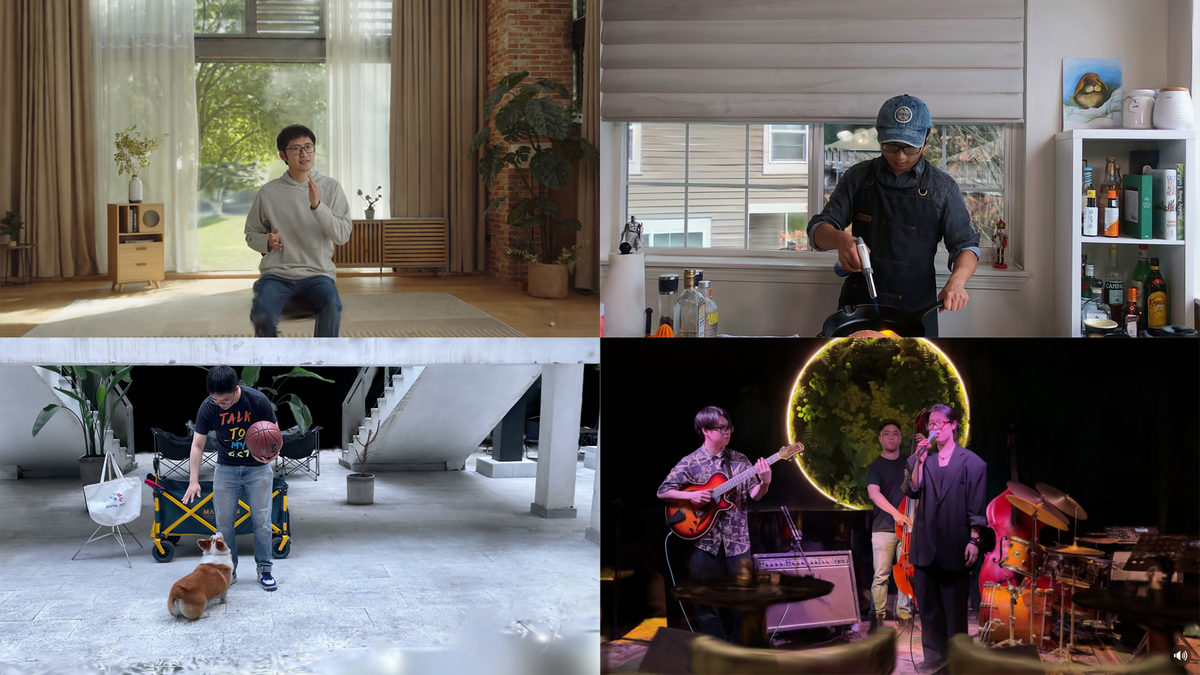
There is, as far as we’re aware, nothing else like Gracia’s streaming in the world today. China’s 4DV showed moving scenes in WebXR last year, but those were only 10 seconds long and predownloaded. Gracia is once again leading the pack when it comes to rendering moving volumetric captures in VR.
The startup says it achieved this by developing a technique for sending keyframes and motion change deltas, encoding only what parts of the capture change over time rather than sending the entire scene for each frame. Essentially, Gracia is applying a video codec style approach to Gaussian splatting. It also uses the new WebGPU graphics API in your browser to achieve the maximum possible performance, rivaling native apps, to eliminate the most frictionful step of all for any consumer app, that initial download requirement in the first place. The compression makes the stream feasible; WebGPU makes rendering the streamed splats fast enough in the browser.
As well as allowing for near-instant streaming of volumetric captures, this means captures have no hard file-size cap, in theory supporting use cases like entire concerts.
To stream Gracia’s moving volumetric scenes at relatively high quality, 120K splats per frame, you’ll need a constant 75 Mbps connection. A decade ago that would be a non-starter, but as of 2026 around 90% of homes in developed countries now have sufficiently fast internet for this.
Still, some don’t, and sometimes the headset will be too far away from the router or on a network where other devices are hogging the bandwidth. For that, Gracia has demonstrated a 17 Mbps mode, offering 15K splats per frame, though in this mode the quality takes a significant hit.
Gracia streaming compression levels.
Three scenes are currently available to stream from Gracia’s website: a 36-second clip of a person working on a bicycle wheel, a 39-second clip of a doctor examining a patient’s shoulder, and most impressive of all, a 4-minute performance by a musician singing with a guitar, complete with spatial audio.
Gracia is also keen to point out that while its captures are well-suited to be placed in your living room via mixed reality, they can also be placed into existing virtual Unity or Unreal environments, including for VR games, if a developer wanted to do this.
Gracia captures can be placed into virtual scenes.
To be clear, by the way, by “stream” in this article I’m referring to watching content without having to fully download it. Gracia’s technology does not support livestreaming. And the capture and processing requirements are the elephant in the room here.
Capturing these scenes requires around 60 shutter-synced and genlocked cameras, which studios typically charge at least $15K for, and Gracia charges $800 per minute for processing plus a “minimum charge per segment”. iPhone 17 Pro’s genlock support may allow for a lower marginal capture cost, though for best results creators will want to use professional cameras like those from Blackmagic and Sony.
Still, the capture and processing requirements aside, what Gracia has pulled off here is remarkable. I would much rather watch a musician or comedian perform as a 6DoF volume in my living room, or preferred VR environment, than a 3DoF 180° 3D video, and I suspect if you’re reading this, you agree.
If you own a VR headset, head over to gracia.ai/store in your headset’s web browser, or your desktop browser for PC VR, and try it out for yourself. And even if you don’t, you can try a flatscreen render in your browser to get the basic idea, though without the sense of depth and scale.
The next frontier for the volumetric scenes space will be developing the technology to allow anyone to capture volumetric scenes with a couple of iPhones and to significantly reduce the processing time. As impossible as this might sound today, so did the idea of even streaming this type of content a few years ago, and the pace of progress in the 3D reconstruction scene, leveraging the rapid advancements in AI, remains staggering. The “YouTube of truly volumetric content” is not possible today, but I suspect it very much so will be by the end of this decade – and it could become a core use case of XR technology, propelling its mainstream use by the compounding advantages of a social content feed platform that truly takes advantage of it.
I’m actively writing on UploadVR again, and this article is one in a series of “catch up” pieces where I report on some of the interesting things that have been happening in the industry in recent months. And yes, VR Download is coming back very soon!