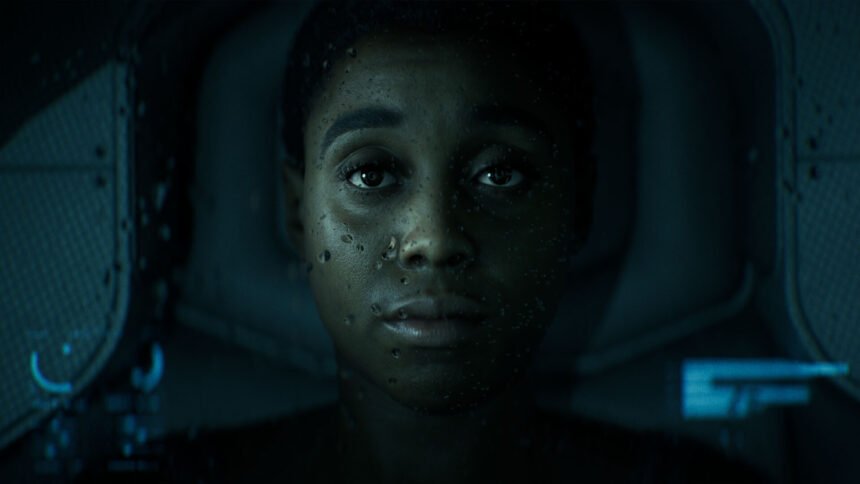
Almost immediately, you’ll realise Directive 8020 and the rest of The Dark Pictures Anthology aren’t alike. Panning for the first time through the Sleep Technician’s quarters aboard interstellar colony ship Cassiopeia – Simms floating horizontally as she fixes her boots, Carter laser-focused on pruning his Bonsai tree – a foreboding thump rocks the vessel. Neither sleep tech shows serious concern, engaging instead in cordial discussion on whether to investigate or check in with the ship’s all-knowing AI system, Oracle first. Once they’ve chosen – or, rather, you decide for them – you’re thrust into real-time control of Carter, prompting sliding doors and strolling through corridors, moving from the vantage of a familiar third-person.
Straight away, you might be thinking about agency – I know I was. Directive 8020 promises to be the series at its most mechanically ambitious, but I’m already detecting a tension between my character’s broader movement and expectations for narrative immersion. The key question is this: can Supermassive Games successfully blend the upcoming survival-horror gameplay with their signature, interactive-drama style?
“Real-time controls’ biggest problem, however, reveals itself soon enough. During the game’s frequent stealth sections, with looping patrols, repeating dialogue, and a predictable structure of sneaking, re-routing power, unlocking doors, and sneaking some more, the design is unarguably formulaic.”
And, real-time controls and a sci-fi setting aren’t the only deviations. As each of the game’s eight episodes concludes, you’ll notice a diminished role for the Curator. Episodic summaries aren’t lost entirely; they’re just handled differently. The game is also built for the single-player experience. There’s no Shared Story at launch, although there is a multiplayer party mode, which I’ll get into later. The shift to Unreal Engine 5 supports the game’s cinematic presentation, but these early ambles through dimly lit foyers give the impression that this game is looking closely at Dead Space for inspiration rather than refining its anthology roots.
The biggest shift – those third-person, real-time controls – brings forth a mechanical mindset too, something you’ve likely experienced countless times before, especially if you’ve played the aforesaid Necromorph-slicing horror, The Last of Us, or Alan Wake 2. You’re accustomed to walking, crouching, whipping out a flashlight, and so on. Yet, this fundamental change also introduces something less tangible: for the first time in the series, horror isn’t something you simply react to but something you actively participate in. Together with presenting binary dilemmas – a hallmark of the series, retained for this title – Directive 8020 stands to merge its derivative control schemes with the psychological fallout of following repeated moral quandaries; elevating it, perhaps, into something that still feels like a Dark Pictures game.
Real-time controls’ biggest problem, however, reveals itself soon enough. During the game’s frequent stealth sections, with looping patrols, repeating dialogue, and a predictable structure of sneaking, re-routing power, unlocking doors, and sneaking some more, the design is unarguably formulaic. It’s clear this isn’t Supermassive’s strong suit, and it’s a shade disappointing that stealth happens so extensively throughout. It’s like the game wants me to feel hunted, but rarely did I feel vulnerable; even if, in another switch-up from the Dark Pictures formula, death can occur outside of scripted events, too. The Last of Us comparisons bear more weight here: the threats you encounter are eerily similar to Clickers, in form and function.
But while outdated stealth design ultimately undermines the vulnerability the game is trying to create, the sense that you’re truly exposed is found instead amongst Directive 8020’s core emotional themes: trust and paranoia.
“The game is absolutely at its best when it slows down and lets the characters collide. Their interpersonal dynamics and loyalties are truly put to the test, and with strong narrative pacing, the emotional payoff in most late-game decisions is powerful.”
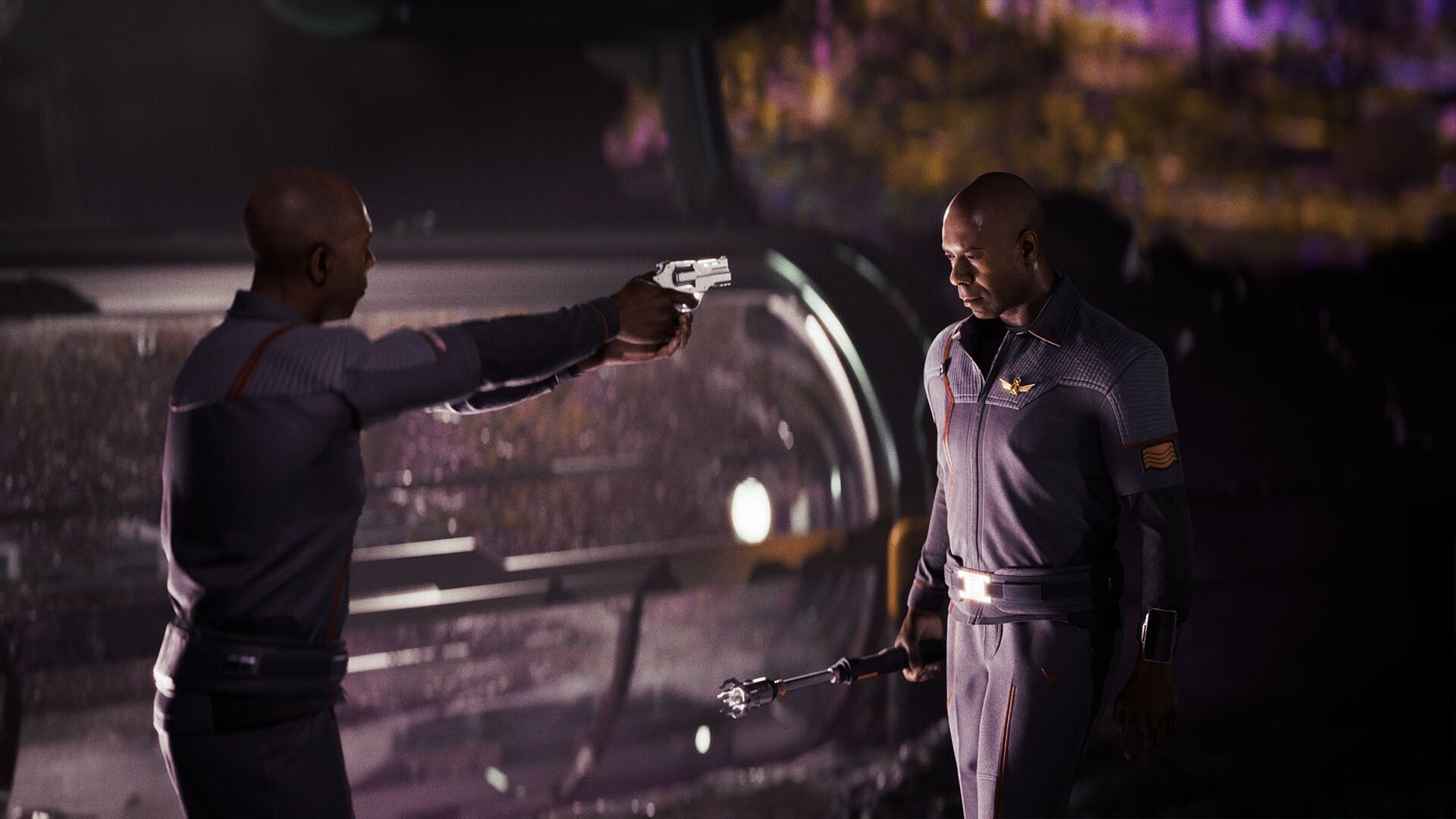
Thanks to an invasive extraterrestrial force, an organism akin to John Carpenter’s The Thing which can replicate any member of the Cassiopeia’s crew, it wasn’t long before I was scrutinising every interaction, looking for shifts in dialogue, expression, or body language to clue me in on who’s who. Even a character’s augmented reality messaging system could be a source for potential deception, as could any voice coming through in-ear communication. Tie into this the interpersonal relationships between certain characters – familial bonds, shared traumas – then any moment of social awkwardness could, in theory, be a mimic, or, perhaps, a hidden agenda, or something else. Throughout my playthrough, I felt the game successfully establishes and escalates trust and paranoia, both through emotional attachment and wider atmosphere.
The immediate counterpoint to this, however, is that I’m unsure how many scenarios I actually faced a mimic and didn’t realise. Now, I know this could be deliberate, but allow me to elaborate. See, if I did interact with a mimic and didn’t know, surely the fact that an alien has infiltrated the ranks would be revealed later. Standoffs do occur, of course, but they’re infrequent. The fear of deception is constant, but the reality felt surprisingly rare.
I consistently engaged in “interrogation gameplay”, but seldom was there clarity. What’s more, characters’ personas switch from one episode to the next. They’d speak with precision or assertiveness, only to soften their delivery later on, leading me to suspect I’m dealing with a nefarious being. But, if my suspicions aren’t addressed either way, I grew to realise that I’m continually being pulled between genuine uncertainty and red herrings. The overriding feeling throughout is that I was an omniscient observer; the only one with an overview of the entire situation, especially during the early episodes before the crew even realises there are shapeshifters among them.
This had a knock-on effect on how I related to certain characters, too, leaving them at the mercy of my own prejudices. Without giving too much away, there’s a crewmate I oppose, so when my dialogue choices led to a clutch moment for this specific character, my uncertainty wasn’t established enough in-game.
Now, that isn’t to say the characters aboard the Cassiopeia are unlikable. The reality is far from it. The game is absolutely at its best when it slows down and lets the characters collide. Their interpersonal dynamics and loyalties are truly put to the test, and with strong narrative pacing, the emotional payoff in most late-game decisions is powerful.
“Still, Directive 8020’s mechanical ambition, tonal shift, and character systems aren’t complex by any stretch, arguably making this entry the most accessible in The Dark Pictures Anthology, albeit less recognisable or distinct.”
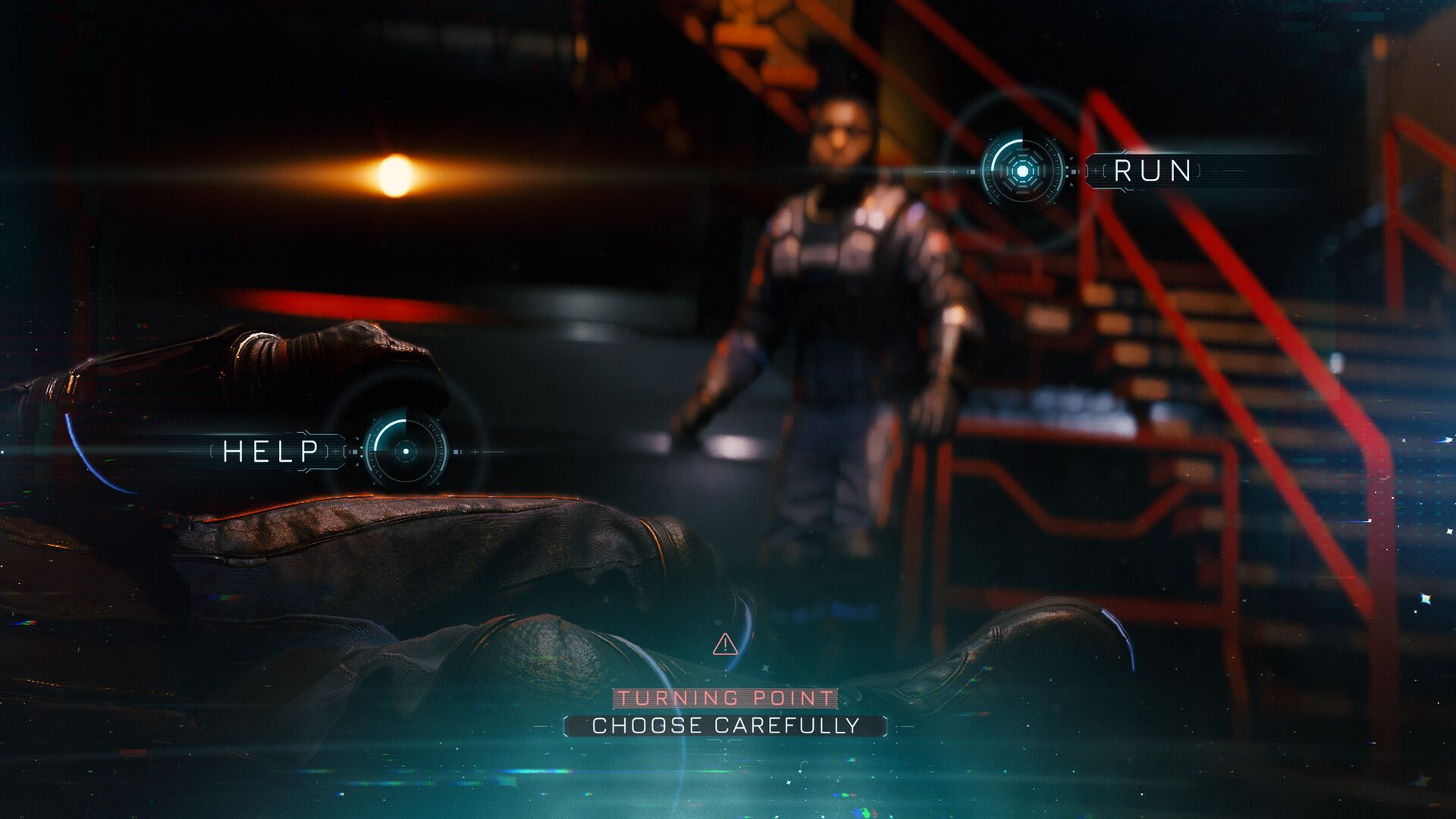
If my favourite character does succumb to space death, however, Directive 8020’s Turning Points system allows me to rewind the clock to retry their pivotal moments, perhaps to change the course of their fate. Through a visible throughline, selecting which scenes I’d like to reattempt is simple enough, but, for me, I felt this feature was too immersion-breaking for a first playthrough. I prefer the tension in choice finality, feeling that the ability to turn back time undermines my original, instinctual decision-making.
Turning Points, instead, feels like an interesting post-game experiment rather than a core design. Or, to frame it another way, it’s akin to replaying an RPG where I create a character archetype that’s rude and aggressive, for example, just to see how far I can push the NPC’s resolve. It’s not me in real life, but it’s fun to take a turn as someone else in-game. But, in Directive 8020, I find it most immersive if I play and react instinctively rather than thinking about how else to behave in a situation.
If you’re like me, but you don’t even want the temptation to re-write a character’s fate, then a Turning Points-less Survivor Mode is a worthy option. Or, of course, you can engage in Turning Points more thoroughly if playing with someone else. It’s here, in the game’s controller-swapping party mode, where it has greater value, where there’s less scrutiny on the unfolding narrative. Instead, my partner and I discussed plot points, sometimes heatedly. Rewinding moments yielded more fun when coinciding with lively discussions.
Now, revisiting specific moments isn’t just a way of exploring different outcomes for the crew, but they’re a chance to steer conversations in a different direction, shaping and reshaping each character’s traits as you go. Establishing traits adjusts a “Destiny” meter for individual characters, too, with each having two that can be unlocked. These can influence a character’s final fate, their overarching narrative arc, and relationship dynamics rather than relying on binary life-or-death choices. Whilst I appreciate this system, like Turning Points, I feel it requires multiple playthroughs to truly understand its depth.
Still, Directive 8020’s mechanical ambition, tonal shift, and character systems aren’t complex by any stretch, arguably making this entry the most accessible in The Dark Pictures Anthology, albeit less recognisable or distinct. And I don’t mean that in an inherently negative way. This is the most confident and forward-looking title in the series, bravely shedding its legacy to pursue something more modern. But, it does come at a cost: what it gains in immediacy, it loses in distinctiveness that previously set the Anthology apart.
“Occasionally, flat facial animations and performance stutters further dilute the experience, the former especially jarring as so much character interaction relies on interrogating expressions and mannerisms.”
Yet, for all these grievances for what it isn’t, I must praise what the game is. At its best, it’s driven by a thick, oppressive atmosphere, elevated by excellent sound design, from cavernous groans and piercing cues, to a score leaning on familiar horror motifs – atonal strings, for instance – without losing effectiveness. Alongside character-driven tension, it’s in these stiller moments where the game shines, and Supermassive delivers its suffocating themes of trust and paranoia with confidence.
The studio’s ambition isn’t always matched by execution, with stealth encounters rarely delivering on their promise of vulnerability. Occasionally, flat facial animations and performance stutters further dilute the experience, the former especially jarring as so much character interaction relies on interrogating expressions and mannerisms. But then, saying that, the game underdelivers on its mimic concept overall. They could be among us, but – on my playthrough at least – they rarely revealed themselves.
Even with its inconsistencies, Directive 8020 marks a compelling step forward for The Dark Pictures Anthology, trading the series’ identity for an immersive, real-time leap.
This game was reviewed on PlayStation 5.