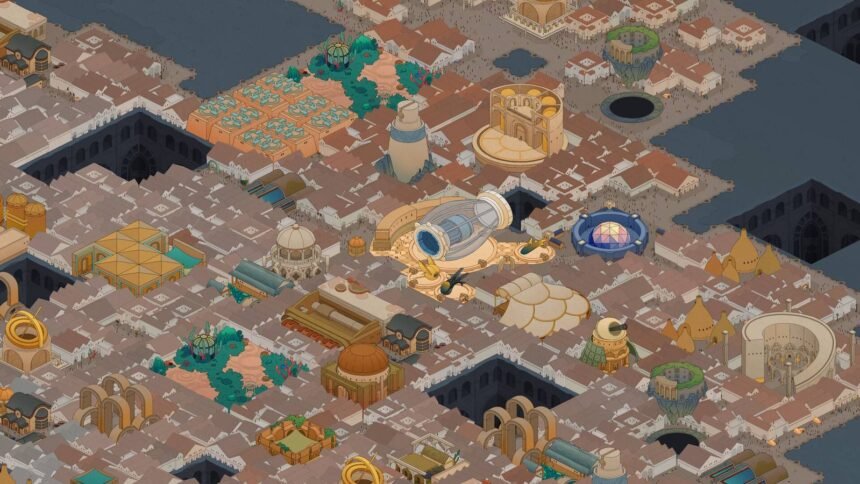
Amberspire, a new tabletop-like city builder from The Banished Vault maker Lunar Division, drops you onto a distant moon that’s seen better days. An opulent civilization once flourished here, but the dead are all that remain of it. And you see reminders of them daily, as the city’s rulers turned the moon into a mausoleum under the surface. Holes open in the moonrock sometimes, and little glimpses of the rows of dead show through. The mausoleum’s central shaft is your town square, always present, always determining the shape of your city. You might be looking forward, but you can’t escape the past.
Except you kind of can, at least depending on how the dice roll. As you’d expect from a city builder, much of Amberspire‘s focus is on the future and turning this odd little death moon into a place where people want to live. Events deal with the present — a disaster that threatens to destroy one of your essential buildings, or a development that makes one of your potential off-world patrons less inclined to bestow their benevolence. They leave a mark on your city for better or worse (usually worse, as the outcomes are often unpleasant), but for a city built on the dead with a big window into the massive cemetery at its center, there’s very little sign that anyone thinks about it. Like… at all.
For much of a city’s lifecycle, there’s no circumstance that has the burg or its inhabitants reckon with the past or show curiosity about it, not even exploring it to find ancient treasures or using it as a symbol of burgeoning national pride during its more militant phase. It’s not a huge deal, but it does relegate one Amberspire‘s prominent visual and narrative features to something that feels more like window dressing.

Or maybe there are more events, and the invisible dice that determine which ones play just didn’t favor me in that way. Dice, invisible and otherwise, are everything in Amberspire. They’re literally what you build your city with, as you roll them to get resources from your important buildings. Some of them get used to construct other buildings, and some are trade goods, things you can exchange for prestige points to help your city grow.
Each cycle consists of four turns. Three of them are yours, where you roll dice to get resources and decide what to do with them. The fourth belongs to nature. Most die have a “weather” side that adds a weather die, and all accumulated weather dice roll on the fourth turn. Some cause flooding, while others generate rust that encroaches on your city and consumes whatever’s built nearby. Later, you’ll also find event faces, which, after you accumulate three, trigger a narrative event with outcomes you also roll a die to determine. The goal is to lead your city through different prestige phases, which you do by attracting more settlers and gaining influence. Influence comes from exchanging resources at certain marketplace buildings, though losing it is also the main penalty you incur in most negative events.
Buildings generate no resources on their own. Instead, you choose a building, get a die, then roll it to see which resource that building will provide. The kiln, for example, could give you bricks, salt, or earth, while later, less practical buildings might provide things like “starglow” or “ritual.” Esoteric as some resources may seem, everything has a use for a specific period of your city’s development, whether it’s selling at the market until you offload so much that the value drops or attracting new settlers.
One of Amberspire‘s best features is how your city evolves like a mini-history lesson, rather than the structure you often see in builders where progress just means more efficiency or better resources. You start with crude basics, like the kiln, a furnace, and a rudimentary crystal-making device that sounds fancier than it is. This is basically your city’s caveman phase. At the next prestige level, you can start gathering and trading slightly more refined goods, such as textiles or tea. Things feel more settled and lively in this phase, as more people flock to what’s no longer a backward little outpost.
Then the church comes storming in (or Amberspire‘s equivalent to organized religion) as your city starts to think about things that aren’t just food and dirt. The most important feature for a while is the fortress, because military ambition is an inevitable occurrence in the life of any state. Better trade goods have event tags attached to them, so your actions are more likely to clash with the world around you. And always lurking in the background is the threat of ecological disaster, made more real every turn you take as the weather rolls stack up. Amberspire is essentially the story of every civilization across the world condensed to a six-sided cube, and it’s brilliant.
The cycle remains largely the same in each phase of your city’s life. You get access to new buildings, which grant resources. You can invest those in constructing more buildings or hope the dice bless you with materials you can sell at the marketplace to raise your prestige. For something that sounds so repetitive, it’s remarkable that Amberspire never feels that way. Limiting how many dice you can roll each turn adds a gentle layer of strategic prioritizing, and there’s always some new venture to work towards. Above all else, though, is a sense of fun and discovery — at least for a time.

That sounds cheesy, but it’s the feeling I kept going back to with Amberspire. The random nature of each turn means you’re always doing something in a different way as you adapt to whatever the game throws at you. You’re learning new ways to do it, too. Everything unfolds at a gentle pace so even when you’re juggling a dozen tasks and a minor apocalypse simultaneously, you’ve accumulated know-how over multiple cycles. It’s just another turn, and whatever bad things happen can be fixed eventually. For a long time, Amberspire‘s biggest appeal is adding that next layer or making you contend with a new challenge by throwing your plans out of whack.
Once that sense of mystery and learning fades, though, it’s hard to find a reason to keep playing. Amberspire may have benefited from slightly more complexity, giving you more things to do with your city beyond using buildings to get resources to get more buildings that give you more resources ad nauseum. Once I reached a certain tier and realized that’s pretty much all there is, my motivation to spend as much time as I initially did dropped. I still built multiple cities and enjoyed it for a while, though.
And that’s the beauty of Amberspire. It’s less of an obsessive time sink and more like a traditional board game. You don’t want to pull out Monopoly on the weekend, play it for hours every night, and then do it again next weekend. You dabble with it every now and again, appreciate what it’s there for and what its limitations are, and move on to something else. Maybe it wasn’t Lunar Division’s intent, but Amberspire lives up to its initial premise quite well: Nothing lasts forever, nor should it.
Amberspire is out now for Windows PC. The game was reviewed on Windows PC using a prerelease download code provided by Bithell Games. You can find additional information about gamexplore’s ethics policy here.