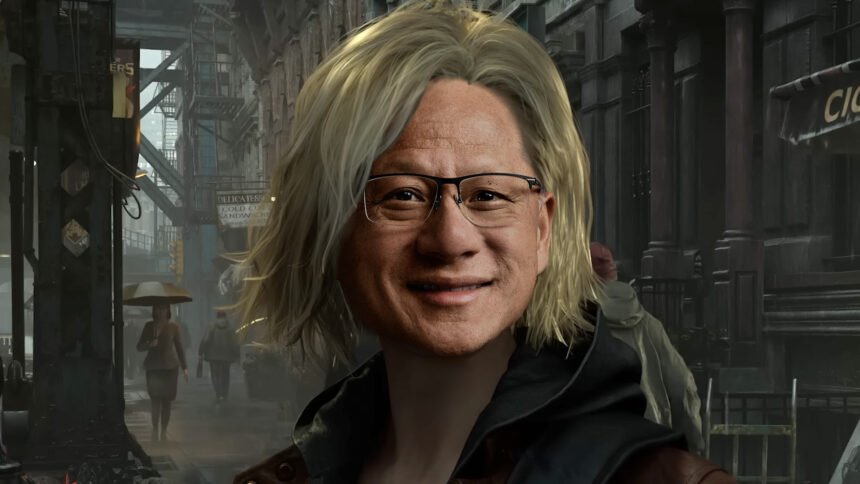
Apparently, the customer isn’t always right, at least according to Nvidia CEO Jensen Huang. While there was widespread eyerolling, teeth-gnashing, and shoulder-shrugging at the announcement yesterday of Nvidia DLSS 5, Huang has hit back at those complaining, saying “they’re completely wrong.”
We’re still six months or more away from DLSS 5 actually being available for regular users to try on their graphics card and truly make up their own minds, but the reaction to Nvidia’s demo of the tech has been swift and sometimes hilarious, with many a magnificent DLSS 5 meme now doing the rounds. Crucially, though, Nvidia is adamant that critics have so far got it all wrong.
Responding to a question from Tom’s Hardware regarding the negative response to the way DLSS 5 has seemingly changed the artistic intent of the underlying models for, in particular, Resident Evil Requiem’s Grace Ashcroft and Leon Kennedy, Huang hit back straight away with that “completely wrong” line.
He then goes on to explain why he believes these criticisms are wrong, pointing out that, contrary to what many seem to be assuming, the tech isn’t just a final-stage AI filter but that “DLSS 5 fuses controllability of the geometry and textures and everything about the game with generative AI,” adding that developers can “fine-tune the generative AI” to match their vision.
Cutting to the heart of the matter, Huang states that “it’s not post-processing at the frame level, it’s generative control at the geometry level.”
However, a later statement goes on to slightly contradict this sentiment, in a way. He says that developers can, for instance, make a “toon shader” or make it appear like the game is “made of glass.” While that would fit the definition of it being in control of the developer, it suggests the tech goes way beyond just being in control of a part of the render pipeline and that it can, in fact, completely reinterpret the final rendered scene, even if it is based on the developer’s own parameters.
Huang wrapped up his rebuttal, pointing out that, “This is very different than generative AI; it’s content-control generative AI. That’s why we call it neural rendering.”

Ultimately, the jury has yet to even assemble, let alone step out to mull over its decision on DLSS 5, what with it not actually being available for the public to try. After all, despite all my and others’ scepticism, it genuinely could be utterly revolutionary for cinematic games. It’s undeniable that plenty of otherwise great-looking games have been let down by the final modelling of faces and other crucial details, and if DLSS 5 can just step in and improve those, without it being too uncanny valley, well, that’s a pretty powerful tool.
If, on the other hand, it results in the whole game just looking AI-generated or having the slightly smudgy, soft appearance that immediately greets you the moment you engage any sort of upscaling, well then, it’s clearly going to alter the look of some games for the worse. in many instances. And that’s all ignoring that it will be totally useless for any games that have an art style that steps even slightly away from “lifelike.” Still, at least you’ve got six months to save up for the two RTX 5090 cards it currently needs to run.