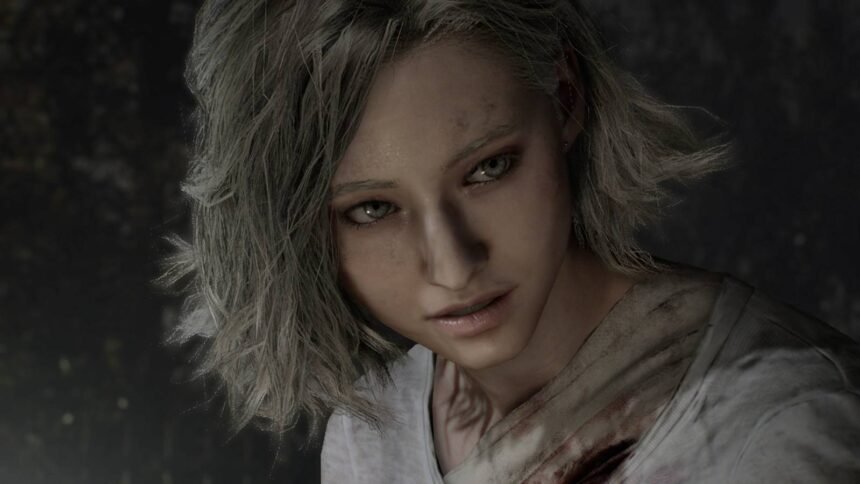
When Angela Sant’Albano’s agent contacted her about a potential audition, she didn’t realize the cultural magnitude of the project or how unique the experience would be for her. As usual with auditions for unannounced media, Sant’Albano received a limited brief about the character and the project. She did a bit of research based on what little information her agent could provide and thought it might be for a Resident Evil project. But by the time the audition rolled around, there wasn’t much room for doubt.
“We did a lot of improvisation,” Sant’Albano tells gamexplore over a Zoom call. “We did a couple of scenes that [Capcom] had already written, and then one of the improv prompts was ‘I need you to die for about two to three minutes, and I’m going to time you. But you can’t die quickly. It’s got to be a slow burn of a death. And you’ve got to give a death cry at the end.’ And then, while I was dying, [casting director Kate Saxon] would give me new instructions like, ‘and now a zombie has bitten your left leg.'”
Performing in a Resident Evil project was a step into the unknown for Sant’Albano, who hadn’t acted in a video game or a horror project previously. It wasn’t due to a lack of interest. Horror was always appealing to her, or more specifically, the challenge of creating intense emotional states with few prompts outside of the imagination.

Still, Sant’Albano wasn’t sure what to expect from her first day on the set of Resident Evil Requiem and says it was a bit overwhelming, with the clunky grey suit, the big helmet, and a camera mounted just in front of her face to capture expressions and vocal performances. Motion-capture setups differ depending on the director and production company. But behind-the-scenes looks at high-profile projects like The Last of Us Part 2 and Baldur’s Gate 3 popularized the idea that motion capture and voice recording are separate processes, and that the motion-capture stage is often empty, save for some mattress-like padding here and there. That wasn’t the case for Requiem.
Kate Saxon, the casting, voice performance, and cinematic director for Resident Evil Requiem, treated the project like a theater performance and encouraged Sant’Albano and the other actors to do the same. Scenes included props to give a general sense of a room’s layout and its important objects, and aside from some lines used as dialogue during combat or chases, all of the game’s voiced lines were recorded during motion capture.
“Kate told us not to think of it as a video game and to make it as truthful as we could,” Sant’Albano says. “She wanted us to perform the way we would for film and TV and theater and to think of it like theater-in-the-round. It’s actually really freeing, because you have the same freedom as doing theater-in-the-round, but the intimacy of film, because the camera and the audience are right there in front of your face, and you know that they’re listening to you perform.”
There were technical challenges to adapt to, including an unlikely obstacle: approaching a door. Sant’Albano describes the process like this:
“There’s a door, but it can’t be like a 3D door, because that would block the camera sensors or the cameras. So it’s a fake door but you have to approach it the way you would a real door. You can’t wrap your hand around the fake handle, because that’s not realistic.”
She took creative approaches to other obstacles too, like the scene early in Requiem where Grace is strapped upside down to a gurney. Sant’Albano was concerned about making Grace’s movements seem natural and remembering every step of what she needed to do, so she wrote a beat sheet and treated the scene like a dance with every major moment — waking up, realizing what’s happening, keeping calm, and so on — taking a beat. She was also eager to do her own stunts and asked the motion capture team to suspend her partially upside down on a gurney-like object, holding onto her arms and legs, so she could give as much truth to that moment as possible.
The environment Sant’Albano, Saxon, and the other actors created made it easier than you might expect to tackle Requiem‘s more demanding scenes. Sant’Albano recalls that the yell she gave during a scene where The Girl drags Grace down a hallway was partly genuine surprise and alarm, as the stunt team hooked up to a rope and suddenly yanked her across the studio floor. It was a perfect take with the kind of genuine emotion that would be challenging to muster in a recording booth.
[Ed note: Spoilers for the middle of Resident Evil Requiem follow.]

The same was true for Sant’Albano’s most challenging scene as well: Emily’s mutation. It’s a heart-rending and terrifying moment, when the young blind girl that Grace has sworn to protect succumbs to her infection and transforms into a deadly, rampaging monster. Grace doesn’t want to harm Emily, but she’s still determined to survive.
“When you do a scene that is like that high emotion or stress, you know it’s going to be really hard to do it too many times, and then it’ll start to feel acted,” Sant’Albano says. “And so we [Sant’Albano and Emma Rose Creaner, Emily’s actor] were like, we have to just go all out and go completely mad with it.”
The two agreed they would have it done in under three takes, and Sant’Albano credits Creaner with making it possible. During the transformation scene, Sant’Albano says Creaner’s movements — the writhing and twisting, the sudden stillness, and then the complete change in bearing and manner — were so genuinely disturbing that it took little imagination to give Grace the shock and fear the moment demanded.
“It all worked so well because it was in the moment,” Sant’Albano says. “It brought humanity to the game in a way that makes it feel that much more real so the story can shine, which was wonderful for an actor. I think that’s kind of the dream.”