When Hollow Knight: Silksong launched in September 2025, we didn’t just get a strong Metroidvania sequel filled with adorable bugs and killer bosses. We also got another serving of gaming’s unkillable difficulty debate. Like clockwork, the (in)famously challenging game reignited a long-running conversation around how developers can retain the intended difficulty of a hard game without ignoring accessibility. It’s a nuanced topic that tends to get reduced to heated arguments over “easy mode” options.
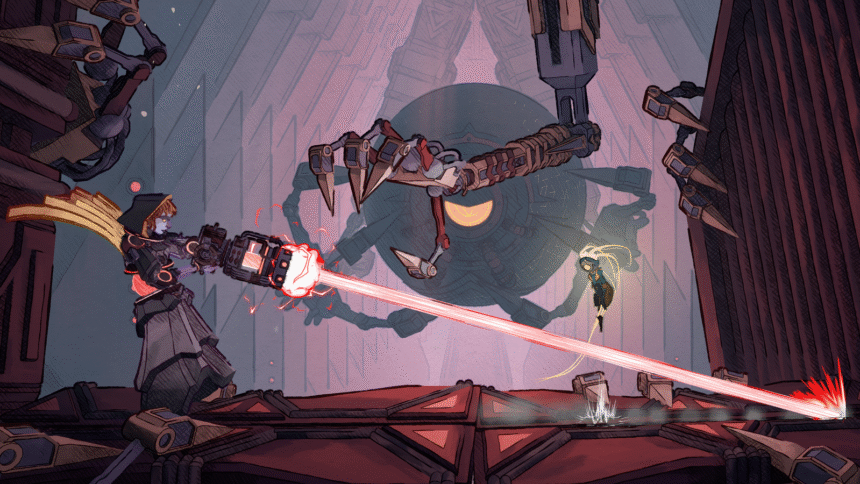
For its own tough Metroidvania, the newly released Mio: Memories in Orbit, developer Douze Dixièmes found its own creative solution. Rather than adding in difficulty options that make the game easier wholesale, Mio contains three brilliant accessibility features that model how a developer can welcome more players into their game without compromising their vision.
There’s no easy mode in Mio. Instead, when you pop into Mio’s settings menu, you’ll find a tab called Assists. It contains three options: Eroded Bosses, Pacifist, and Ground Healing. All three of them give players subtle assists that make traveling around the game’s maze-like spaceship a touch more manageable. All three options are cleverly conceived in their own way.

Pacifist, for instance, makes it so regular enemies won’t attack Mio unless they are struck first. That lets players move around more freely, putting their focus on tricky platforming and hidden secrets, and significantly reduces the stress of runbacks. Ground Healing, on the other hand, gives the main character an extra node of health that will be recharged by standing on the ground for a few seconds.
The most useful of the three, though, is Eroded Bosses. When this is toggled on, bosses will become just a tiny bit easier to fight every time they kill you. Mio’s attacks inflict a bit more damage on bosses each time, eventually capping out at double damage after 15 deaths. It’s an ingenious compromise that doesn’t trivialize tough fights. Players still get the experience of getting their butt kicked by a tough boss and having to learn all of its attack patterns gradually, over multiple attempts, but they won’t have to bash their head against a wall if they’re stuck on the precise execution of a fight. In a recent video interview with gamexplore, Douze Dixièmes co-founder Sarah Hourcade explained how the option came to be and why it was necessary to implement.
“We had to put something in, but we didn’t want to alter the experience too much,” Hourcade told gamexplore. “So one of the big inspirations for that was the system in Hades actually. They do this amazing thing where if you put yourself in God Mode, every time you lose to enemies, they do 2% less damage, something like that. And that was the beginning of this thinking about how to make accessibility modes where the player keeps playing this game, not another one.”
The most important part is exploration…
It’s a smart thought that’s likely going to speak to anyone who bounced off of Silksong due to its punishing difficulty. I was in that boat myself after hitting a wave-based arena battle late in Act 2 that simply couldn’t hold my attention. There were too many other great games to play that month to spend my time dying over and over at the same fight for hours. I would have killed to have an option like Eroded Bosses in Silksong so I could move on from one annoying encounter and experience the game’s full scope. Instead, I just stopped playing.
Even though Mio is more approachable than Silksong, thanks to its assists, the two games still share one controversial design decision: boss runbacks. If you lose to a boss in Mio, you’ll head back to a checkpoint that’s not always close to the boss room. Silksong functioned the same way, and that decision played into the debates surrounding its difficulty. For Douze Dixièmes, there was a good reason to leave runbacks intact rather than giving players an assist option, as it does for bosses.
“The most important part is exploration, and that’s why we didn’t put an accessibility mode where you can start at the beginning of the boss,” she said. “You always have to walk there because it’s your invitation to go see something else.”

The contrast between that decision and the assist tools models the ways that accessibility doesn’t mean you have to make a singular “easy” switch to bring more players in. There are plenty of creative ways to loosen difficulty in areas that make sense while leaning on smart design to keep other parts of the experience consistent between players. Anyone who turns on Eroded Bosses will more or less get the same experience as someone who doesn’t.
So if you’re finding yourself stuck during one of Mio’s boss fights (the last one is a doozy, especially), don’t be afraid to pop into the settings menu. You might just find an option that changes your perspective in time for the next round of what’s become a circular debate.