Every great story starts in a dungeon. At least, that’s what the folks at Bethesda must’ve thought when they decided to begin almost every The Elder Scrolls game in the same fashion: Sad and imprisoned. Following some of the best cinematic intros in gaming, the starting dungeons act as veritable thrill-killers before you make it out of the opening sequence and into the open world. And that’s a shame, for The Elder Scrolls games would be in spitting distance of perfection if it weren’t for that first-dungeon curse.
The Elder Scrolls 2: Daggerfall‘s first minutes are nothing short of glorious. At the crack of thunder, an old, candle-lit library comes into view. As the camera zooms in on an open book showing a world map and pictures of dragons, a deep voice begins to speak:
“Four hundred years after Tiber Septim’s reign, the beginning will meet the end, and the bloody circle will close in the Empire of Tamriel. The unworthy heirs of the Septim Dynasty have allowed the bonds of the Empire to weaken and crack. Uriel Septim the Seventh cannot repair what his ancestors ignored. The provinces fight among themselves like neglected children, drunk with rebellion, and one indomitable power hides itself… but not forever.”

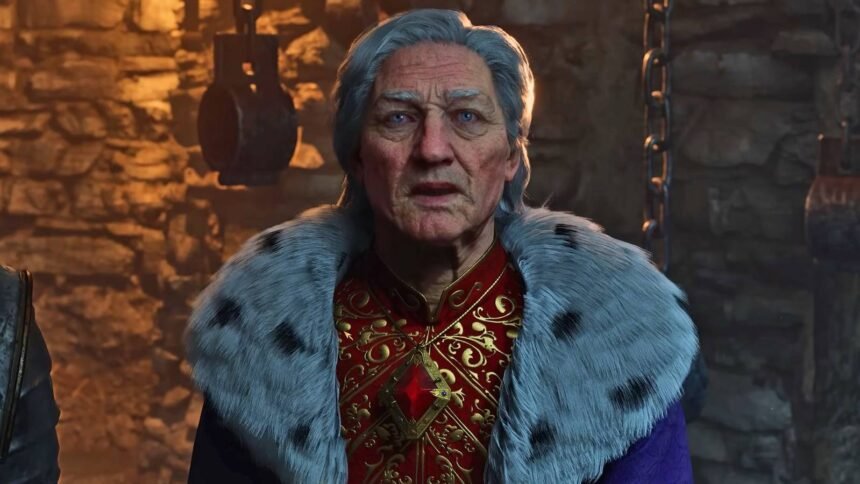
As if that’s not grand enough for a game from 1996, Daggerfall then brings forth the Emperor, who, illuminated by torchlight, informs you of a spectral army haunting the kingdom of Daggerfall. It is up to you, brave hero, to find its ghostly king, retrieve a lost letter, and “close the marble jaws of Oblivion.” That sets the tone quite nicely, doesn’t it?
The drama, the lore, the atmospheric scenery… By instantly making you part of the grand narrative and using a talented actor for the role of Emperor Uriel Septim VII (who clearly put 100% effort into the delivery), The Elder Scrolls 2: Daggerfall has one of the best opening scenes I’ve ever witnessed in a video game. Please allow me to repeat: This intro dates back to 1996.

It’s all the more disappointing, then, that Daggerfall‘s starting dungeon seems to have been crafted by sadists. Imagine an endless labyrinth of similar-looking corridors filled with dozens of monsters, some of whom can easily one-shot you, and not a single sign to point toward the exit. If I were playing this game in 1996, I’d have either thrown it out the window or gone insane, but since I have the internet at my disposal, I was able to find the teeny-tiny hidden lever that opens the door to the outside world.

Don’t get me wrong; I’ve nothing against the cinematic opening and starting dungeon combo — I actually like the transition from sad prisoner to liberated scoundrel with a whole fantasy world at their feet. But does it have to be so tedious? As evidenced by other games in The Elder Scrolls series, the answer may be “yes,” because Daggerfall‘s devilish dungeon doesn’t stand alone.
The Elder Scrolls: Arena, Daggerfall‘s predecessor from 1994, opens with a dungeon that’s arguably 10 times worse. Following an introduction that isn’t nearly as engaging as Daggerfall‘s (though it does have a cool blue sorceress who speaks with you from the sky), you’ll awaken in a dreadfully gloomy dungeon ridden with the usual vermin, and you can hardly see two paces ahead. Have fun navigating this one!

Whereas Arena may fall back on its age, however, The Elder Scrolls 4: Oblivion has no such excuse. Following an excellent Daggerfall-style monologue by Emperor Uriel Septim VII and a lovely shot of the Imperial City, the player awakens in yet another prison cell. Admittedly, the first few minutes spent inside Oblivion‘s starting dungeon are far more interesting than Daggerfall‘s, mainly due to Uriel Septim himself barging into your cell, opening a hidden passageway, and leading you into a sewer, but it goes downhill from there.

Tunnels — endless tunnels full of rats and goblins, that’s what’ll keep you occupied for the next 20 minutes or so, until you regroup with the Emperor and his two guards. Good ‘ole Uriel tries to make the dungeon crawl more interesting by dying, but this effort is mostly wasted as his death is followed by another tedious stroll through the sewers before finally entering the open world. Oblivion‘s intro cutscene and the first step into the open world of Cyrodiil are positively mesmerizing, but the dungeon that lies between them? Not so much.
The Elder Scrolls 5: Skyrim, shows improvement with its dragon-induced chaos, but doesn’t quite break the curse of the dreary opening dungeons. The first minutes of gameplay are phenomenal; the cart ride, your impending doom, the iconic “Hey, you. You’re finally awake” quote, the unexpected dragon attack… But then you’re directed into Helgen Keep, which is — surprise! — Skyrim‘s take on the classic opening dungeon. Granted, this one isn’t as tiresome as the ones in Daggerfall and Oblivion, but the escape through Helgen Keep still feels like a hindrance wedged between a thrilling intro and the exciting first steps into the open world.

To illustrate, here’s what happens in Skyrim‘s starting dungeon: You follow the path, fight a couple of soldiers, follow the path again, fight more soldiers, follow the path, fight soldiers, enter a torture chamber (this is actually quite gruesome and interesting), follow the path, fight way too many soldiers, follow the path, get ambushed by spiders, follow the path, sneak past a bear, and then, finally, you enter the open world of Skyrim.
Should The Elder Scrolls games just skip the starting dungeon, then? One of them actually tried this approach: The Elder Scrolls 3: Morrowind. With nothing but a few text screens and a voiceover to introduce the story, Morrowind plunges the player into the open world within seconds. There’s no cutscene, no starting dungeon — you spawn on a ship, walk down the docks, speak to some guy, and that’s it. You’re free.
I’m sorry, but as much as I appreciate the initiative to try something new, I don’t like Morrowind‘s opening. The rush of complete freedom feels nice, but it would’ve felt nicer after a more dramatic entrance. So, rather than culling the starting dungeons entirely, Daggerfall, Oblivion, and Skyrim might’ve benefited from certain improvements — make them more surprising, easier to navigate, and (above all!) shorter, thus preventing the initial adrenaline kick from dying in a dungeon.
If I were to construct the perfect opening to an Elder Scrolls game, I’d take Daggerfall‘s intro cutscene, follow that up with the first minutes of Oblivion‘s dungeon, and paste some surprising events akin to Skyrim‘s dragon attack into that dungeon. After less than 10 minutes of pure spectacle, without rat fights, we’d have Oblivion‘s iconic sewer exit, thus concluding the video game intro to end all video game intros. This is what I dream about at night.
So… The Elder Scrolls 6 developers, you wouldn’t mind taking some notes, would you?