William Gibson’s 1984 novel Neuromancer describes jacking into “the consensual hallucination” of “the matrix” with a “custom cyberspace deck” projecting one’s “disembodied consciousness” there. The hardware necessary to spend time in VR is a “cyberspace deck” seen “banging against” the hip of the main character.
In 2026, the “Realworld cyberdecks” page on Reddit says “The era of virtual reality is coming, so it is also time for cyberdecks to come” as hundreds contribute new rigs weekly.
If the “era of virtual reality” is coming and a “cyberspace deck” is how we get there, what do the first “realworld” decks look like? What are their functions?
Unlocking Digital Data In VR By Locking It To The Real World
What is a cyberdeck?
My custom deck begins at a couple terabytes of local storage of videos, photos, music, games, and other personal files. I’ve been able to access this data store in VR since about 2016 with Virtual Desktop. I don’t buy much software from Microsoft, though, so my data has been an ill fit inside Windows. Looking ahead, I’d love to build on my data with a Framework laptop to drive VR directly with Linux. In the meantime, I’m using macOS, iOS, Windows 11, SteamOS, and various flavors of Android to operate my file systems.
Many of us already carry, at the very least, 50 gigabytes of storage in our phones everywhere we go. Is it so difficult for us to imagine a couple years more and almost everyone finding use for terabytes carried with us?
After roughly a decade of headsets from Gear VR in 2014 to Quest 3 in 2023, when the Vision Pro arrived in 2024 I first experienced a standalone system unlock terabytes of digital information to use in VR. Apple brought apps from my iPad and iPhone, sure, but I also started perusing my own personal data store on local drives wirelessly through Mac Virtual Display. When I use the feature, my Mac’s screen turns off in the “realworld” and a resizable virtual panel opens in VR instead. If anybody else happens to be watching my screen my data isn’t displayed there anymore. For some scenarios that’s a bug, but for many it’s a feature.
Gibson’s fiction understood the value of cyberspace before “the matrix” could actually be. Now VR is a consumer reality and our model for personal storage of digital content collides with Gibson’s idea of a deck and the technical delivery of cyberspace. For example, you discover the confines of your digital keepers when you apply personal computing to your life without any specific platform limitations. The FAT god commands us to store no file greater than 4 gigabytes. And beware special characters in thy filenames.
In my view, a “custom deck” starts with pouring one’s personal data into any portable device. MicroSD cards are readable in Steam Decks and Steam Frames while thumb drives include their universal connector. So you can start building a deck starting from a $15 thumb drive or MicroSD card, and build up over time to a multi-thousand dollar laptop with the very latest graphics card to cyberspace.
Entry Level Decks
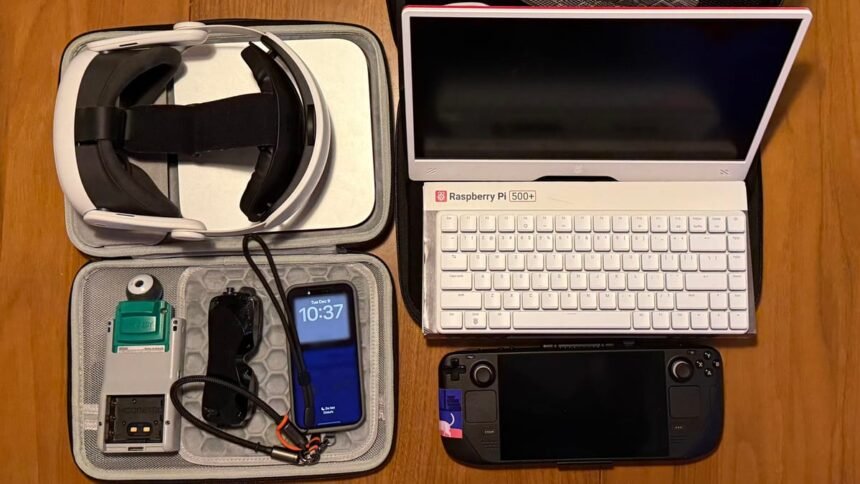
Hanging from a bag in the corner of my office is the latest personal computer from Raspberry Pi. Described as a “premium desktop computer” the Raspberry Pi 500+ is a keyboard selling for $200 with a 256-gigabyte solid-state drive built in running Linux.
Just send USB-C power into the Raspberry Pi and the keyboard starts computing. I used the included tools for the 500+ to unscrew the bottom of the keyboard and swap out its drive. The custom computer boots to the desktop quickly and now carries four terabytes of storage underneath satisfying mechanical keys.
Now I just need somewhere to display my files.
Conceptually, Raspberry Pi and I put together a custom deck of hardware and software that’s cheaper and more portable than anything made by Apple. The Pi doesn’t take me to cyberspace but it can display in cyberspace, and I can access it there as if from a floating terminal just like my Mac. And all of it is running in the space occupied by the keyboard traditionally used to operate a personal computer.
Wi-Fi and Bluetooth emanate from the keyboard. In the back, ethernet, USB and micro HDMI ports connect physical accessories. The biggest problem is that the year is 2026 and we don’t have the easy-to-use software I need in virtual reality to access my deck’s files wirelessly. Instead, I hack my keyboard PC into VR by any means necessary. That means dealing with stuff like VNC and IP addresses or perhaps a latency-inducing capture card.
The Steam Deck offers access to Linux in a more user-friendly handheld console-like form factor compared with any Pi or Mac. If logging into Steam online before you can do fun things with your computer is too restrictive, then you can build your own deck of hardware and software and log in online only if you want.
A Framework For The Future
Readers who invest multiple thousands of dollars in their personal computing rigs know $200 or even $500 doesn’t truly buy a “premium desktop computer”. If a Raspberry Pi can only display a flat screen in VR, then a Framework laptop should be able to fully embrace the concept of a cyberdeck carrying an NVIDIA RTX 5070 and 64 gigabytes of RAM.
My ideal configuration for a personal computer essentially matches the price of a top-of-the-line headset for a top-of-the-line deck that’s upgradeable for years. To me, it doesn’t really matter if my “deck” starts with my data on a thumb drive in a well-structured folder system, or if there’s a complex operating system and graphics card and central processor with a virtual assistant managing my data. The computer becomes “custom” and “personal” when I put my data inside.
The aim is to bring personal computing with me wherever I go. It’s not to the cafe or on a plane I really care about my deck of data and hardware going. Sure, those places would be great, but the most important place a deck goes is in VR.
Everyone Already Owns A Cyberdeck Lacking Direct VR Support
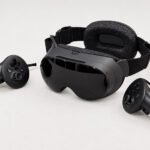
A cyberdeck is the missing key to Bigscreen Beyond.
As long as you’re seated there in your chair and have a good supply of clean power, conceptually speaking, Bigscreen Beyond and a Framework laptop should put you in cyberspace when the headset touches your face.
Yes you need lasers sweeping the room right now for Beyond and a network connection added to this core experience would bring a lot. Yes you could also add accounts, friends, entitlements, digital rights management and thousands upon thousands of other services and software packages as with any open computer.
Whether Beyond is running from a desktop PC or the Framework laptop is a secondary concern. All that fundamentally matters is that when you go to VR you have at your fingertips a storage device you can separate from your computer with all your personal and favorite files organized, indexed, searchable, accessible and playable.
As of this writing, data portability in the “cloud” typically means waiting hours or days to download a store of information from a provider. There’s a more immediate and extreme example of data portability, however, and we’ve had it for decades with removable storage systems.
If you have the freedom to immediately unplug both your content and yourself from the network and the headset, you also have the freedom to take your stuff with you anywhere and everywhere, in VR or otherwise.
From MP3 Players & Headphones To PCs & Assistants
Over the last quarter century, the MP3 player became the iPod and music libraries became the launchpad for iPhone – a new kind of hyper-connected deck filled with personal information. From iPhone and Android, our pocket decks consumed almost every product category of personal computing and remade a few others.
Something new is happening with spatial computing starting with experiences in virtual reality and extending into passthrough views and mixed reality. Any surface can become a touch-sensitive display. And our existing touch-sensitive displays become even more useful accepting touch input while turning off the flow of photons. They just send that data as bits over the network when needed. With reskinnable passthrough views, that “deck” in hand can become anything from a camera to a map to a tool to drag objects. Even non-interactive displays can become frames for new functionality. Watch a movie with closed captions while a friend seated on the same couch enjoys the same film in 3D without any text distractions.
That’s just for starters. Now imagine looking down at your phone in hand in VR and swiping along its surface, but in the real world the screen is off. Or imagine playing Breath of the Wild while standing in Hyrule and holding a Sheikah Slate.
Like the words “virtual reality” before we could go there anytime, the word “cyberdeck” right now still exists largely in the realm of fiction, except to the people posting to a creative subreddit. It is still mostly a concept. But as a concept, consider the possibility that VR is taking so long to become accepted by mainstream audiences because we lack our companion devices, data, and services as we walk around another universe. To interact with VR, we hold a pair of controllers standing in for hands instead of a cyberdeck displaying a map of where to go.
Bring on the pucks to access cyberspace with terabytes carried between headsets and glasses. In the meantime, Neuromancer is in production for Apple TV.