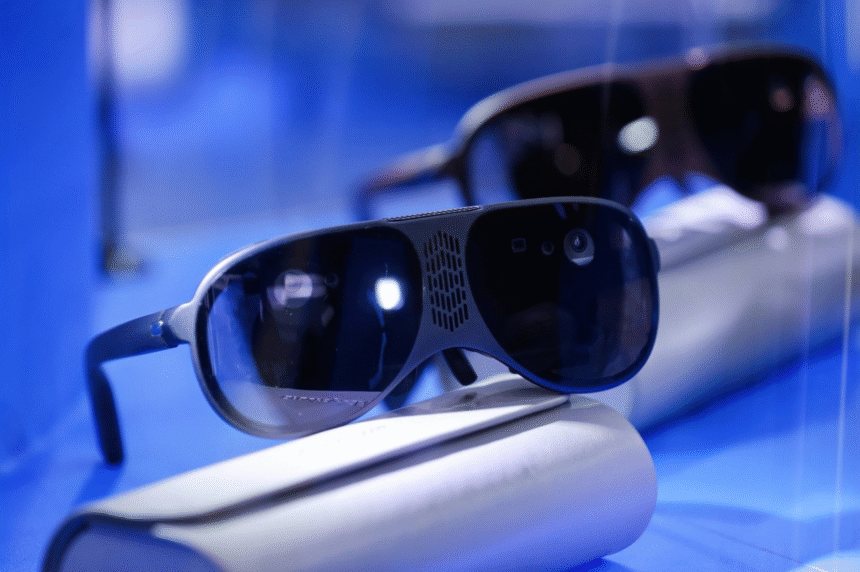
A Chinese startup with former Apple and Meta engineers built a coprocessor that enables ultralight headsets, and its reference design is the lightest ever shown.
The startup is called GravityXR, and includes engineers who worked on the R1 chip at Apple, the coprocessor present in both Vision Pro headsets to date, as well as others who worked on hardware at Meta, Huawei, and Amazon.
GravityXR’s investors include Goertek, the Chinese company that manufactures Meta headsets, as well as ByteDance, the owner of Pico, and VC firms like Sequoia China and Lenovo Capital.
The chip that GravityXR built is called G-X100, and it’s designed to be onboard ultralight mixed reality headsets, handling the latency-sensitive image processing and computer vision tasks like presenting the camera passthrough feed, positional tracking, hand tracking, and reprojection, with just 9 milliseconds of photon-to-photon latency.
This allows the general purpose chipset, such as a Qualcomm Snapdragon, to be moved to a tethered external puck.
With a TDP of just 3 watts, G-X100 can be passively cooled, eliminating the need for the heavy heatsinks and fans that make up a significant chunk of the weight of standalone headsets today, aiming to cool 10-20 watt chips.
To prove out this approach of using G-X100 to offload the primary chipset, GravityXR built a reference design headset called GravityXR M1. It’s a passthrough headset, using pancake lenses, displays, and cameras, yet weighs less than 100 grams.
That makes GravityXR M1 the lightest headset ever – lighter than even Bigscreen Beyond 2. In fact, its form factor arguably reaches the point that it might be better described as “mixed reality glasses”
And unlike with birdbath devices like Xreal and Viture, GravityXR M1 has a field of view of 90 degrees, close to current VR headsets, and as a passthrough system can render virtual objects with full opacity without dimming your view.
Meta Prioritizing Ultra-Light Headset With Puck Over Traditional Quest 4
Meta is prioritizing shipping an ultralight Horizon OS headset with a tethered compute puck in 2026, and might not ship a new traditional form factor Quest until 2027.
To be clear, GravityXR M1 is just a reference design, and no company has yet publicly committed to using G-X100 in a headset.
But rumors suggest that both Meta and Pico intend to launch ultralight headsets next year, and both companies are likely to take a similar engineering path to what GravityXR is showing. Just last week, a Pico executive said that the company had developed its own R1-style chip internally, for example, and Meta has a multi-year partnership to work closely with Qualcomm, alongside its own custom chip teams.
It seems that, across the industry, mixed reality headsets are set to significantly shrink from half-kilogram facebricks into sleek glasses-like visors relatively soon. And a split-chip architecture, alongside an open periphery design that sacrifices some field of view, is how that remarkable jump will be possible.